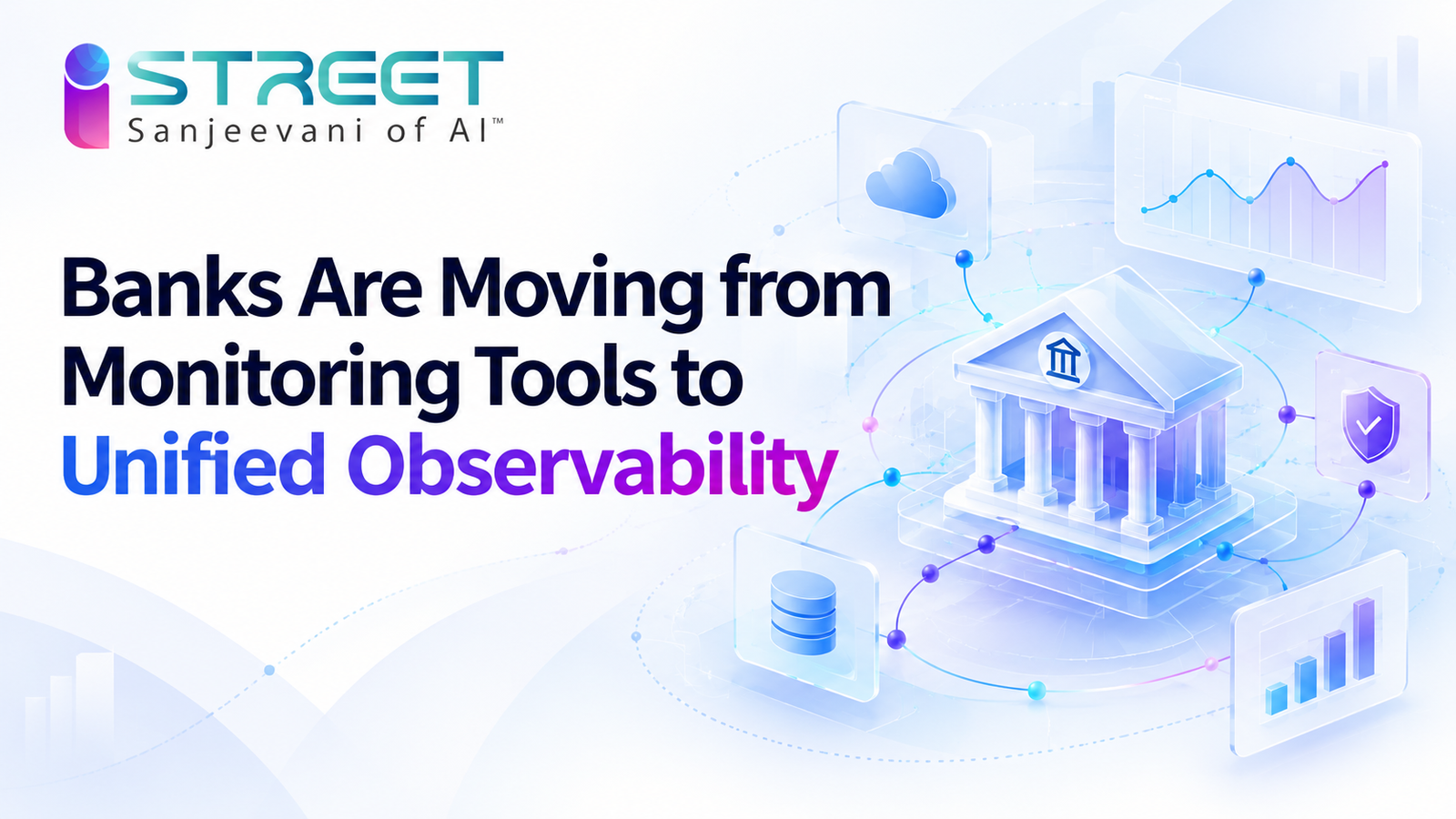
Monitoring tells a bank that something is wrong. Unified observability tells it why, where and what to do next, before customers feel it.
Banks have spent years adding monitoring tools one layer at a time. Each tool did its job. Together, they created a fragmented view of operations at the exact moment banking became always-on, API-driven and closely regulated.
That is why unified observability for banks has moved from an architecture discussion to an operational priority. Payment rails, mobile banking, core banking and partner integrations now behave as one connected service chain, and a failure in any link reaches the customer within seconds.
This blog explains what separates monitoring from unified observability, why regulation and resilience expectations are accelerating the shift, how iStreet approaches the move, and how banks can evaluate their own readiness.
Why Are Traditional Monitoring Tools Falling Short?
Traditional monitoring tools fall short because they were built to watch individual components, while banking failures now emerge from the interaction between components. A UPI transaction, for instance, travels through mobile front ends, API gateways, middleware, core banking systems, switches and external partners. Each layer may report healthy thresholds while the end-to-end transaction slows or fails.
If your operations team still moves between multiple consoles during an incident, you are not alone. Most banks run a layered toolset that grew through procurement cycles, acquisitions and channel launches rather than through a single design. The consequences are consistent across the sector.
Alert volume without context
Every tool raises its own alerts against its own thresholds. A single upstream fault can surface as dozens of separate alerts across network, application and database tools. Operations teams spend the first, most critical minutes of an incident establishing which alerts belong together rather than resolving the cause.
Root cause buried across silos
When telemetry sits in separate tools, root cause analysis becomes a coordination exercise. Infrastructure, application and network teams each review their own data, and the answer only emerges once someone correlates it manually. This lengthens mean time to resolution and keeps senior engineers on bridge calls instead of improvement work.
No line of sight to the customer journey
Component monitoring reports CPU, memory, latency and error counts. It rarely tells a bank which customer journeys are degraded, which branches or regions are affected, or which business service is at risk. Without that service-level view, prioritisation during an incident depends on judgement rather than evidence.
Rising tool overhead
Each monitoring product carries licences, integrations, upgrades and specialist skills. As the toolset grows, the effort to maintain it competes directly with the effort to improve service reliability.
What Does Unified Observability for Banks Actually Mean?
Unified observability for banks means bringing metrics, events, logs and traces from every layer of the technology stack into one correlated, service-aware view. Instead of asking whether each component is up, the bank asks whether each business service is performing as customers expect, and gets an answer grounded in data from across the stack.
The distinction from monitoring is one of purpose, not just tooling.
| Dimension | Monitoring tools | Unified observability |
| Core question | Is this component healthy? | Is this business service healthy, and why not? |
| Data scope | One layer per tool | Metrics, events, logs and traces across all layers |
| Alerting | Threshold alerts per tool | Correlated alerts tied to probable cause |
| Incident response | Manual correlation across teams | Guided root cause analysis on a shared view |
| Business view | Limited or absent | Mapped to payments, lending, channels and branches |
| Operating mode | Reactive | Predictive and increasingly autonomous |
From component health to service health
The central shift is service topology: a live map of how applications, infrastructure and dependencies support each banking service. Once telemetry is tied to that map, an issue in a database cluster is understood immediately in terms of the payment, loan or account-opening journeys it affects.
From threshold alerts to AI-driven correlation
AIOps sits at the heart of unified observability. Machine learning establishes dynamic baselines, detects anomalies before they breach static thresholds, and groups related alerts into a single incident with a probable cause. Operations teams work from fewer, higher-quality signals rather than from raw alert streams.
From reactive to predictive operations
With correlated history and behavioural baselines in place, observability moves banks from responding to outages toward anticipating them. Capacity pressure, degradation patterns and recurring failure signatures become visible early enough to act on during planned windows rather than during peak transaction hours.
Why Is the Shift Accelerating in Indian Banking Now?
The shift is accelerating because regulators now treat operational resilience as a board-level obligation, and fragmented monitoring cannot produce the evidence that obligation requires. Indian banks face a combination of supervisory expectations, incident reporting timelines and data protection duties that all depend on a clear, correlated view of operations.
Operational resilience as a supervisory expectation
The regulatory bodies direction on IT governance, risk, controls and assurance practices, together with its guidance on operational risk management and operational resilience, expects banks to identify critical services, understand their dependencies and maintain service within defined tolerances. Meeting that expectation requires service-level visibility, which component monitoring does not provide by design.
Sovereignty over operational intelligence
For regulated banks, observability data is a record of how critical financial infrastructure behaves. Routing it through offshore, hyperscaler-dependent platforms creates exposure on residency, auditability and control. This is driving interest in sovereign observability: platforms deployable on-premises or in private Indian cloud environments, aligned with the principles of Atmanirbhar AI.
How iStreet Approaches Unified Observability for Banks
iStreet approaches unified observability as a sovereign, AI-native operating layer for banking services rather than as one more tool added to the stack. The architecture brings telemetry, intelligence and action together so that operations teams see one picture of service health and act on it with confidence. iStreet Network, forms the intelligence core, appling machine learning to establish behavioural baselines, detect anomalies early and correlate related alerts into a single incident with a probable cause. Operations teams receive context, not volume.
Service-aware visibility across the stack
Telemetry is mapped to banking services, including payments, digital channels, lending and core banking, so every signal is read in terms of customer and business impact. Technology teams and business stakeholders work from the same view, which shortens decisions during incidents and strengthens reporting afterwards.
Agentic AI for operational workflows
Autonomous agents extend observability from insight into action. They guide root cause analysis, recommend remediation steps and run approved runbooks, with human oversight retained for critical decisions. This moves banks toward self-healing operations in a controlled, auditable way.
The Resiliency Operations Centre as the convergence layer
The Resiliency Operations Centre (ROC) serves as an AI-powered convergence layer above the NOC and SOC. Performance and security signals are brought together, so a slowdown caused by a network fault and one caused by malicious activity are distinguished quickly and handled by the right team.
Sovereign by design
The platform is deployable on-premises or in private cloud within India, keeping operational data under the bank’s control and aligned with regulatory bodies expectations. This reflects iStreet’s broader commitment to Sovereign Intelligence and AI-Native Enterprise Resilience for regulated industries.
From Watching Systems to Understanding Services
Monitoring tools served banks well when systems were simpler and failures stayed within one layer. Today, banking runs as a connected chain of services, and resilience depends on seeing that chain as one. Unified observability for banks provides that view, and when built on sovereign, AI-native foundations, it also provides the control and evidence that Indian regulators expect.