Enterprise IT teams already operate multiple monitoring, observability, and IT service management (ITSM) platforms. These systems generate valuable operational data, but identifying relationships between alerts, understanding service dependencies, and determining the probable cause of incidents can still require considerable manual investigation. Artificial Intelligence for IT Operations (AIOps) aims to address these challenges by applying machine learning, event correlation, predictive analytics, and automation to operational telemetry.
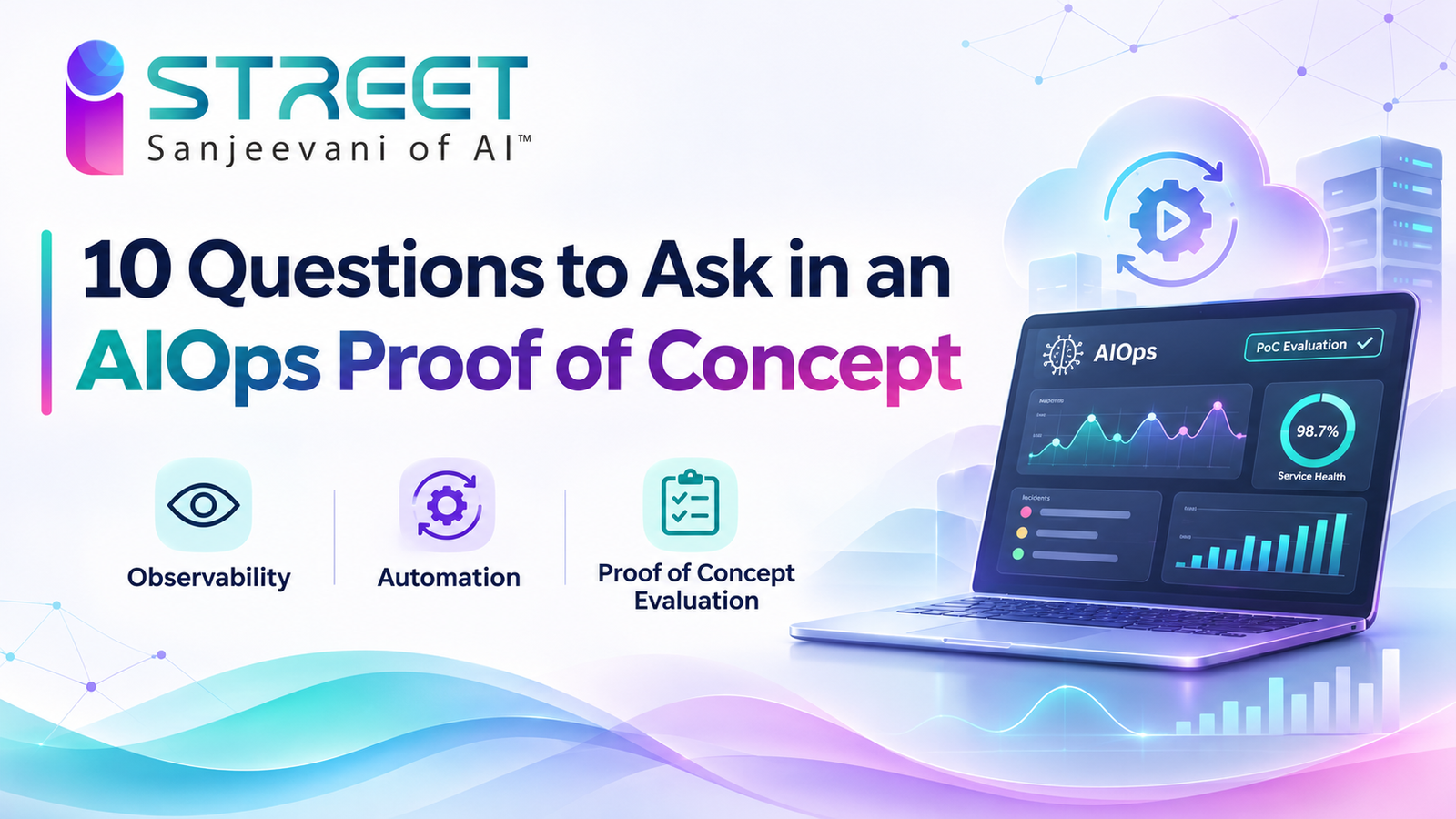
However, selecting an AIOps platform requires more than evaluating its features. A successful AIOps proof of concept (PoC) must establish whether the platform can work with existing enterprise systems, deliver reliable operational intelligence, and improve incident management outcomes under realistic conditions. Before progressing from evaluation to deployment, enterprise technology leaders should ask ten critical questions.
1. What Operational Problems Are We Trying to Solve?
The first question in an AIOps PoC should concern the enterprise’s operational challenges, not the vendor’s AI capabilities. AIOps platforms address different problems, including alert fatigue, slow incident diagnosis, repetitive remediation, unpredictable capacity demand, and fragmented operational visibility. Attempting to evaluate every capability simultaneously makes it difficult to establish whether the PoC has delivered meaningful results. Instead, enterprises should identify two or three high-priority use cases.
What to validate:
- Current alert volumes and the proportion requiring investigation.
- Mean time to detect (MTTD), acknowledge (MTTA), and resolve or restore (MTTR), using consistently defined measures.
- Time spent on manual event correlation and incident triage.
- Frequency of recurring incidents.
- Operational impact on critical business services.
2. Can the Platform Process Our Existing Telemetry Data?
AIOps intelligence depends on the availability, consistency, and quality of operational data. Most enterprises maintain telemetry across application performance monitoring, infrastructure monitoring, network management, cloud services, log platforms, and ITSM systems. These sources may use different timestamps, identifiers, severity classifications, and data formats. An AIOps platform must be able to interpret these signals together to establish operational context.
What to validate:
- Ingestion of metrics, logs, traces, alerts, and topology information.
- Data normalisation and timestamp consistency.
- Mapping between infrastructure components and business services.
- Treatment of missing, delayed, duplicated, or incomplete telemetry.
- Historical data requirements for behavioural baselining.
The evaluation should also examine data ingestion latency and the impact of high-cardinality telemetry on processing performance.
3. How Easily Does AIOps Integrate with Our Existing IT Operations Ecosystem?
An enterprise AIOps implementation should strengthen existing IT operations workflows rather than introduce another isolated operational system. Integration capabilities determine whether AI-generated insights can reach processes, and platforms responsible for incident resolution. During the PoC, teams should verify connectivity with existing monitoring tools, ITSM systems, incident management workflows, and automation platforms. The evaluation should also establish whether integrations support bidirectional information exchange.
What to validate:
- Compatibility with existing monitoring and observability platforms.
- API availability and supported integration methods.
- Bidirectional ITSM integration.
- Incident enrichment with service context and supporting evidence.
- Synchronisation of incident status, ownership, and remediation outcomes.
- Integration maintenance and version compatibility.
4. Can the Platform Reduce Alert Noise Without Suppressing Critical Incidents?
Alert reduction is frequently presented as a core AIOps capability. However, reducing the number of alerts is not sufficient evidence of effective event correlation. A platform could reduce alert volume by aggressively suppressing notifications, while also hiding signals that indicate genuine operational problems. The objective is to distinguish related symptoms from independent incidents and preserve alerts that require action.
What to validate:
- Cross-domain event correlation.
- Intelligent grouping and deduplication.
- Accuracy of incident clustering.
- Identification of primary and downstream signals.
- Preservation of critical alerts.
- Correlation stability when service dependencies change.
5. Can AIOps Detect Emerging Problems Before Traditional Threshold Alerts?
Traditional monitoring typically detects conditions when predefined thresholds are exceeded. AIOps extends this approach by applying behavioural baselines, anomaly detection, and predictive analytics to identify unusual operational patterns. However, an anomaly is not necessarily an incident. A seasonal increase in transaction volume, a scheduled batch process, or a planned infrastructure change may produce unusual telemetry without indicating service degradation. The PoC must therefore determine whether the platform distinguishes expected operational variations from meaningful anomalies.
What to validate:
- Dynamic behavioural baselines.
- Detection of previously unseen degradation patterns.
- Recognition of seasonal and workload variations.
- False-positive and false-negative rates.
- Early-warning lead time.
- Accuracy of predictive alerts under changing workloads.
Historical incidents can support initial testing, but previously unseen or withheld test scenarios provide stronger evidence of detection performance.
6. Can the Platform Identify the Root Cause with Supporting Evidence?
Root cause analysis is one of the most important capabilities to evaluate in an AIOps PoC. Traditional incident investigations frequently require engineers to compare logs, metrics, traces, system changes, and service dependencies across multiple tools. AIOps can accelerate this process by correlating operational evidence and identifying likely fault locations. However, a root cause recommendation must be distinguished from a confirmed diagnosis. A platform that identifies a database as the probable source of application degradation should also explain why.
- Did database latency increase before the application failure?
- Was there a configuration change?
- Does the service topology support the proposed relationship?
These questions establish whether the recommendation is supported by evidence rather than superficial correlation.
What to validate:
- Service topology and dependency awareness.
- Incident timeline reconstruction.
- Ranking of probable causes.
- Supporting logs, metrics, traces, and change events.
- Identification of affected applications and business services.
- Accuracy against previously investigated incidents.
Where GenAI-assisted incident investigation is available, teams should verify that generated explanations remain consistent with the underlying telemetry.
7. How Reliable and Explainable Are the AI-Generated Insights?
Generative AI is increasingly being incorporated into IT operations workflows. Conversational incident investigation, natural-language summaries, and AI-generated remediation recommendations can make operational data easier to interpret. However, these capabilities must be evaluated for accuracy, traceability, and operational reliability. An incident summary that sounds convincing but misrepresents the telemetry can create more operational risk than an incomplete dashboard. The PoC should therefore assess whether engineers can verify AI-generated conclusions.
What to validate:
- Accuracy of incident summaries.
- Evidence supporting AI-generated conclusions.
- Ability to distinguish facts, hypotheses, and recommendations.
- Consistency across repeated investigations.
- Handling of incomplete or conflicting operational data.
- Access controls governing AI-assisted investigation.
8. Can AIOps Recommendations Be Converted into Safe Remediation Actions?
Detecting and diagnosing incidents provides operational value. Connecting those insights to corrective action can extend that value further. An enterprise AIOps platform should be evaluated for its ability to recommend, initiate, or orchestrate remediation through existing operational workflows. However, automation must operate within defined control boundaries. Restarting a non-critical service may be suitable for an approved automated runbook. Changing configurations in a mission-critical production environment may require additional authorisation. The PoC must establish which actions can be automated, which require human approval, and how execution outcomes are recorded.
What to validate:
- Integration with runbooks and orchestration tools.
- Accuracy of remediation recommendations.
- Approval workflows for high-impact changes.
- Role-based access controls and execution permissions.
- Audit trails and remediation history.
- Rollback, failure handling, and escalation procedures.
Automation success should be measured through verified operational outcomes, not merely the number of workflows triggered.
9. Can the Platform Meet Enterprise Scalability, Security, and Data Sovereignty Requirements?
AIOps platforms process operational data that can reveal infrastructure architecture, service dependencies, application behaviour, and incident histories. For enterprises operating critical digital services, the location, handling, and governance of this data are important evaluation criteria. The PoC must therefore test not only functional capabilities but also the platform’s deployment and security architecture. This includes understanding where telemetry is processed, whether data leaves the enterprise environment, how AI models access operational information, and whether deployment options align with internal policies. Scalability should also be validated under realistic event volumes.
What to validate:
- Supported on-premises, private cloud, hybrid, or other deployment models.
- Data residency and processing boundaries.
- Encryption, authentication, and access controls.
- Telemetry retention and deletion policies.
- Model access to potentially sensitive operational information.
- Event-processing throughput, ingestion latency, and resource consumption under load.
- Operational resilience during connector failures or processing interruptions.
10. Can the PoC Demonstrate Measurable Operational and Financial Value?
The final question determines whether the AIOps PoC provides sufficient evidence for a larger investment. Technical capability alone does not establish business value. Enterprise leaders need to understand whether the platform can reduce operational effort, accelerate investigation, improve service resilience, or reduce the financial impact of recurring incidents.
The evaluation should compare measured outcomes against the baseline established at the beginning of the PoC.
| Evaluation metric | What to measure |
| Alert noise reduction | Reduction in duplicate and non-actionable alerts without loss of critical detection |
| Incident detection | Change in time taken to identify relevant service degradation |
| Root cause investigation | Reduction in time or engineering effort required to identify probable causes |
| Incident resolution | Change in MTTR where sufficient comparable incidents are available |
| Automation effectiveness | Percentage of approved workflows completed and verified successfully |
| Operational productivity | Engineering hours saved through reduced triage and repetitive tasks |
| Cost efficiency | Estimated benefits compared with licensing, infrastructure, integration, and operating costs |
Short-duration PoCs may not generate enough production incidents to establish statistically reliable MTTR or availability improvements. In such cases, enterprises should distinguish directly observed improvements from projected business benefits.
How iStreet Network Supports Enterprise AIOps Evaluation
iStreet Network approaches enterprise AIOps as part of a broader operational resilience framework, where observability, intelligence, automation, and governance work together. Through its AIOps and GenAIOps capabilities, powered by HEAL Software, iStreet Network supports the operational capabilities enterprises need to evaluate during a PoC:
Intelligent event correlation: Connecting related alerts and operational events across multiple infrastructure and application layers to reduce noise and improve incident context.
Predictive anomaly detection: Applying behavioural baselining and machine learning to identify unusual performance patterns and emerging service degradation.
Topology-aware root cause analysis: Analysing service dependencies, telemetry, and incident timelines to identify probable causes and accelerate investigation.
GenAI-assisted incident investigation: Supporting conversational incident analysis, natural-language summaries, and context-driven investigation through capabilities such as Talk to Incident.
Governed remediation: Connecting operational intelligence to runbooks, workflow orchestration, and human-approved corrective actions.
Within iStreet Network’s Resiliency Operations Centre (ROC), AIOps contributes to a broader model that connects operational visibility, resilience, and coordinated response. This approach aligns with the Sanjeevani of AI™ framework, which brings together enterprise AI capabilities with security, sovereignty, governance, and operational accountability. For enterprise technology leaders, an effective PoC should validate how these capabilities operate within their own environment, against their own incidents and performance requirements.
Explore iStreet Network’s AIOps and GenAIOps solutions.
Evaluate AIOps by Operational Outcomes
An AIOps proof of concept is an opportunity to establish whether artificial intelligence can improve how an enterprise detects, investigates, and responds to operational incidents. The evaluation should move beyond isolated demonstrations of anomaly detection, alert correlation, or conversational AI. It must demonstrate how these capabilities work together across existing telemetry, ITSM workflows, service dependencies, and governance controls.
Connect with iStreet Network to explore an AIOps proof of concept focused on your operational priorities, integration requirements, and enterprise resilience objectives.