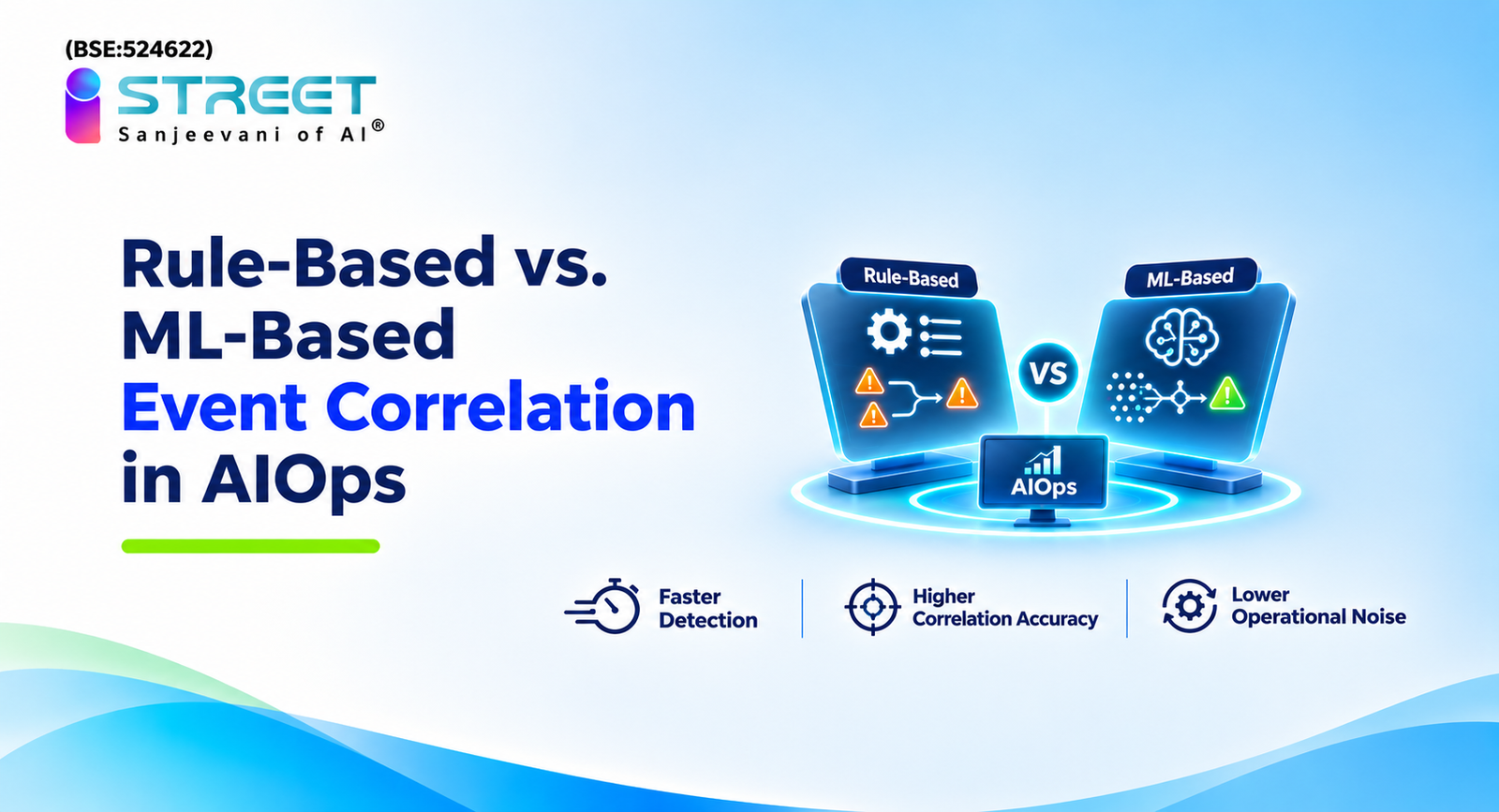
Rule-based and Machine Learning (ML)-based event correlation offer different approaches to consolidating operational signals, identifying incident relationships, and accelerating root cause analysis. Understanding their respective strengths enables enterprises to establish a more effective AIOps strategy.
Enterprise IT environments generate thousands of operational events across applications, networks, databases, cloud infrastructure and digital services. While monitoring platforms provide visibility into individual components, identifying relationships between events remains essential for effective incident management. A single infrastructure issue can trigger multiple alerts across interconnected systems. Without effective correlation, operations teams may investigate these alerts independently, increasing incident resolution time, operational expenditure, and the risk of prolonged service disruption.
Rule-Based Event Correlation: Precision Through Defined Logic
Rule-based event correlation groups operational events according to predefined conditions, thresholds, time windows and dependency relationships. During a database connection failure and application timeout within a defined interval, an established correlation rule can associate these alerts with a common incident. This approach is particularly effective for known failure scenarios where operational relationships are clearly understood.
Rule-based correlation offers predictable execution, transparent decision logic, and straightforward integration with established incident response procedures. However, maintaining extensive correlation rules across dynamic enterprise environments requires continuous updates. Changes in infrastructure, application dependencies, and deployment configurations can introduce event relationships that existing rules do not recognise. Rule-based correlation remains valuable where operational conditions are predictable and deterministic responses are essential.
ML-Based Event Correlation: Intelligence Beyond Predefined Patterns
ML-based event correlation identifies statistical relationships between operational events using historical telemetry, event sequences, and recurring incident patterns. Rather than relying exclusively on predefined conditions, machine learning algorithms can identify events that frequently occur together, detect unusual combinations of signals and group related anomalies. Increasing database latency, message queue of congestion, and application response degradation may collectively indicate an emerging service issue.
ML-based correlation can recognize these relationships through temporal patterns, historical behavior and available infrastructure dependency information. This approach is particularly relevant for hybrid cloud, microservices and distributed applications, where operational relationships change frequently. Statistical correlation does not independently establish causation. Reliable root cause identification requires additional context, including service topology, configuration changes and supporting telemetry. The advantage of ML-based correlation lies in its ability to identify complex event relationships that may not be explicitly captured through predefined operational rules.
Rule-Based vs. ML-Based Correlation: Key Enterprise Considerations
| Evaluation Area | Rule-Based Correlation | ML-Based Correlation |
| Detection approach | Predefined conditions | Learned event patterns |
| Changing environments | Requires rule updates | Can adapt through validated model updates |
| Incident relationships | Known dependencies | Historical and emerging relationships |
| Explainability | Explicit decision logic | Requires interpretable model evidence |
| Operational maintenance | Rule configuration and tuning | Data quality, model validation and monitoring |
| Primary value | Predictable incident handling | Correlation across complex environments |
Excessive grouping can combine unrelated incidents, while insufficient correlation can create duplicate investigations. The more important consideration is whether correlated events accurately represent operational issues and support timely, informed response.
The Business Case for a Hybrid Correlation Architecture
For large enterprises, the strategic opportunity lies in combining deterministic rules with adaptive machine learning and topology-aware analysis. Rule-based mechanisms can manage established operational conditions, critical thresholds, and predefined escalation requirements. ML-based models can identify evolving event patterns, while service dependency intelligence helps determine whether correlated alerts belong to the same operational issue.
This architecture offers several business advantages:
- Reduced Operational Overhead: Consolidating related events can limit duplicate incident tickets and repetitive investigations.
- Faster Incident Triage: Correlated event sequences provide operations teams with more relevant information when assessing potential causes.
- Improved Resource Allocation: Prioritisation based on business-service impact enables teams to concentrate on incidents affecting critical operations.
- Greater Operational Resilience: Identifying related failures and their potential propagation supports coordinated containment and service recovery.
These outcomes depend on correlation accuracy, telemetry coverage and effective integration with incident management processes.
Moving Beyond Alert Reduction to Operational Intelligence
The effectiveness of event correlation should be assessed through its contribution to incident management rather than alert reduction alone. Enterprises should evaluate correlation accuracy, duplicate incident reduction, investigation effort, root cause identification time and Mean Time to Resolution (MTTR).
A mature AIOps approach connects event correlation with application topology, anomaly detection, root cause analysis and incident response workflows. This transforms correlation from an alert-management mechanism into an operational intelligence capability that supports faster decisions and more efficient service restoration.
iStreet’s Approach to Intelligent Event Correlation
iStreet Network Limited advances intelligent event correlation through Sovereign AI approach, leveraging AIOPS capabilities to identify, correlate and consolidate related operational events across complex IT environments. By analysing event patterns, temporal relationships and service dependencies, it enables enterprises to distinguish interconnected incidents from isolated alerts, and reduce alert noise. This approach provides greater operational context, supports faster incident resolution and strengthens the reliability of business-critical digital services.
By connecting event intelligence with existing monitoring and IT Service Management (ITSM) environments, iStreet supports efficient incident investigation, prioritization and coordinated response. The approach extends beyond consolidating alerts to identifying service dependencies, evaluating potential operational impact and providing relevant information for remediation decisions. Through Sanjeevani of AI® and its AI Center of Excellence (AICoE), iStreet emphasizes enterprise control, operational accountability and resilient digital infrastructure.
As enterprise infrastructure becomes increasingly distributed, effective event correlation must combine the predictability of established rules with the adaptability of machine learning. The strategic value lies in converting fragmented operational signals into actionable incident intelligence, reducing investigation complexity and enabling faster restoration of critical business services.