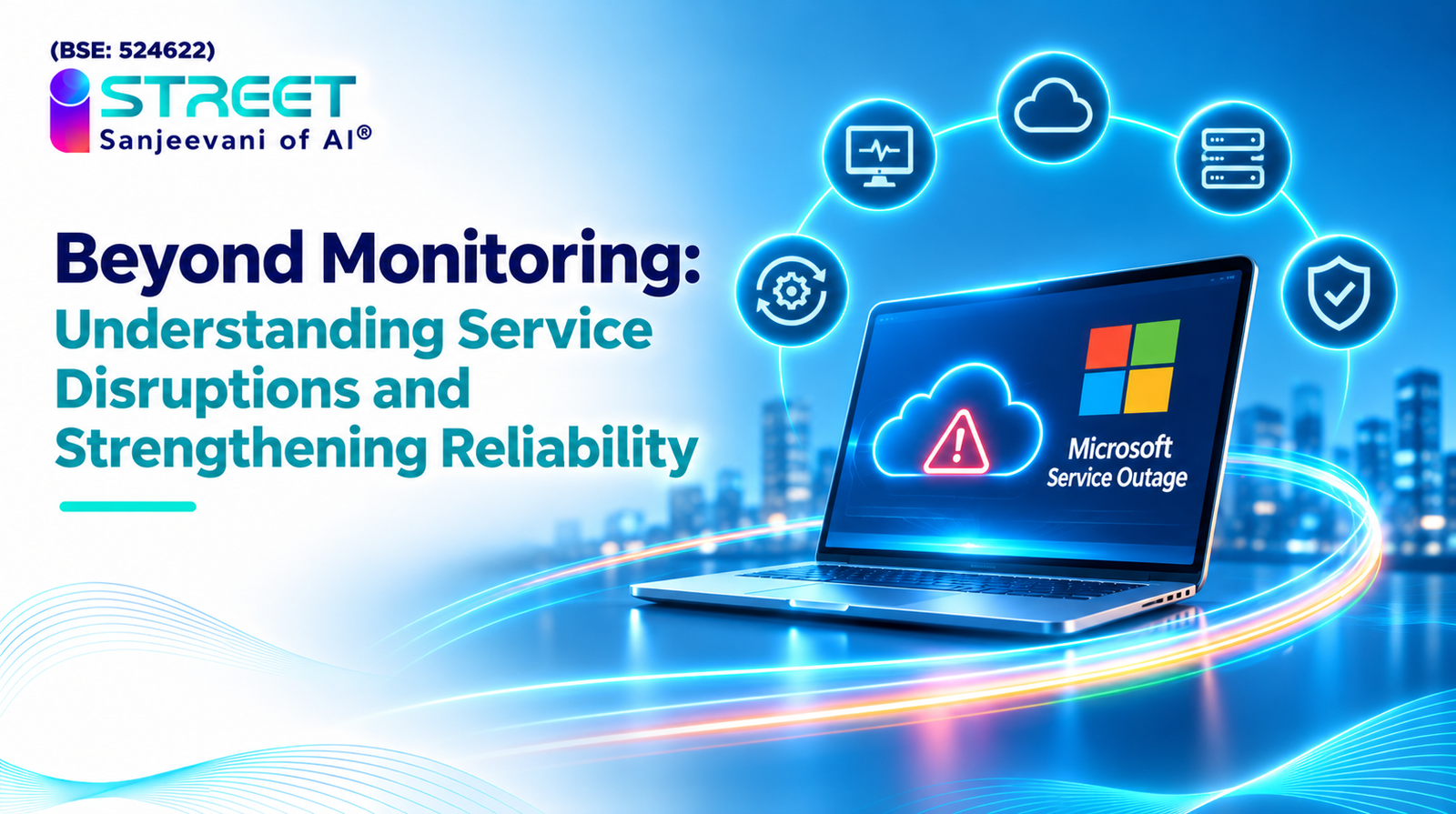
In November 2026, disruptions to Microsoft 365 affected widely used services including Outlook, Teams and other business applications. For organisations that rely on these tools to communicate, collaborate and serve customers, the incident was a reminder that even the most mature technology environments can experience serious service interruptions.
Microsoft’s updates indicated that some servers failed automated health checks and became unavailable. Their workloads shifted to the remaining infrastructure, increasing pressure on systems still operating. Engineers investigated an overwhelmed process involved in establishing secure connections and worked on traffic controls, configuration changes and gradual service restoration. The final root cause was still under investigation in the updates reviewed.
Large technology providers already invest heavily in monitoring, automation, and recovery. The question is what happens when existing safeguards detect a problem, but the actions that follow create new pressure elsewhere.
When a Server Failure Becomes a Business Disruption
Modern digital services rarely depend on one server or one application. They rely on networks of connected systems that share workloads, authenticate users, exchange data and deliver services across locations. When a server becomes unavailable, automated systems may redirect its work to another server. This is normally a sensible protection. But if several servers fail together, the remaining systems may not have enough capacity to absorb the extra work. A mechanism designed to keep a service running can then contribute to a wider disruption that leads to undelivered emails, meetings fail to connect and essential work slows down. For organisations, the consequences may include missed customer commitments, interrupted operations, lost productivity, and recovery costs.
This is why infrastructure reliability cannot be measured only by whether individual machines are healthy. The more important question is whether critical business services can continue operating as conditions change.
The Gap Between Detecting Failure and Controlling Its Impact
Traditional monitoring is essential, but an alert that a server is unavailable tells only part of the story. IT teams must also understand which services depend on it, where its workload has moved and whether other systems can safely handle the additional demand. A stronger approach connects infrastructure health with application performance, service dependencies and real-time capacity conditions. If one part of an environment fails, teams need to see not just the affected component, but the likely impact on connected applications and users.
AI-driven operational intelligence can support this assessment by analysing related events, identifying unusual patterns and highlighting which services face the greatest risk. It can help teams prioritise investigations instead of working through hundreds of disconnected alerts.
There is another important layer: the monitoring and recovery mechanisms themselves need scrutiny. Health checks can produce misleading signals. Automated restarts and traffic shifts can sometimes make an unstable environment worse. Enterprises must therefore assess whether their protective actions remain safe under extreme conditions, rather than assuming automation will always resolve the issue.
Building Resilience Beyond Monitoring
Effective resilience begins with understanding how failures could spread. Organisations should map important application dependencies and regularly assess how much spare capacity remains when servers become unavailable. Capacity planning must account for failure scenarios, not just normal demand. Recovery also needs clear safeguards. Before redirecting large volumes of traffic or returning servers to production, teams should consider whether the receiving systems can handle the load. Changes can be tested on a limited portion of infrastructure, with services restored gradually while performance is checked.
Operational intelligence can help IT teams make these decisions faster by presenting the likely business impact, affected dependencies and available recovery options in one view. However, decisions such as isolating systems, changing routing or adding capacity still require appropriate infrastructure controls and human oversight. Recovery should be measured from the user’s perspective.
The Microsoft 365 disruption illustrates a broader challenge: detecting a technical fault does not automatically prevent a chain reaction. A business can have extensive monitoring and still struggle if failures spread faster than teams can understand and contain them. For enterprises investing in cloud platforms, data centres and digital infrastructure, the priority should be to complement monitoring with operational intelligence and visibility into business-service impact, capacity risks and recovery readiness. The goal is to reduce failure spreads, restore essential services more safely and limit disruption to customers and employees.
Infrastructure resilience is measured not only by how quickly a problem is detected, but by how effectively the business continues operating when systems come under pressure.
About iStreet Network
iStreet Network Limited is an enterprise-grade, AI-native Sovereign AI ecosystem. At its core is Sanjeevani of AI®, iStreet’s AI Centre of Excellence and integrated framework that brings together observability, security, governance, risk, and compliance to operationalize enterprise AI with greater control, resilience, and assurance