We cannot improve what you do not measure. We cannot interpret a metric without consistent definitions and an operating context. For enterprises asking how to benchmark MTTR across different IT environments, the most reliable approach is to compare similar incident types, severity levels and service contexts rather than relying on one universal number.
Comparing MTTR across enterprises is difficult because organizations define incident severity, detection, mitigation, and service restoration differently. Hybrid infrastructure, multi-vendor dependencies, legacy and modern applications, and varying levels of service criticality make a universal benchmark unreliable. Each enterprise should therefore establish benchmarks that reflect its critical services, operating model, and risk obligations.
Why MTTR Matters More Than Ever for Indian Enterprises
Downtime is therefore not only an IT issue. It can affect revenue, customer trust, contractual commitments, and regulatory exposure. For Indian enterprises, MTTR is not just an operational metric. It is a business resilience metric, a compliance metric, and increasingly, a competitive differentiation metric.
MTTR Benchmarks by Industry Vertical
Banking, Financial Services, and Insurance (BFSI)
Indian BFSI organizations deliver high-volume, time-sensitive services and must comply with technology governance, business continuity, disaster recovery, and operational resilience standards. MTTR targets should be set according to service criticality, incident severity, customer impact, and regulatory requirements, rather than using a single sector-wide benchmark. For incidents affecting core banking, payment processing, or trading services, teams should track the time required to detect, mitigate, restore, and validate the service. Severity 2 incidents may follow different recovery targets, but comparisons remain meaningful only when the organization applies consistent severity definitions and measurement points.
Mature BFSI organizations compare median and high-percentile recovery times for each critical service, assess performance against Recovery Time Objectives and Service Level Objectives, and evaluate customer and regulatory impact. This approach provides a more reliable operational benchmark than relying on a blended industry average.
IT Services and Global Capability Centres (GCCs)
Indian IT service providers and Global Capability Centres operate in diverse environments with client-specific service commitments. They should benchmark MTTR by client, service tier, incident severity, and technology environment. While contractual SLAs offer a reference point, internal benchmarks should also assess customer impact, time to mitigation, and the recurrence of similar incidents.
E-Commerce and Digital Platforms
E-commerce and digital platforms often face significant commercial and customer consequences when services degrade during peak demand. Organisations should benchmark recovery performance by customer journey, traffic period, and service tier, rather than relying solely on a company-wide MTTR. During critical sales events, metrics such as transaction completion, user impact, time to mitigation, and service restoration offer more meaningful insights.
MTTR in telecom
MTTR in telecom should therefore be benchmarked by incident category, service impact, region and restoration stage rather than by a single blended average. Telecommunications providers manage geographically distributed networks with complex infrastructure and multiple vendors. Recovery performance should be measured by incident category, region, service impact, and restoration stage. Relying on a single average may obscure significant differences among software incidents, failures, power disruptions, and field-service issues.
Manufacturing and Industrial
Manufacturing organizations should assess MTTR for both enterprise IT and operational technology environments. Incidents affecting production systems can disrupt operational continuity, compromise worker safety, and compromise equipment integrity. Recovery targets should be set based on production criticality, and services must be restored using controlled, validated procedures to ensure safe operations.
The MTTR Maturity Spectrum
Beyond industry-specific expectations, organizations can assess MTTR through a capability-based maturity spectrum. This approach provides a more useful comparison than universal time ranges because recovery requirements differ by service, architecture, and business impact.
- Organisations at the reactive stage are typically relying on manual monitoring, ad-hoc incident response processes, and siloed tooling. They detect issues late, diagnose slowly, and resolve through manual intervention.
- Organisations at the responsive stage have established monitoring coverage, defined incident management processes, and some degree of tooling integration. They detect issues reasonably quickly but still rely heavily on human expertise for diagnosis and resolution.
- Organisations at the proactive stage have implemented AIOps or similar platforms for automated correlation and root cause identification. They use runbook automation for common issues and have mature incident management practices with clear escalation paths.
- Organisations at the predictive stage have achieved significant automation of both detection and remediation. They use predictive analytics to prevent incidents before they occur and reserve human intervention for truly novel issues. These organisations are the exception today, but they represent the direction of travel for enterprise operations.
Factors That Drive MTTR Performance in Indian Enterprises
Several factors materially influence MTTR performance across Indian enterprise environments:
- Tool and data integration: Enterprises reduce investigation time by connecting observability, service topology, change, ITSM, and business-service data. Fragmented tools force responders to reconstruct the incident context while services remain affected. This is one of the main ways AIOps can help reduce MTTR in complex enterprise environments.
- Automation maturity: Pre-approved runbooks and workflow orchestration can accelerate response to repeatable, low-risk incidents. Organizations should apply approval gates, audit trails, and rollback mechanisms to high-impact remediation actions. Intelligent automation can reduce Mean Time to Resolution by removing repeatable manual steps from validated recovery workflows
- Incident management maturity: Clear severity definition, incident roles, escalation paths, communication protocols and regularly practised procedures reduce the coordination delays that extend incident duration.
- Skills and knowledge continuity: Cross-functional expertise and accessible operational knowledge help teams diagnose incidents more efficiently. Organizations that depend on a small number of experienced individuals face greater delays during complex incidents or staff transitions.
- Infrastructure and service complexity: Hybrid, multi-cloud, and legacy-modern environments create additional dependencies and diagnostic complexity. Current service maps, ownership records, and dependency data help teams understand how an incident can affect connected systems.
Strategies for Improving MTTR
Organisations seeking to improve MTTR should focus on four connected areas.
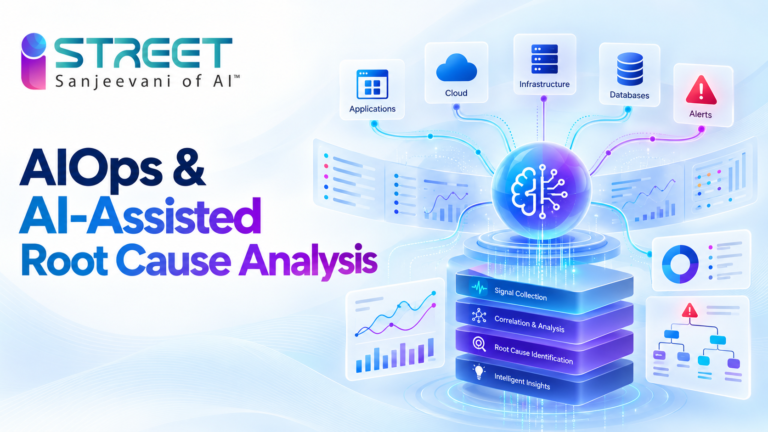
- First, connect operational data before automating decisions. Integrate observability, ITSM, topology, change, and infrastructure data, and use AIOps as it can reduce MTTR by correlating alerts, identifying probable root causes and prioritising incidents according to service impact.
- Second, build and maintain a runbook automation library for the most common incident types. Automate validated remediation steps where appropriate, while applying human approval and rollback controls to actions that could affect critical services.
- Third, strengthen incident-management processes. Conduct regular simulations, clarify response roles, refine escalation procedures, and use structured post-incident reviews to identify recurring operational gaps.
- Fourth, improve the observability architecture. Instrument critical services end-to-end, maintain telemetry quality, map dependencies, and connect technical conditions with customer and business-service impact.
How to Benchmark MTTR Across Different IT Environments
MTTR should be compared within comparable operating contexts. Separate benchmarks by service tier, incident severity, technology environment and business impact. For example, cloud application incidents should not be benchmarked directly against field-service telecom incidents or production OT failures. Consistent definitions and measurement points matter more than a universal industry average.
Next Steps: Benchmark and Improve
To understand how your organization is performing, start by setting an internal baseline using clear severity definitions, measurement points, and similar incident categories. While external benchmarks offer some context, the most important comparison is between your current results and your own service targets, which should reflect user impact, Service Level Objectives, Recovery Time Objectives, and business risk.
iStreet Network is a Sovereign AI Enterprise Platform built on the Sanjeevani of AI™ framework, enabling enterprises to improve MTTR through unified observability, AI-assisted incident analysis, and governed remediation.
→ To understand how AIOps reduces MTTR — Contact us