Alert fatigue is more than an operational inconvenience; it can reduce analyst effectiveness, slow incident response, and make critical signals harder to identify.
Enterprise IT environments generate alerts continuously across applications, infrastructure, networks, databases, and cloud services. As these signals accumulate across multiple monitoring tools, operations teams may spend significant time reviewing duplicate, repetitive, or low-priority alerts while more important events compete for attention.
This is the challenge of alert fatigue. High volumes of uncorrelated alerts can make prioritisation more difficult, increase investigation effort, and reduce confidence in monitoring systems. The operational priority is therefore not simply to generate more alerts, but to correlate related signals, suppress unnecessary noise, and surface the incidents that require human attention.The Anatomy of Alert Fatigue
Alert fatigue is not simply the result of too many alerts. It develops through several interconnected factors that can increase operational noise and make effective prioritization more difficult over time.
Volume Overload
Modern Modern enterprise environments generate significantly more telemetry as architectures become increasingly distributed across microservices, containerized workloads, cloud platforms, and interconnected infrastructure. As the number of monitored components and dependencies grows, so does the volume of operational signals and alerts. A single infrastructure issue, such as network degradation, can produce related alerts across multiple dependent applications and services. Without effective correlation, these signals may appear as separate problems, increasing alert volume and making it harder for operations teams to identify the underlying issue.
Lack of Context
Traditional monitoring approaches often rely on predefined thresholds. CPU utilization above 90% may trigger an alert; latency above 200 milliseconds may trigger another. While these thresholds can identify abnormal conditions, they may not account for whether the behavior is expected at a particular time, associated with a recent deployment, or related to a broader issue elsewhere in the environment. As a result, individual alerts may be technically valid but lack the operational context needed to determine their significance without further investigation.
Threshold Creep and Alert Sprawl
Over time, teams may add new alerts to improve coverage across additional scenarios. Post-incident reviews often introduce new rules intended to identify similar conditions earlier, while existing alerts may remain in place even as applications, infrastructure, and operating conditions change. Without regular review and rationalization, monitoring configurations can accumulate redundant, overlapping, or outdated alert rules. This increases operational noise and makes it more difficult for teams to distinguish meaningful signals from alerts that no longer reflect the current technology environment.
Human Desensitization
One of the most significant consequences of alert fatigue is its impact on operator attention and response. When teams are repeatedly exposed to high volumes of false-positive or low-priority alerts, it becomes harder to distinguish signals that require immediate action from routine operational noise. Over time, response may slow, alerts may be acknowledged with limited investigation, and genuinely important events may receive less attention than they require. At this point, alert fatigue becomes more than an operational challenge; it can increase business and service risk.
The Real Cost of Alert Fatigue
The impact of alert fatigue extends far beyond operational inefficiency. Organizations experiencing chronic alert fatigue suffer measurable consequences across multiple dimensions:
- Extended MTTR: When operators must manually sift through thousands of alerts to identify the real issue, mean time to resolution inflates dramatically.
- Increased incident severity: Issues that could have been caught early escalate into major outages because the early warning signals were lost in the noise.
- Engineer burnout and attrition: Alert fatigue can also contribute to burnout among SRE and NOC teams. Repeated interruptions, particularly during on-call rotations, can increase cognitive load and operational stress, affecting team effectiveness, job satisfaction, and the retention of experienced engineering talent.
- Compliance and audit risk: Emerging issues may develop into broader service disruptions when early warning signals are obscured by high volumes of operational noise.
Why Traditional Approaches Fail
Organizations often address alert fatigue through measures such as threshold tuning, consolidating monitoring tools, improving escalation policies, and adding operational capacity. These approaches can reduce alert volume and improve response efficiency, but when applied independently, they may not fully address the underlying challenge of fragmented signals, limited contextual correlation, and inconsistent prioritization across complex IT environments.
Threshold tuning can be a manual and resource-intensive process, and static configurations may become less effective as workloads and operating conditions change. Consolidating monitoring tools can simplify visibility and reduce dashboard fragmentation, but it may not address the underlying volume of alerts generated across the environment. Adding operational capacity can help teams manage workload, but without better correlation and prioritization, the fundamental challenge of alert noise can remain.
The underlying challenge is that traditional monitoring approaches often evaluate signals against predefined rules and thresholds with limited cross-domain context. While individual tools may provide useful visibility within their own domains, they may not fully account for relationships between services, historical behavior, dependencies, and broader operational conditions. As enterprise environments become more complex, manual tuning alone may therefore be insufficient to maintain effective alert prioritization and correlation at scale.
How AIOps Eliminates Alert Fatigue
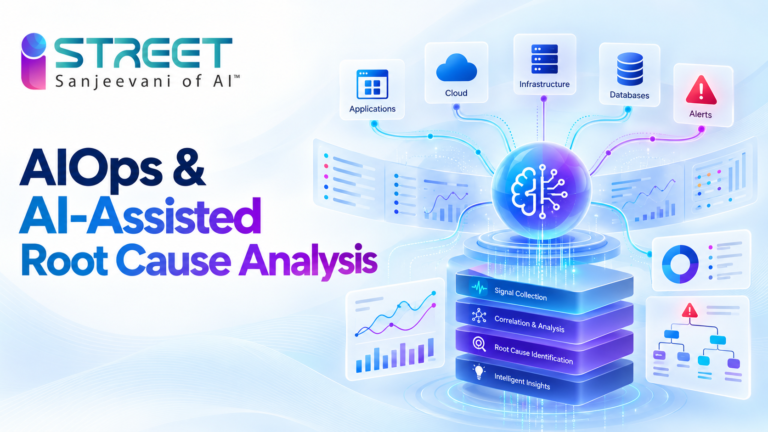
AIOps extends traditional monitoring by applying machine learning and contextual analysis across the alert lifecycle. Rather than relying primarily on static thresholds and manual investigation, AIOps platforms can correlate incoming signals, identify related events, prioritize incidents, and support appropriate operational response.
Intelligent Alert Correlation
AIOps platforms ingest alerts from all monitoring sources and apply correlation algorithms that group related alerts into unified incidents. A network switch degradation that triggers multiple individual service alerts gets reduced into a single incident with full context about the blast radius, affected services, and probable root cause. Instead of multiple alerts requiring investigation, the operations team sees one enriched incident.
Dynamic Baselining and Anomaly Detection
Instead of static thresholds, AIOps establishes dynamic baselines that adapt to normal patterns of behaviour. CPU utilisation that spikes to 95% during a known batch processing window is treated differently from the same spike occurring at an unexpected time. This context-awareness eliminates a massive category of false positives that static monitoring generates.
Noise Reduction
AIOps platforms learn which alerts historically lead to action and which are consistently ignored or auto-resolved. Over time, the platform progressively suppresses low-value alerts, ensuring that what reaches the operations team is genuinely actionable. Organisations typically see 80–95% reduction in alert volume within the first 90 days of deployment.
Topology-Aware Root Cause Identification
By maintaining a real-time model of service dependencies and infrastructure topology, AIOps can trace the propagation path of a failure. When a database server experiences a disk I/O issue, the platform automatically identifies it as the root cause of the downstream application errors, API timeouts, and user experience degradation, rather than presenting each as a separate alert.
Automated Remediation
For known and repeatable issue patterns with established remediation procedures, AIOps can trigger pre-authorized automated responses, such as restarting an unresponsive service, scaling container capacity, clearing approved temporary storage, or rerouting traffic. By executing predefined actions within established operational policies, automation can reduce the number of routine incidents requiring manual intervention and allow operations teams to focus on higher-risk or unfamiliar issues.
Measuring the Impact: Before and After AIOps
The transformation that AIOps delivers is not incremental. Organisations that deploy AIOps for alert management consistently report dramatic improvements:
- Alert volume reduction of 80–95%, with only actionable, contextualised incidents reaching operations teams.
- MTTR reduction of 50–75%, driven by automated root cause identification and enriched incident context.
- Operator productivity improvement of 40–60%, as engineers shift from reactive triage to proactive optimisation and improvement work.
- On-call escalation reduction of 30–50%, as lower-severity issues are auto-resolved and only genuine emergencies page on-call engineers.
Building an AIOps-Driven Alert Strategy
Implementing AIOps to address alert fatigue does not require a complete replacement of existing monitoring tools. Enterprises can adopt it incrementally, beginning with high-noise or operationally critical areas and expanding coverage as correlation models, integrations, and response workflows mature.
- Phase one focuses on data integration: connecting all existing monitoring tools to the AIOps platform and establishing a comprehensive data ingestion pipeline.
- Phase two activates correlation and noise suppression, using historical alert and incident patterns to identify related events, group repetitive signals, and improve alert prioritization.
- Phase three introduces automated remediation for well-understood issue patterns.
- Phase four shifts the operations model toward exception-based management, where human attention is reserved for novel or complex incidents that require judgement.
Throughout this journey, organizational adoption remains important. Operations teams need confidence in the platform’s recommendations and automated actions, which can be strengthened progressively by demonstrating measurable improvements in alert quality, investigation efficiency, and operational outcomes at each phase.
Control Your Operations
Alert fatigue need not remain a persistent operational challenge. Addressing it requires more than manual threshold tuning and tool consolidation alone. AIOps introduces machine learning-driven correlation, prioritization, and contextual intelligence to help operations teams reduce noise, identify the signals that matter, and respond more efficiently across complex enterprise environments.
If your team is spending more time managing alerts than improving systems, it is time to explore a different path.