Modern enterprise IT environments generate large volumes of telemetry, alerts, and operational events across applications, infrastructure, cloud, and network layers. As these environments become more distributed and interconnected, operations teams need more than traditional monitoring to understand what requires attention and how incidents are connected.
Enterprise IT has reached a point where manual triage, disconnected tools, and reactive incident management can struggle to keep pace with the scale and complexity of modern technology environments. Hybrid infrastructure, cloud services, distributed applications, and growing service dependencies have increased the amount of operational data that teams must analyze during an incident.
AIOps helps address this challenge by applying machine learning, analytics, and automation to operational data and workflows. It enables IT teams to reduce alert noise, identify unusual behavior, correlate related events, investigate probable causes, and support faster, more consistent incident response. This guide explains what AIOps is, how it works, why it matters for enterprise IT teams, and what organizations should consider before adopting it.
The Problem: IT Operations at Breaking Point
Enterprise IT teams operate across increasingly complex environments that can include on-premises infrastructure, public and private cloud services, distributed applications, networks, databases, and third-party dependencies. At the same time, businesses expect higher availability, consistent performance, and faster delivery of digital services.
The challenge is not simply the number of alerts. It is the amount of operational context that teams must process to understand which signals are related, which incidents affect critical services, and where to begin an investigation. When this correlation remains manual, operations teams spend significant time moving between tools, validating information, and reconstructing incident timelines, rather than focusing on service recovery and improvement.
What Is AIOps? Defining the Concept
AIOps, or Artificial Intelligence for IT Operations, applies machine learning, analytics, and automation to operational data and IT workflows. It helps enterprises analyze large volumes of telemetry, identify patterns, reduce noise, and support faster operational decisions.
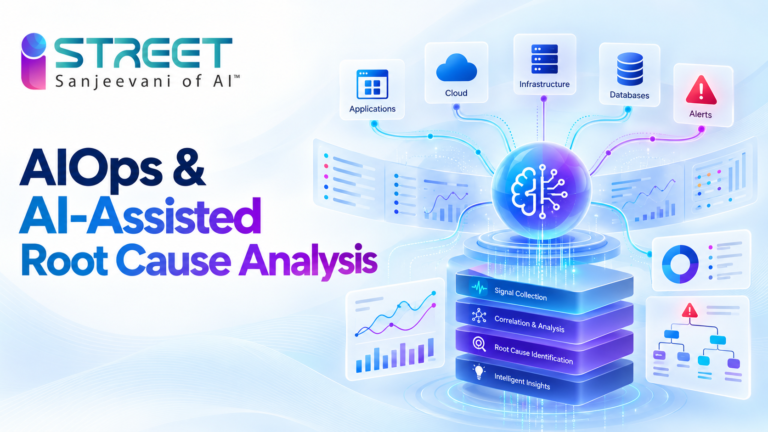
AIOps platforms collect logs, metrics, traces, events, topology information, and service-management data as inputs from across the technology environment. They analyze these signals to detect anomalies, correlate related events, identify probable causes, prioritize incidents, and recommend or initiate remediation actions in accordance with defined operational policies.
The key capabilities of an AIOps platform include:
- Data Aggregation and Normalisation: Collecting and standardising data from disparate monitoring tools, cloud platforms, applications, and infrastructure components into a unified data lake.
- Noise Reduction and Alert Correlation: Using ML-driven pattern recognition to group related alerts, suppress duplicates, and surface only the events that require human attention.
- Anomaly Detection: Establishing dynamic baselines for system behaviour and automatically flagging deviations that indicate emerging issues before they become outages.
- Root Cause Analysis: Leveraging topology awareness and event correlation to identify the underlying cause of an incident rather than just its symptoms.
- Automated Remediation: Executing predefined or AI-recommended actions to resolve known issue patterns without waiting for manual intervention.
How AIOps Works: The Architecture Overview
Understanding how AIOps operates helps IT leaders evaluate where it fits within their existing operations architecture. A typical implementation can be understood in terms of four connected layers:
Layer 1: Data Ingestion
The platform connects to existing monitoring tools, ITSM platforms, log aggregators, and APM solutions. It collects operational signals from these sources to create the data foundation required for correlation, analytics, and investigation.
Layer 2: Machine Learning and Analytics
Once operational data is collected and normalised, machine-learning and analytical models can identify recurring patterns, establish behavioural baselines, detect deviations, and classify known incident conditions.
Layer 3: Correlation and Insight
At this layer, AIOps connects related operational signals into contextual incidents rather than presenting every alert independently. By combining event timelines, service dependencies, topology, changes, and historical patterns, the platform can help teams distinguish primary signals from downstream symptoms and identify probable causes and affected services.
Layer 4: Action and Automation
AIOps can convert operational insight into action by connecting incidents with ITSM workflows, runbooks, orchestration tools, and remediation processes. In known, low-risk scenarios, predefined workflows may automatically execute corrective actions. Higher-impact actions should use approval gates, audit trails, rollback mechanisms, and human oversight.
Why Enterprise IT Teams Need AIOps
AIOps helps enterprise IT teams address several operational challenges arising from complex, distributed technology environments.
- There is the noise reduction benefit. Organisations deploying AIOps typically see a 70–95% reduction in alert volume through intelligent deduplication and correlation. This alone frees significant engineering capacity.
- AIOps can support faster incident investigation and recovery. By bringing together telemetry, topology, change information, and historical incident context, teams can narrow their investigation and identify probable causes more efficiently.
- AIOps enables a shift from reactive to proactive operations. Anomaly detection catches degradation patterns before they escalate into outages, reducing the frequency and severity of production incidents. This translates directly into improved SLA compliance, better customer experience, and reduced revenue loss from downtime.
- AIOps enables more automated operations. It helps teams move from AI-assisted investigation to recommended actions and automated remediation for repeatable incidents, with appropriate controls.
AIOps Use Cases Across the Enterprise
AIOps is not limited to a single domain. Its applications span the full breadth of enterprise IT:
- Infrastructure Monitoring: Correlating alerts across servers, networks, storage, and cloud resources to identify infrastructure-level root causes.
- Application Performance Management: Detecting latency spikes, error rate increases, and throughput degradation across distributed application architectures.
- Security Operations: Enriching security alerts with operational context to distinguish genuine threats from benign anomalies, reducing false positive rates in SOC environments.
- Change Impact Analysis: Assessing the operational impact of deployments and configuration changes in real time, enabling faster rollback decisions.
- Capacity Planning: Using predictive analytics to forecast resource utilisation trends and recommend provisioning actions before performance thresholds are breached.
Evaluating Your Organisation’s AIOps Readiness
Adopting AIOps is not simply a platform-purchasing decision. Organizations need sufficient readiness across data, processes, and people to realize value from the technology.
Data maturity is the first consideration. AIOps depends on the quality of the telemetry it receives. Organizations need consistent monitoring and observability across critical services, along with reliable asset, topology, change, and service management data.
Process maturity is equally important. Teams with defined incident-management workflows, escalation processes, remediation runbooks, and post-incident review practices provide AIOps with a stronger operational foundation. Automation works best when the underlying process is already understood and governed.
Teams need to understand how AI-assisted recommendations and automated actions fit into existing roles and responsibilities. Trust should develop through explainable insights, measurable outcomes, clear approval boundaries, and progressive automation rather than through unrestricted autonomy.
Common Misconceptions About AIOps
One common misconception is that AIOps is intended to replace IT operations teams. Its primary value is in reducing repetitive analytical work, collecting context, correlating signals, and assisting with repeatable response processes. Human judgement remains important for complex incidents, high-impact decisions, and situations where operational context is incomplete.
Another common misconception is that AIOps requires a complete overhaul of existing monitoring infrastructure. In practice, AIOps can integrate with existing observability, monitoring, infrastructure, and ITSM systems, allowing organizations to build an intelligence and correlation layer across their current technology investments.
A third misconception is that AIOps creates value only in extremely large environments. The more relevant question is whether an organization faces sufficient operational complexity, alert fragmentation, manual correlation, or incident response effort to justify automation and intelligence. The value of AIOps should be evaluated against the organization’s actual incident patterns and operating model, rather than solely on infrastructure size.
Getting Started with AIOps
AIOps can help enterprises move from fragmented, reactive operations to more connected, intelligence-led incident management. However, successful adoption should begin with a clearly defined operational problem rather than a broad objective to “implement AI.”
Organizations should first assess their current telemetry coverage, alert volumes, recurring incidents, service dependencies, ITSM workflows, remediation processes, and areas where teams spend the most time gathering context or performing repetitive investigations.
iStreet Network is a Sovereign AI Enterprise Platform built on the Sanjeevani of AI™ framework. Through its AIOps capabilities, iStreet enables enterprises to move from reactive IT operations to intelligent, resilient operations by reducing alert noise, correlating operational events, identifying probable causes, accelerating incident resolution, and enabling governed automated remediation across complex IT environments.
→ Explore the iStreet AIOps platform
→ Contact Us for a live demo with our solutions engineering team