The monitoring tools that kept your infrastructure visible for the past decade were never designed for the complexity, scale, and speed that modern enterprises demand. Reactive IT is no longer just inefficient, it is a quantifiable business risk.
For more than two decades, enterprise IT has relied on a familiar operational model: deploy monitoring tools, set thresholds, wait for alerts, and respond. This reactive paradigm served organisations reasonably well when infrastructure was largely static, monolithic applications ran on predictable hardware, and the pace of change was measured in quarterly release cycles.
That world no longer exists. Today’s enterprise environments are characterised by hybrid and multi-cloud architectures, thousands of containerised microservices, continuous deployment pipelines pushing dozens of changes per day, and an ever-expanding attack surface. The operational complexity has outgrown the capabilities of traditional monitoring, and the gap between what reactive IT can deliver and what the business requires is widening rapidly.
Understanding Traditional Monitoring
Traditional monitoring encompasses the suite of tools and practices that most enterprise IT teams have used for years: infrastructure monitoring, application performance monitoring, log management, and network monitoring. These tools perform an essential function: they provide visibility into the application health and performance of technology systems.
The operational model is straightforward. Teams instrument their environments, define thresholds and alerting rules, and configure dashboards. When a metric breaches a threshold, an alert fires. An operator investigates, diagnoses the issue, and applies a fix. The system returns to normal, and the cycle repeats.
This model works adequately in relatively simple, stable environments. But it carries structural limitations that become increasingly problematic as complexity grows.
The Five Structural Limitations of Traditional Monitoring
- Static Thresholds in Dynamic Environments
- Siloed Tools and Fragmented Visibility
- Alert Noise Without Actionable Context
- Reactive by Design
- Linear Scaling of Human Effort
How AIOps Fundamentally Changes the Operating Model
AIOps does not simply add intelligence on top of traditional monitoring. It represents a fundamentally different operating model, one that is proactive, contextual, and designed to scale with complexity rather than against it.
From Static Thresholds to Dynamic Baselines
AIOps platforms establish dynamic baselines by learning the normal behavioural patterns of every monitored service and infrastructure component. These baselines account for time-of-day variations, day-of-week patterns, seasonal trends, and the impact of scheduled activities. Anomaly detection operates against these adaptive baselines, dramatically reducing false positives while improving sensitivity to genuinely unusual behaviour.
From Siloed Tools to Unified Operational Intelligence
AIOps platforms ingest data from across the entire monitoring ecosystem, infrastructure, application, network, log, and security tools and normalise it into a unified data model. This enables cross-layer correlation that is impossible when tools operate in isolation. An application error spike can be automatically linked to an underlying infrastructure change, a network configuration update, or a deployment event, providing operators with complete incident context in seconds rather than hours.
From Reactive Response to Predictive Prevention
By analysing historical patterns and current trends, AIOps platforms can identify conditions that are likely to lead to incidents before they occur. Gradual disk space consumption, slowly increasing memory leaks, and latency trends can all be detected and flagged for proactive remediation, shifting the operational model from incident response to incident prevention.
From Manual Triage to Automated Resolution
AIOps enables automated remediation for well-understood issue patterns. When the platform detects a known failure scenario, it can execute a predefined runbook automatically, restarting services, scaling infrastructure, clearing caches, or rerouting traffic, without waiting for human intervention. This reduces MTTR for common issues to near-zero and frees human operators to focus on novel, complex incidents that genuinely require their expertise.
The Business Risk of Staying Reactive
The decision to remain on traditional monitoring is not simply a technology choice. It is a business risk decision with quantifiable consequences.
- Revenue impact: Unplanned downtime can disrupt transactions, digital services, and customer-facing operations. When incident detection, diagnosis, and recovery are delayed, the resulting service disruption can affect revenue, customer experience, SLA performance, and overall operational resilience.
- Customer experience degradation: In digital-first business models, application performance is customer experience. Reactive approaches detect performance issues after users have already been impacted.
- Competitive disadvantage: Organisations with mature AIOps practices can deploy faster, recover faster, and maintain higher availability. Competitors using AIOps are operating with a structural operational advantage.
- Talent retention: Organisations still relying on manual, reactive operations find it harder to attract and retain skilled engineers.
- Regulatory exposure: In industries with SLA and compliance requirements, the inability to demonstrate proactive operational practices creates audit and regulatory risk.
Making the Transition: A Practical Roadmap
Moving from traditional monitoring to AIOps does not require discarding existing investments. AIOps platforms are designed to be on top of existing monitoring infrastructure, ingesting data from the tools already in place while adding the intelligence layer that those tools lack.
A practical transition roadmap typically begins with a pilot deployment focused on a high-value, high-pain domain, often the NOC or a specific application portfolio with known alert fatigue issues. The pilot establishes the data integration patterns, and demonstrates measurable value.
Organisations expand coverage incrementally: adding more data sources, enabling more advanced correlation and automation capabilities, and progressively shifting the operational model from reactive triage to proactive exception management.
The critical success factor is executive sponsorship. The transition to AIOps is not just a tooling change, it is an operational transformation.
Next Steps: Move Beyond Reactive Operations
The gap between what traditional monitoring delivers and what modern enterprises require is no longer a gap, it is a chasm. AIOps bridges that chasm by bringing machine learning-driven intelligence, automation, and predictive capabilities to IT operations at enterprise scale.
The question for IT leaders is not whether to adopt AIOps, but how quickly they can begin the transition.
Key Capabilities of AIOPS
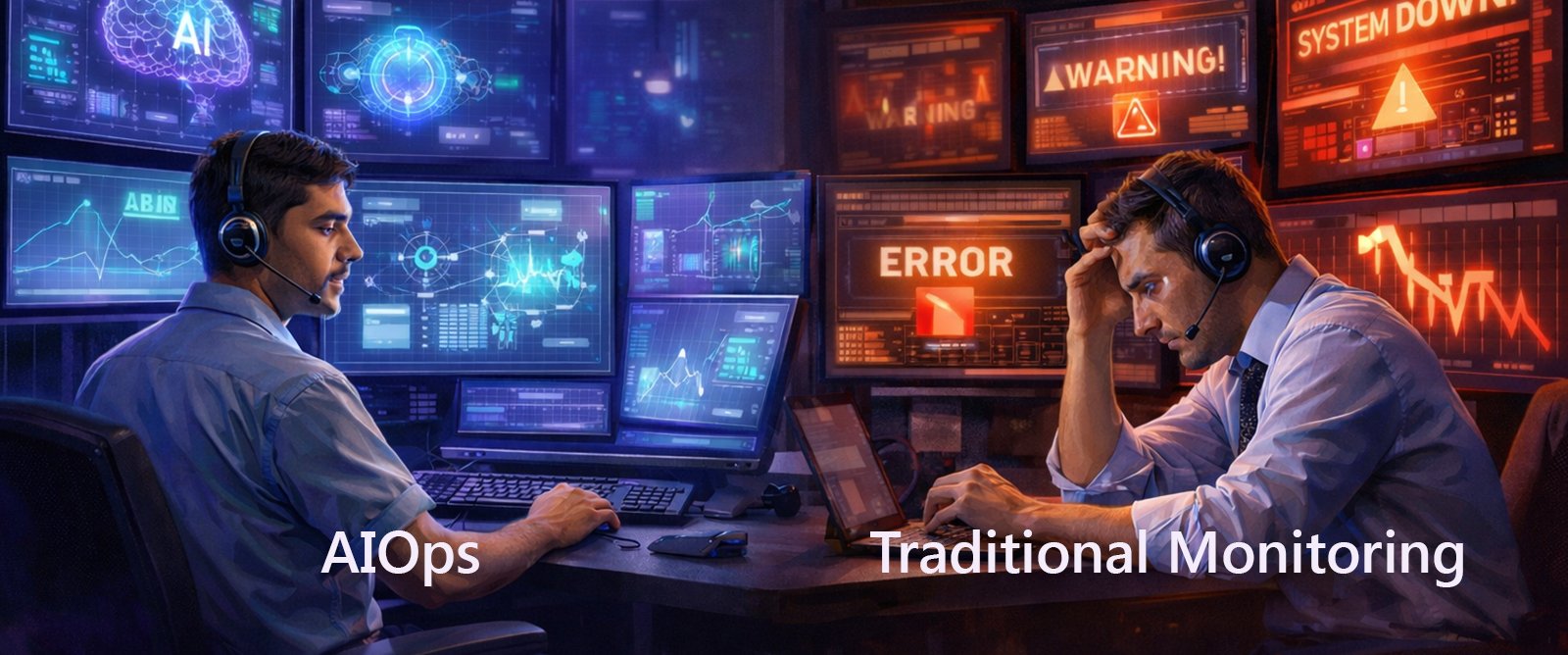
To illustrate the difference, consider how traditional monitoring and AIOps address the same operational scenarios across several critical dimensions.
Incident detection: Traditional monitoring detects threshold breaches after they occur. AIOps detects anomalous patterns as they emerge, often identifying degradation trends minutes or hours before they would trigger a static threshold alert. This difference translates directly into reduced incident frequency and severity.
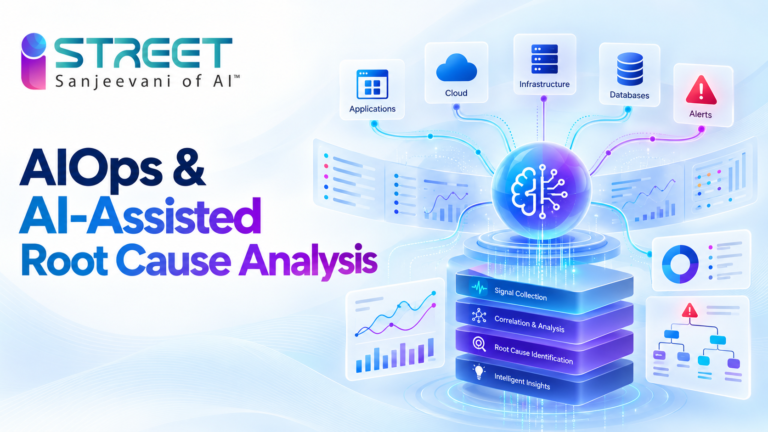
Root cause analysis: In traditional environments, root cause analysis is a manual, expertise-dependent process that can take hours. Operators must correlate events across multiple tools, examine logs, and trace dependencies manually. AIOps platforms perform automated topology-aware root cause analysis in seconds, presenting operators with a probable root cause and the evidence supporting it.
Capacity planning: Traditional approaches rely on periodic capacity reviews using historical trend data, often resulting in either over-provisioning or under-provisioning. AIOps applies predictive models to forecast capacity needs based on growth trends, seasonal patterns, and planned business events, enabling just-in-time provisioning decisions.
Change impact assessment: When a deployment or configuration change is made in a traditional environment, the impact is assessed reactively, teams wait to see if something breaks. AIOps platforms correlate change events with operational telemetry in real time, automatically flagging changes that correlate with performance degradation and recommending rollback when appropriate.
The Total Cost of Ownership Argument
Enterprise AIOps platforms represent a meaningful investment in licensing, integration, and organisational change. However, the total cost of ownership analysis consistently favours AIOps when the full picture is considered.
Traditional monitoring environments accumulate significant hidden costs over time: the licensing and maintenance costs of multiple overlapping monitoring tools, the staffing costs of large operations teams required to manage manual processes, the business costs of extended outages and degraded performance, and the opportunity cost of engineering talent trapped in reactive triage rather than contributing to innovation and improvement.
Organisations adopting AIOps can improve operational efficiency by reducing repetitive manual work, consolidating fragmented operational workflows, and accelerating incident detection and resolution. The value comes from enabling operations teams to spend less time on routine alert triage and remediation, while improving the use of existing monitoring investments and reducing the business impact of prolonged service disruptions.