Beyond Root Cause Identification: The Resolution Gap
AIOps platforms have fundamentally advanced the speed and accuracy of root cause analysis. Machine learning analyses alerts and events, correlates them with historical data and knowledge bases, and identifies root causes with exceptional accuracy. This advanced root cause analysis significantly reduces Mean Time to Resolve and minimises downtime.
A gap can still remain between identifying the root cause and resolving the incident, the difference between knowing what is wrong and determining the most appropriate action. Root cause analysis may identify a database bottleneck behind transaction failures, but effective resolution still requires teams to determine whether to scale the database, optimize a query, roll back a recent deployment, or redirect traffic. That decision often depends on additional operational context: whether the same pattern has occurred before, which remediation worked previously, what changes preceded the incident, which teams and services are affected, and whether there are governance or compliance considerations. Bringing this context together helps engineering teams move from root-cause identification to faster, more informed resolution.
This resolution gap is where conversational AI delivers its most transformative value. Not as a generic chatbot that provides scripted responses, but as a fully integrated extension of the AIOps platform, an intelligent interface that provides deep, actionable intelligence by drawing on the full breadth of operational data, incident history, and institutional knowledge. Closing this gap requires guided remediation based on current telemetry, historical incidents and operational context.
How Conversational AI Transforms the Resolution Process
When IT teams at Indian enterprises face critical issues, such as transaction failures in IMPS services, payment gateway latency during peak hours, or core banking performance degradation during month-end processing, rapid access to contextual operational intelligence becomes critical. The AIOps platform provides this foundation by analyzing logs, metrics, traces, topology, and recent changes to correlate signals, identify affected dependencies, and surface the probable root cause.
Dynamic contextual understanding. When the AIOps platform identifies a database bottleneck contributing to IMPS transaction failures, the GenAI copilot goes beyond presenting error details. It brings together context from historical incidents, recent configuration changes, deployment records, and system behavior patterns to support deeper investigation. If the team asks, “Has this kind of issue happened before?”, the copilot can surface similar historical incidents, the conditions in which they occurred, previous resolution actions, and the outcomes of those actions. This transforms incident investigation from a largely search-driven process into an interactive problem-solving experience, making relevant operational knowledge accessible through conversation. This GenAIOps approach makes operational knowledge accessible during incident investigation instead of requiring teams to search across multiple systems manually.
Tailored recommendations based on real-time scenarios. Unlike systems that rely on pre-set runbook answers, the copilot generates recommendations that account for current conditions. When the team faces an overloaded database, the copilot does not merely propose a generic rollback. It analyses current traffic volumes, the system’s current load, recent configuration changes, and the specific workload characteristics. It then suggests a specific optimisation strategy, query adjustments, resource scaling, tailored to the actual situation. This creates guided troubleshooting and remediation based on the current incident context rather than generic runbook responses.
Integration with external knowledge. The copilot pulls in external resources, standard operating procedures, vendor documentation, regulatory guidelines, and industry best practices, ensuring that recommendations are compliant with both technical and operational standards. For Indian banking institutions, this means remediation guidance that accounts for compliance requirements, data handling protocols, and institution-specific operational procedures.
Adaptive intelligence that evolves with your environment. As IT environments change, new deployments, configuration updates, architecture modifications, the copilot adapts its insights accordingly. It does not provide stale recommendations based on outdated system state. It dynamically adjusts, ensuring that guidance is always relevant to the current operational context.
In Practice: Managing a Critical Transaction Failure
Consider an illustrative scenario in India’s banking sector. A bank relies on IMPS to support real-time fund transfers across its digital channels. During peak hours, a sudden increase in transaction failures affects both the mobile application and web interface. The disruption creates immediate operational pressure, with potential impact on transaction volumes, customer experience, and service continuity. The IT team needs to identify the cause and restore service quickly.
The AIOps platform begins by analyzing transaction logs, database performance metrics, network telemetry, and recent changes. It correlates these signals with historical incidents and available operational knowledge to surface the probable root cause. The analysis indicates that a database service is experiencing increased load and identifies a recent change to transaction-processing logic as a contributing factor. Further analysis indicates that an unoptimized query is creating a performance bottleneck during peak usage.
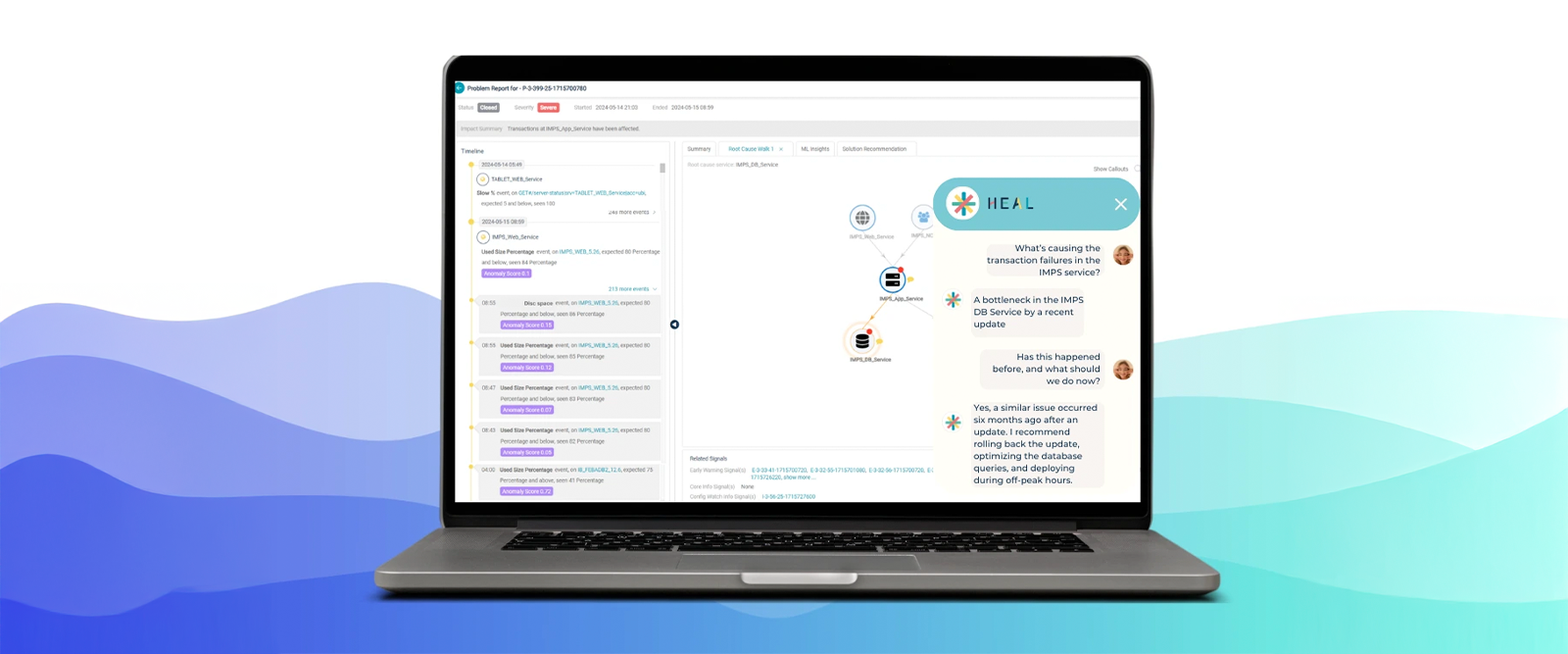
The conversational copilot provides interactive resolution guidance. The IT team engages the copilot for deeper insight. When the team asks, “What is causing the IMPS transaction failures?”, the copilot provides contextual insight: the current failure pattern is associated with an unoptimized query introduced in the recent update and resembles an incident following an earlier deployment. The analysis indicates that the query is struggling under peak transaction loads, contributing to the observed bottleneck. For production incident management, this allows engineers to move interactively from diagnosis to resolution options
The team then asks, “What was the solution last time?” The copilot surfaces the previous resolution history, including query optimization, key table indexing, and a temporary increase in database capacity. Based on this historical context and the current incident conditions, it can recommend relevant remediation options, such as evaluating a rollback of the recent update and applying previously successful query optimizations, subject to established operational controls and approval workflows.
This conversational approach reduces the need to manually search historical incident tickets, review runbooks, and gather operational context from multiple teams, helping engineers move more quickly from diagnosis towards informed resolution.
The copilot provides ongoing adaptive guidance. As the team implements the rollback and begins query optimisation, the copilot remains actively engaged. It monitors the impact of changes in real time. If the rollback causes unexpected effects on other services, the copilot provides immediate recommendations to mitigate the impact. It tracks resolution progress against SLA timelines and alerts the team if the pace of resolution puts compliance at risk.
The Compound Value: Institutional Memory at Machine Speed
One of the most significant benefits of conversational AI in incident resolution goes beyond speed: it captures institutional knowledge and makes relevant operational experience more accessible to teams during investigation and resolution.
In every enterprise, the most effective incident resolution depends on the engineers who have seen similar problems before, the senior operators who carry years of pattern recognition and resolution experience in their heads. When these engineers are available and on-call, incidents resolve quickly. When they are not, resolution slows dramatically.
Conversational AI solves this structural dependency by capturing resolution patterns automatically. Every incident that is diagnosed, every root cause that is identified, every remediation that is applied, all of this becomes part of the platform’s institutional memory. The next time a similar issue occurs, the copilot provides the accumulated wisdom of every previous resolution.
This capability reduces Mean Time to Identify by 60 to 80 percent and Mean Time to Resolve by 40 to 60 percent, not just because the AI is fast, but because it eliminates the knowledge access bottleneck that is the primary driver of resolution delay in complex enterprise environments.
From Status Updates to Strategic Intelligence
The copilot also transforms how incidents are communicated to stakeholders. Instead of generic status updates, ‘We are investigating the issue’, stakeholders receive contextual intelligence: what happened, why it happened, what is being done, what the expected resolution timeline is, and how similar issues have been resolved in the past. This level of transparency maintains trust during high-pressure incidents and provides leadership with the information they need to make informed decisions about customer communication, regulatory disclosure, and resource allocation.
For Indian enterprises operating under regulatory frameworks that require timely incident and root cause reporting to regulatory bodies, this automated, contextual communication capability is not a convenience. It is a compliance enabler.
GenAIOps for Enterprise Incident Diagnosis and Resolution
Conversational AI, built on the foundation of advanced AIOps, represents the next evolution in how Indian enterprises manage IT incidents. It does not replace engineering expertise. It amplifies it, ensuring that the right knowledge is available at the right time, that resolution decisions are informed by complete context, and that every incident makes the organisation’s operational intelligence stronger.
About iStreet Network
iStreet Network’s Sovereign AI Enterprise Platform, built on the Sanjeevani of AI™ framework and powered by HEAL Software’s AIOps capabilities, helps enterprises move from root-cause identification to faster, more informed incident resolution. By combining AI-driven root cause analysis with GenAIOps conversational intelligence, iStreet brings together current telemetry, topology, historical incidents, operational knowledge, and previous resolution patterns to provide contextual guidance during investigation. This enables IT teams to understand not only what is contributing to an incident but also which remediation options are relevant to the current operational context, supporting faster decisions, a governed response, and stronger operational resilience.
Talk to our advisors to explore how conversational AI can accelerate incident investigation and resolution across your enterprise environment.
Originally inspired by insights from HEAL Software, an iStreet Network’s AIOps product.