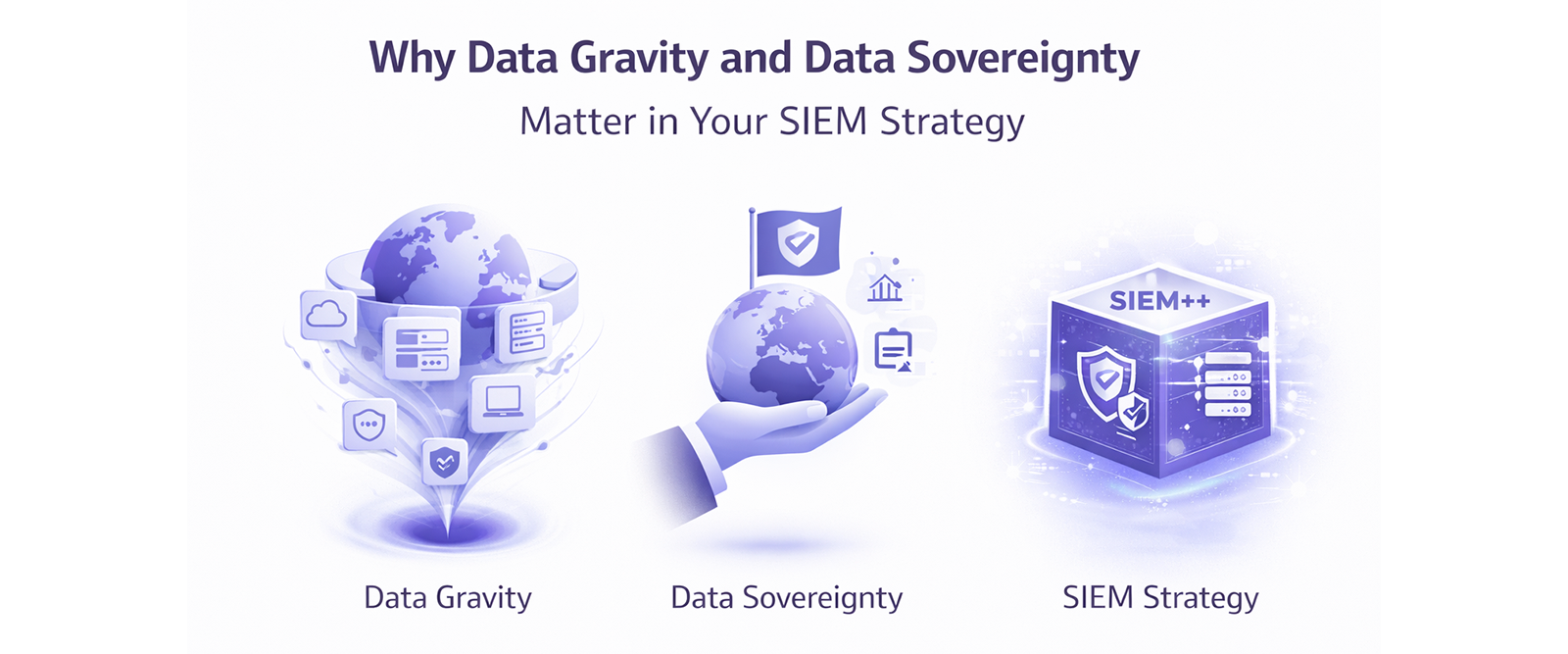
In the SIEM++ era, data is no longer just a log entry. It is a strategic asset with ‘mass’ and ‘jurisdiction.’ As enterprises scale, two physical and legal forces Data Gravity and Data Sovereignty are fundamentally reshaping how security architectures are built, moving them away from centralised ingestion toward decentralised, federated models.
- Data Gravity → Avoiding the ‘Black Hole’ Effect
Data gravity is the phenomenon where large datasets ‘pull’ applications, services, and additional data toward them. For a modern SOC, this creates significant strategic risks-
Latency tax- As data mass grows, the proximity of analytical tools becomes critical. If your SIEM is in one cloud but your data is in another, latency will make investigations feel like ‘moving through molasses’!
Economic lock-in- The bigger the dataset, the costlier it is to move. High egress fees and proprietary formats act like a gravitational pull, making it nearly impossible to switch vendors or cloud providers without massive capital expenditure.
Concentrated risk- Large, centralised ‘data planets’ become high-value targets for attackers. Centralisation creates a single point of failure where a single breach can expose the entire enterprise’s historical telemetry.
- Data Sovereignty → Navigating the Geographic Lock
Data sovereignty is the principle that information is subject to the laws of the country in which it is located. In 2026, this is a non-negotiable design constraint for multinationals-
Regulatory pressure- Frameworks like GDPR (Europe), DORA (Finance), and NIS2 (Critical Infrastructure) mandate strict control over where data resides and who can access it. Non-compliance can lead to forced service shutdowns and public-trust crises.
Visibility paradox- Security teams need a ‘single pane of glass’ view, yet sovereignty laws often prohibit moving sensitive logs across borders for central analysis.
Operational sovereignty- Beyond where bytes ‘rest’, regulators now examine who has the power to disclose it. Storing data in one country does not necessarily protect it from another country’s extraterritorial legal claims (e.g., the U.S. CLOUD Act).
- The Solution → Federated Search and Decoupled Lakes
To solve the conflict between needing global visibility and respecting gravity/sovereignty, the industry is pivoting to a Federated Security Stack.
| Strategy Component | Impact on Gravity & Sovereignty |
| Federated Search | Allows querying data at the source (in-region/in-cloud) without moving it, respecting residency rules and avoiding egress fees. |
| Decoupled Data Lakes | Stores raw telemetry in low-cost, open formats (Parquet/JSON) within the local jurisdiction, only sending high-fidelity alerts to the central SIEM. |
| Zero-Egress Architectures | Ensures sensitive data never leaves its designated sovereign zone while still providing access to innovative cloud-native analytics. |
| OCSF Normalisation | Provides a common language (lingua franca) for detections, allowing a single query to run across disparate global regions simultaneously. |
Strategic Bottom Line
A modern SIEM strategy must treat data placement as a path-dependency for future agility. By adopting Federated Search and Decoupled Architectures, CISOs can achieve the visibility required for 24/7 defence without falling into the ‘black hole’ of vendor lock-in or the legal minefield of sovereignty violations.
If you are interested to know more, we would be happy to help