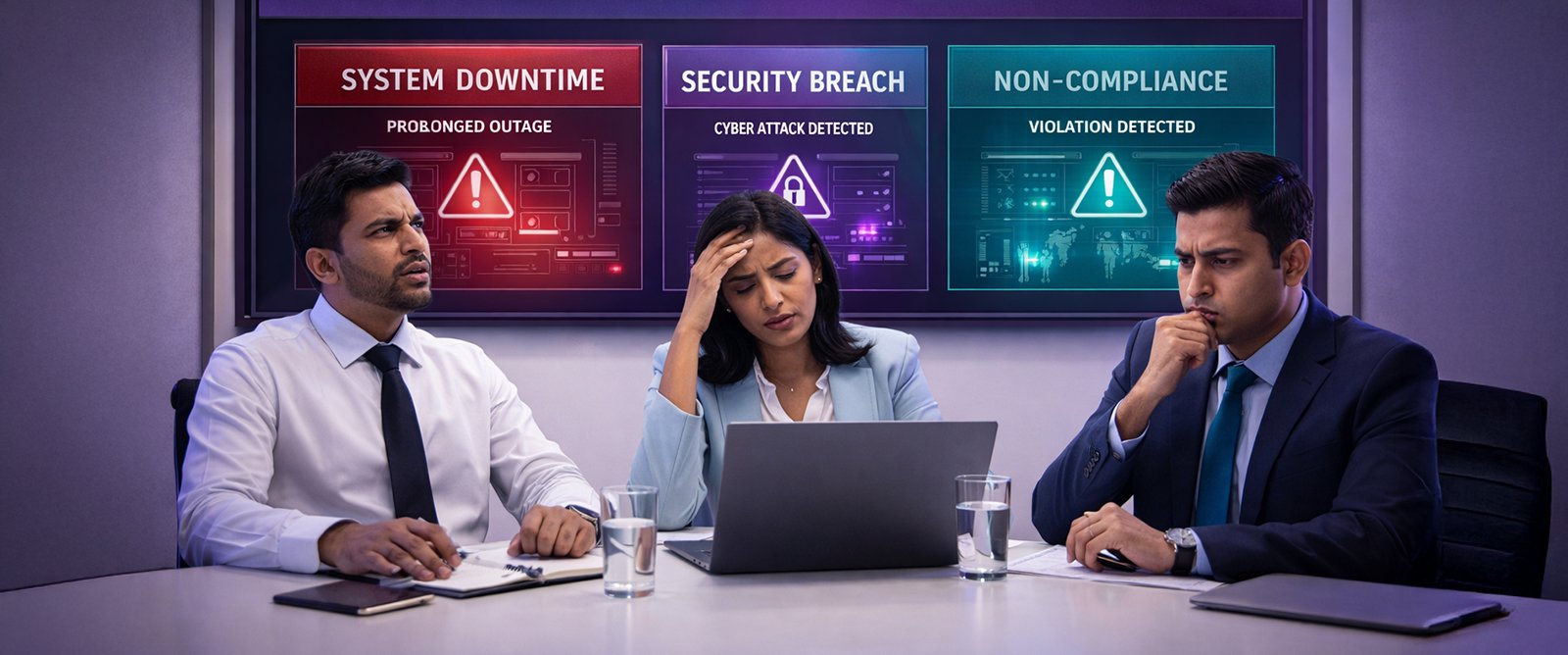
The most expensive thing in enterprise IT isn’t the tools. It’s the gap between them. That gap has a price measured in hours of downtime, millions in lost revenue, compliance penalties that were entirely preventable, and senior engineers burning out on bridge calls that shouldn’t exist.
Most enterprises don’t calculate this cost. They experience it, quarterly, sometimes weekly, but never total it. The P1 that took 6 hours gets a post-mortem. The audit scramble gets a retrospective. Each event is often treated in isolation rather than connected to the broader operating-model gap: infrastructure, security, and compliance functions working independently even when incidents span multiple operational domains.
This article examines the real costs that can accumulate when enterprises operate without a Resiliency Operations Centre (ROC), a connected operating model that brings operational, security, and compliance context together to support faster, more coordinated resilience. These recurring gaps can weaken operational resilience even when individual monitoring, security and compliance tools are functioning as intended.
The Downtime Tax: When Coordination Delays Resolution
When a critical incident affects an enterprise operating separate NOC, SOC, and application monitoring functions, resolution often requires coordination across multiple teams and tools.
The initial phase is detection. Multiple tools may generate alerts, while different teams see symptoms through their respective dashboards and workflows. This phase generally works as intended: each tool provides visibility within its own domain.
The next challenge is coordination. Infrastructure, security, and application teams compare observations, timelines, and telemetry to determine whether they are investigating separate issues or different symptoms of the same incident. Cross-team hand-offs and manual correlation can add significant time before the broader incident context becomes clear.
Diagnosis may then depend on experienced engineers who can connect fragmented context across infrastructure, applications, and security domains. Resolution begins once the underlying issue is identified and the appropriate response is determined.
A significant portion of incident-resolution time can be consumed by data gathering, cross-team coordination, and manual correlation rather than diagnosis and remediation. Engineers may need to move between tools and reconstruct context before they can act on the underlying issue.
The financial impact of downtime can be substantial. New Relic’s 2025 Observability Forecast reported a median cost of $2 million per hour for high-business-impact outages. Among organisations with full-stack observability, the median cost was $1 million per hour, compared with $2 million for those without it. Cockroach Labs’ State of Resilience 2025 reported that organisations experienced an average of 86 hours of downtime per year, highlighting the continuing business impact of operational disruption. Resilient operations depend not only on detecting an incident, but on correlating context and coordinating the right teams quickly. A Resilience Operations Center reduces this coordination gap by connecting operational and security context around the same incident.
When coordination overhead is repeated across incidents, the cumulative cost can become significant—not because individual tools have failed, but because teams still need to correlate fragmented operational context manually across separate systems.
The Blind Spot Tax: Risks Hidden Across Siloed Systems
Downtime is visible. Blind spots aren’t. That’s what makes them more dangerous.
A blind spot is the gap between what an enterprise believes is being monitored and what’s actually being monitored. It exists whenever tools operate in silos, which, in most enterprises, is always. Operational blind spots become a resilience issue when infrastructure, security and compliance teams see different parts of the same business-service risk.
The NOC-SOC blind spot. Infrastructure monitoring sees performance metrics. Security monitoring sees threat signals. Neither sees the other’s data. When a security compromise causes a performance degradation, a cryptominer consuming CPU, a DDoS attack saturating bandwidth, a compromised credential generating anomalous API calls, the NOC treats it as a resource issue and the SOC treats it as a threat investigation. Two parallel investigations run for hours before someone on a bridge call connects the dots. In the meantime, the attacker has more time to move laterally, the operational impact compounds, and the enterprise is exposed on both fronts simultaneously without anyone seeing the full picture. This is one of the practical differences between a ROC and traditional NOC/SOC operating models: the ROC correlates cross-domain context rather than leaving teams to reconcile it manually.
The compliance blind spot. Compliance posture is typically assessed periodically, quarterly reviews, annual audits. Between those checkpoints, the actual compliance state is unknown. A control stops generating telemetry on the next day. A configuration drift creates a regulatory exposure on another day. None of these are detected until the next scheduled review, weeks or months later. By then, the violation has persisted, the exposure has accumulated, and the evidence trail is cold. Continuous compliance visibility therefore becomes part of operational resilience rather than a separate periodic activity.
The 2025 A-LIGN Compliance Benchmark Report found that 53% of enterprises spend 3 to 6 months preparing for audits, and 87% of organizations report negative outcomes from reactive compliance approaches. These aren’t technology failures. They’re visibility failures, the direct consequence of compliance data living in a separate silo from operational and security telemetry.
The AI blind spot. This is the newest and fastest-growing gap. Teams across the enterprise are deploying AI tools, agents, and models at a pace that governance can’t track. Shadow AI, the AI equivalent of shadow IT, is invisible to compliance teams. Nobody knows what data these tools access, what decisions they influence, or what exposure they create. According to A-LIGN’s 2025 report, 90% of organisations are building AI compliance policies, but most aren’t ready to enforce them. The gap between AI adoption speed and AI governance maturity is widening every quarter.
A ROC closes these blind spots by design. When operational, security, and compliance telemetry lives in the same data lake and is correlated by the same AI engine, the blind spots between domains disappear. A security event that causes an operational impact is identified as one incident, not two separate investigations. A compliance violation is detected the moment it occurs, not during the next quarterly review. AI adoption risks are monitored continuously alongside infrastructure and security posture.
Blind spots are invisible by definition. Enterprises don’t know if they have them until an incident exploits one. The cost of that exploitation is in breach impact, regulatory penalties, customer churn, and leadership confidence, is always higher than the cost of the platform that would have prevented it.
The Compliance Tax: The Cost of Fragmented Compliance Operations
Compliance in most enterprises follows a predictable and expensive cycle: prepare frantically, present evidence, remediate findings, repeat next quarter. Each cycle consumes weeks of effort from multiple teams, produces documentation that’s partially stale by the time it’s compiled, and leaves the enterprise in an unknown compliance state between review periods. Connecting compliance evidence with operational and security telemetry can reduce the gap between control failure and awareness.
The direct financial cost is significant. According to the 2025 A-LIGN Compliance Benchmark Report, 71% of enterprise organisations spend over $100,000 per year on audits alone. Enterprises conducting 6 or more audits annually, 35% of large organizations do face cumulative costs that extend well into six figures before accounting for the internal team.
But direct audit costs are only part of the picture. The broader operational risk often emerges between audit cycles.
When compliance is periodic instead of continuous, violations accumulate silently. A configuration change that creates a regulatory exposure persists for weeks or months before detection. A control that stops functioning goes unnoticed until the next assessment. Remediation can become significantly more complex and costly when a compliance violation remains undetected for an extended period, as its impact may widen, supporting evidence may become harder to reconstruct, and regulatory scrutiny may increase.
The compliance tax isn’t just financial. It’s strategic. Every week the compliance team spends scrambling for evidence is a week not spent on risk reduction. Every audit finding that repeats from the previous cycle signals a governance gap that erodes Board confidence. Every compliance officer spending 80% of their time on data gathering instead of risk management represents a misallocation of scarce expertise.
AI Governance turns compliance from a periodic tax into a continuous capability. Inside iStreet’s ROC, compliance monitoring runs alongside operational and security monitoring on the same platform, so a violation triggers an alert the moment it happens.
The Talent Tax: The Cost of Knowledge Dependency
There’s a cost that never appears on a balance sheet but shows up in every MTTR metric: the dependency on specific individuals whose knowledge holds the entire incident response capability together. This expert dependency can directly affect MTTR when incident context and previous resolution knowledge are not available to the wider operations team.
Every enterprise has them. The architect who built the payment platform and knows every dependency. The SRE who has been on-call for three years and recognizes failure patterns that no runbook documents. The security analyst can correlate a SIEM alert with an infrastructure anomaly in minutes because they’ve seen the pattern before. Generative AI can help make historical incident context, resolution steps and operational knowledge easier to access during active incident management.
When these people are on the bridge call, incidents resolve in an hour. When they’re on vacation, the same incident takes four. When they leave the company, the institutional knowledge leaves with them.
The replacement cost is significant: 6–12 months to hire and onboard someone to the same level of environment-specific expertise. But the real cost isn’t the hiring. It’s the MTTR degradation during the gap. When incident resolution is delayed because critical expertise is unavailable, the impact can be measured in additional downtime, customer disruption, and engineering effort.
In the siloed model, this talent dependency is structural. Critical operational knowledge often remains dependent on individual expertise because existing tools do not always connect the domains that knowledge spans. Experienced architects may understand how infrastructure, application, and security layers interact, but that cross-domain context is not always captured in a reusable, system-level form.
iStreet Network ROC changes this by systematically capturing institutional knowledge into the platform. Root-cause context, resolution steps, affected components, and incident outcomes can be captured within iStreet Network’s ROC as reusable operational knowledge. As similar patterns emerge, the platform can surface relevant historical context and resolution guidance, making that knowledge accessible to engineers across teams and shifts.
Critical operational knowledge becomes embedded in the system rather than remaining dependent on individual availability. Engineers across shifts can access the same resolution intelligence, helping reduce variability in incident response and preserve institutional knowledge over time.
The Opportunity Tax: What Teams Could Focus on Instead
Every hour an engineer spends on a bridge call gathering context is an hour not spent on reliability engineering, automation, capacity planning, or the strategic projects sitting in the backlog. Every week the compliance team spends preparing for an audit is a week not spent on risk reduction, governance improvement, or AI policy development. Every month a security analyst spends triaging false positives is a month not spent on threat hunting, security architecture, or proactive vulnerability management. Reducing repetitive triage and coordination overhead gives teams more capacity to improve resilient IT operations, automation and preventive engineering.
The opportunity cost of the siloed model is invisible because it manifests as work that doesn’t get done rather than work that fails. The automation project that keeps slipping. The reliability improvement that never gets prioritized. The security architecture review that’s been on the roadmap for two quarters. The AI governance framework that everyone agrees is needed but nobody has time to build.
The business case for a ROC often considers operational cost reduction and improvements in incident resolution. However, an equally important source of value is the engineering and security capacity recovered as operational overhead decreases, enabling teams to redirect time towards reliability, automation, threat investigation, and other strategic initiatives. This opportunity value may be harder to quantify, but it remains an important part of the overall business case.
By reducing manual correlation, repetitive triage, and cross-team coordination, iStreet Network’s Resiliency Operations Centre can free engineering and security capacity for higher-value work. Engineers can focus more on reliability and innovation, compliance teams on continuous governance, and security analysts on threat investigation rather than repetitive alert triage.
The Total Cost: Building the Business Case
When enterprises calculate the cost of not having a ROC, they typically look at one dimension either downtime, or tool spend, or compliance overhead. The total cost spans all of them simultaneously. The business case for a ROC should therefore consider the cumulative cost of fragmented operations, not only the cost of downtime or individual tools.
Downtime and coordination overhead: Engineering hours consumed by bridge calls, manual correlation, and context gathering across siloed tools. This time incurs both direct operational costs and an opportunity cost, as it diverts experienced engineers from reliability, automation, and other strategic work.
Blind spot exploitation: Incidents that escalate because cross-domain correlation and response were delayed. Security breaches that create operational impact without being immediately correlated across teams and systems. Compliance violations that may remain undetected between periodic reviews. Each can create additional remediation costs, regulatory exposure, and customer impact.
Compliance overhead: Direct audit costs, internal team time spent on evidence gathering and preparation, and remediation costs associated with findings that may have been identified earlier through continuous monitoring.
Talent risk: MTTR degradation when key engineers are unavailable, plus replacement costs when they leave, plus the knowledge gap that persists during onboarding typically 6–12 months for environment-specific expertise.
Opportunity cost: Strategic projects delayed, automation deferred, proactive risk management postponed all because the team’s capacity is consumed by the operational overhead of the siloed model. For leadership teams, this becomes an enterprise resilience question: whether operational, security and governance risks can be understood through one connected view. A Resilience Operations Center becomes a strategic resilience investment when recurring coordination, visibility and governance gaps begin to create measurable operational overhead.
The combined annual impact varies by enterprise size, operational complexity, incident frequency, regulatory exposure, and dependence on manual processes. For organizations operating across multiple business units, geographies, or regulated environments, these costs can accumulate across downtime, engineering effort, security operations, compliance, and opportunity costs. iStreet Network’s Resiliency Operations Center is designed to reduce this operational overhead by accelerating cross-domain correlation, investigation, and response while enabling teams to focus more capacity on higher-value work. The business case for a ROC should therefore be evaluated against the cumulative cost of fragmented operations, not technology investment alone.
The Cost That Doesn’t Have a Number
Beyond the quantifiable costs, there is another form of value that is harder to measure but important to CxOs: confidence in operational resilience.
iStreet Network’s Resiliency Operations Center provides a level of correlated operational context that siloed models can struggle to deliver, a continuously updated view of enterprise resilience, grounded in correlated operational and security data across domains and connected with business impact and governance context.
That confidence may not appear as a direct line item in the budget, but its absence becomes visible in leadership discussions where resilience information must be assembled manually across multiple teams and systems.
From Operational Cost to Resilience Investment
Enterprises operating with fragmented resilience processes may already be absorbing high operational costs. These costs can appear through downtime, coordination overhead, operational blind spots, reactive compliance effort, dependence on individual expertise, and strategic work deferred by day-to-day incident management.
The strategic question is when a more unified resilience operating model becomes necessary. As fragmented operations continue absorbing recurring operational and business costs, a more connected resilience model can become a strategic priority.
A ROC does not eliminate incidents. Incidents will continue to occur. It is designed to reduce operational inefficiencies in incident response, coordination overhead, fragmented context, compliance overhead, and reliance on individual expertise, thereby reducing the time, effort, and business impact of incident response.
The real cost of operating without a ROC is therefore not limited to a single major incident. It is the cumulative impact of recurring operational inefficiencies that can eventually make the case for a more unified resilience model difficult to ignore.
About iStreet Network
iStreet Network’s Sovereign AI Enterprise Platform, built on the Sanjeevani of AI™ framework, enables enterprises to establish a Resiliency Operations Center that brings AIOps and SecOps intelligence into a unified, correlated command layer. By connecting operational and security signals across existing enterprise tools, the ROC enables faster investigations, coordinated responses, resolution intelligence, and stronger operational resilience.