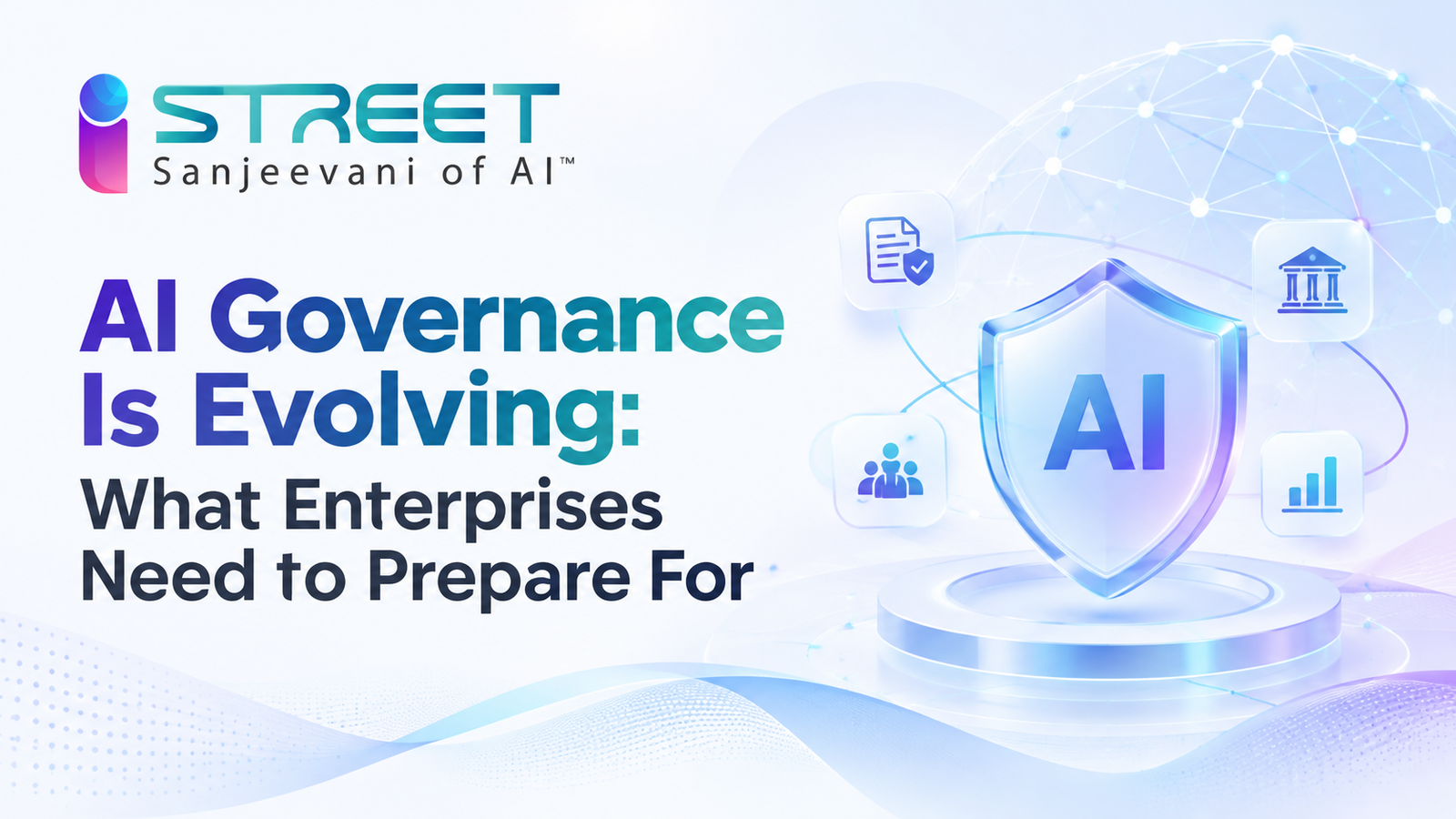
India’s approach to AI governance is taking shape through a principle-based framework built on trust, accountability, safety, and a people-first outlook, with an explicit emphasis on innovation over restraint. At the same time, the government is exploring a dedicated AI law and will use feedback from its consultation process to shape the regulatory framework. For any organisation that builds, buys, or embeds AI in its services, this is the point to understand where the framework is heading and what it will ask of you.
What India’s AI Governance Guidelines Establish
India’s AI governance guidelines set out a principle-based framework rather than a prescriptive rulebook. Four ideas anchor it:
- Trust: AI systems must earn the confidence of the people who use them and are affected by them.
- Accountability: Someone must answer for what an AI system does, including automated decisions.
- Safety: Risks must be identified and addressed before and during deployment.
- People first: Human outcomes, not technical capability, define whether an AI system is acceptable.
Running through all four is a deliberate position: innovation over restraint. The framework starts from the premise that India should build and adopt AI at pace, with safeguards and guardrails that scale alongside it.
Why a principle-based model matters for enterprises
Principles give enterprises room to design controls that fit their own systems, but they also raise the bar evidence. When a regulator asks how a bank, insurer, or public-sector body ensures trust and accountability in a deployed model, a policy document will not be enough. Teams will need records of how the system was built, tested, monitored, and corrected.
The Issues the AI Safety Framework Examines
India’s framework looks across a defined set of risk areas. Together they describe where AI safety concerns are expected to concentrate:
- Deepfakes: Synthetic audio, video, and imagery that impersonates real people.
- Synthetic content that misleads users: A rising volume of AI-generated material that people cannot easily distinguish from authentic content.
- Cybersecurity: AI-enabled attacks, and the security of AI systems themselves.
- Skilling: Building the workforce that can develop, operate, and oversee AI.
- Psychological impact of AI systems: The effect of AI-driven interactions on people’s wellbeing and behaviour.
Several of these sit outside what a traditional compliance programme covers. Psychological impact and misleading synthetic content, for example, require product design decisions, not only security controls. Enterprises running consumer-facing AI will find these areas move quickly from policy discussion to operational requirement.
A Techno-Legal Approach to AI Governance
The most distinctive feature of India’s direction is its techno-legal approach: combining technological safeguards with legal ones, rather than relying on law alone.
What “techno-legal” means in practice
Legal rules state what must happen. Technological safeguards make it happen, and make it demonstrable. A techno-legal model treats controls such as content provenance, disclosure mechanisms, audit logging, access governance, and monitoring as part of the compliance mechanism itself.
For enterprises, this has a direct consequence. Governance cannot sit in a policy folder, separate from the platform that runs the AI. It has to be built into the architecture: where models run, how data moves, who can invoke a system, and how every automated action is recorded.
Where sovereignty fits
A techno-legal model works best when the organisation controls the stack it must account for. Data residency, model hosting, and operational visibility become governance questions, not only infrastructure choices. This is where sovereign AI infrastructure supports compliance: when AI runs on platforms the enterprise controls, evidence for regulators is easier to produce and accountability is easier to assign. It also aligns naturally with existing obligations under regulatory bodies requirements that Indian enterprises already manage.
Toward a Dedicated AI Law
India is looking at a dedicated AI law. The government will use feedback from the consultation process to shape the regulatory framework, and a coordinating body, the AI Governance and Economic Group, is set to align national AI governance policy.
A new framework could shape areas ranging from:
- AI-generated content and deepfake disclosures, including how synthetic material is labelled
- Accountability for automated systems, including who answers for decisions made without a human in the loop
- Deployment of generative AI in consumer-facing services, including chat assistants, recommendation engines, and automated customer interactions
What this signals to enterprises
Because the consultation is still shaping the final framework, specific obligations may change. The direction, however, is consistent: disclosure for synthetic content, clear accountability for automated systems, and safeguards for generative AI that faces consumers. Enterprises that build these capabilities now will adapt to the final rules faster than those that wait for them.
How Enterprises Can Prepare Now
Preparation does not need to wait for the law. Five steps align with the direction already visible:
- Inventory AI systems. Record every model and automated decision process in use, including those embedded in third-party tools.
- Assign accountability. Name an owner for each system, with a clear line to risk and compliance functions.
- Build disclosure capability. Prepare mechanisms to label AI-generated content and tell users when they interact with an automated system.
- Strengthen security around AI. Treat models, prompts, and training data as assets requiring protection and monitoring.
- Invest in skilling. Equip security, risk, and product teams to assess and oversee AI behaviour.
iStreet’s sovereign AI-native platforms are designed around exactly this requirement: AI that runs under the enterprise’s control, with governance, security operations, and audit evidence built into the architecture. That gives Indian enterprises a foundation for meeting a techno-legal standard without rebuilding systems each time the rules evolve.
AI governance model pairs principles of trust, accountability, safety, and people-first design with an explicit commitment to innovation. Its techno-legal approach asks enterprises to embed safeguards into their technology, not append them afterward. With a dedicated AI law under consideration and consultation feedback shaping the outcome, the practical move is to build governance into AI systems now.