The Challenge: Alert Storms Across Siloed Telemetry Sources
A checkout failure in production triggers 47 alerts across infrastructure monitoring, network monitoring, database monitoring, and your ITSM tool within 90 seconds. Your on-call engineer receives notifications from three channels simultaneously. Which alert represents the root cause? Which seventeen are symptoms? The engineer spends 12 minutes correlating timestamps, tracing dependencies manually, and ruling out false positives before even starting remediation.
This is the operational reality of modern observability environments in Indian enterprises. Infrastructure teams rely on tools like Prometheus or Nagios. Application teams instrument with Datadog or New Relic. Security operations maintain separate SIEM platforms. The service desk operates through ITSM tools like ServiceNow. Each system generates alerts based on its own thresholds, formats, and escalation rules, with no native understanding of how these signals relate to each other.
A single root cause, say, a database connection pool exhaustion triggers cascading failures that manifest as dozens of distinct alerts across multiple tools. Each alert is technically correct: the API is timing out, the queue is backing up, the health checks are failing. But treating each as an independent incident creates cognitive overload precisely when focused attention matters most. The engineer who needs to fix the actual problem is instead buried under a mountain of redundant signals, each demanding attention.
Research indicates that organisations with high alert noise experience 2.3 times longer mean time to resolution compared to those with optimised alerting strategies. For Indian BFSI institutions processing millions of UPI transactions per hour, or healthcare platforms managing critical patient workflows, every minute spent correlating alerts manually is a minute not spent fixing the actual problem and a minute of compounding customer impact, compliance exposure, and revenue loss.
What Intelligent Event Correlation Solves
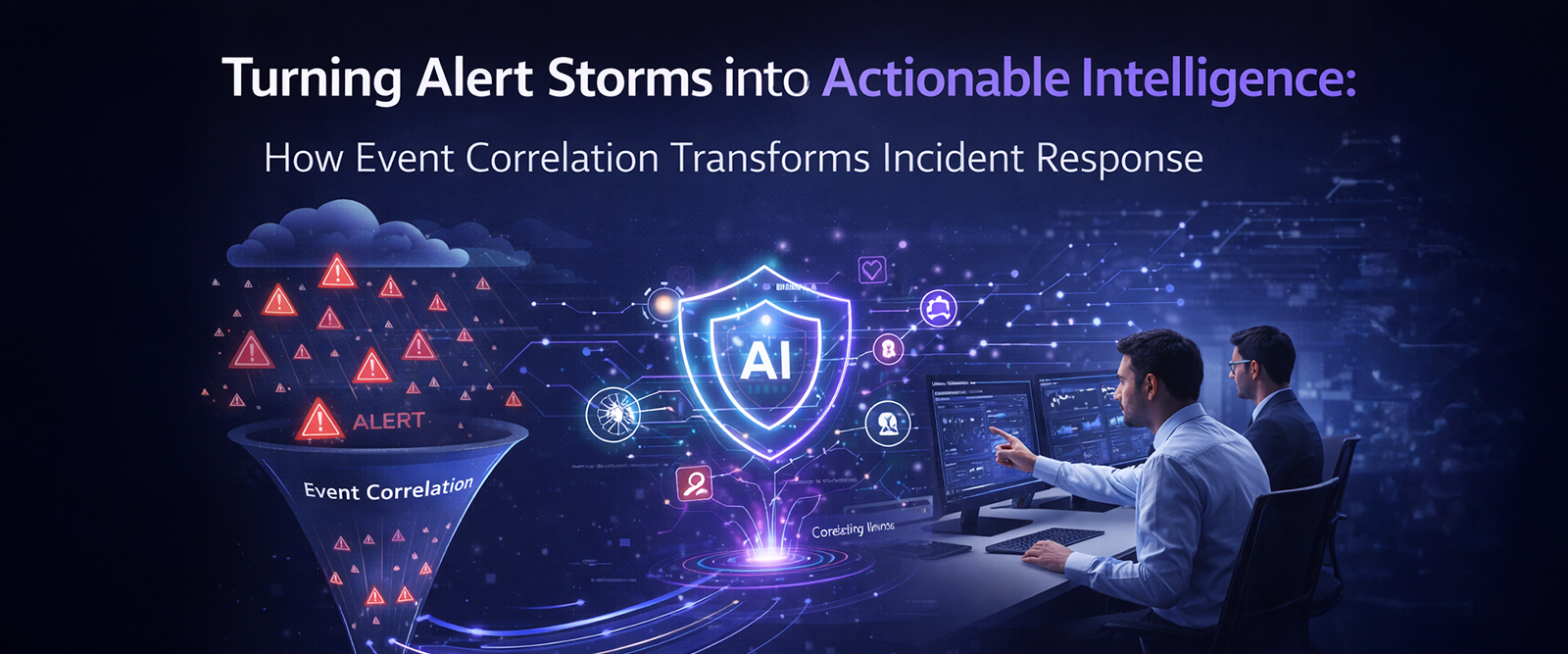
iStreet Network’s Resilient Operations solutions, powered by HEAL Software’s AIOps correlation engine, address this challenge through a fundamentally different approach. Instead of presenting raw alerts to human operators, the correlation engine ingests events from heterogeneous sources, normalises timestamps and metadata, then applies temporal and topological analysis to correlate related alerts into a single incident with ranked probable causes. The same 47 alerts become one incident tagged with ‘API gateway timeout’ as primary signal and ‘upstream database saturation’ as contributing factor.
This is not simple alert deduplication or time-based grouping. It is multi-dimensional analysis that understands not just what happened, but how different events relate to each other through the service dependency graph, through historical co-occurrence patterns, and through causal inference.
How the Correlation Engine Works
Ingestion and Normalisation
Different monitoring tools use different timestamp formats, severity scales, and naming conventions. A ‘critical’ alert in one system might map to ‘P1’ in another and ‘severity: 1’ in a third. The first challenge is creating a common language. HEAL’s correlation engine addresses this through extensive connector libraries and normalisation pipelines. Incoming events are parsed, timestamps are synchronised to a common reference, and metadata is mapped to a canonical schema. This normalisation layer is foundational, without it, cross-tool correlation is impossible.
Temporal Correlation
Alerts that fire within a configurable window are candidates for grouping. But pure temporal correlation has significant limitations, two completely unrelated issues might coincidentally occur within the same window. A database error and a network latency spike that happen at the same time could share a root cause, or they could be entirely independent of problems.
Effective temporal correlation therefore incorporates additional signals beyond simple time proximity: alert source, affected resource, and critically historical co-occurrence patterns. If two specific alert types have appeared together in 87% of past incidents, their simultaneous appearance in the current incident carries much stronger correlative weight than two alerts that have never been seen together before. This probabilistic approach, refined over thousands of incident cycles, produces groupings that reflect actual causal relationships rather than coincidental timing.
Topology-Aware Correlation
Topology awareness is where the correlation engine delivers its most differentiated value. The platform maintains a service dependency graph — often learned from actual traffic patterns rather than manually configured so when an alert fires in the authentication layer, the correlation engine already knows which downstream services will cascade failures. If the authentication service depends on a shared database that also serves the payment processing pipeline, the engine understands that a database issue will produce alerts in both service chains and groups on them accordingly.
Alerts are not just grouped by time of proximity; they are weighted by dependency relationships and historical co-occurrence patterns. Machine-learned topology, refreshed continuously from actual communication patterns, provides a more accurate foundation for correlation decisions than manually maintained dependency maps that drift out of sync with reality as architectures evolve. In the fast-moving environments of Indian enterprises, where new services are deployed weekly and infrastructure changes are continuous, this dynamic topology learning is the difference between correlation that works in theory and correlation that works in production.
Measurable Outcomes
Organisations implementing HEAL’s event correlation through iStreet Network’s Resilient Operations solutions observe measurable improvements across several dimensions.
Alert noise reduction of 60 to 85%. This is not just a number, it represents a fundamental transformation in the operational experience of on-call engineers. Instead of wading through hundreds of alerts during an incident, they see a small number of correlated incidents with clear context. This reduces cognitive load, prevents alert fatigue, and restores trust in the alerting system.
Mean time to resolution improvement of 30 to 50%. When engineers start diagnosis with a ranked hypothesis rather than raw alert lists, they bypass the correlation exercise entirely. The 12 minutes previously spent connecting dots becomes time spent resolving the issue. This is a direct reduction in customer impact duration.
Time to hypothesis drops from 12+ minutes to near-immediate. Engineers start with ranked causes, not raw noise. This single metric captures the qualitative transformation: instead of beginning every incident with ‘what is going on?’, teams begin with ‘here is the most likely cause, let us verify and fix it.’
Engineering capacity is reclaimed. Over hundreds of incidents annually, the time saved on manual correlation compounds into substantial operational capacity recovery. This capacity can be redirected from reactive firefighting to proactive reliability work, automation development, and architectural improvements that prevent future incidents.
Why It Matters to Your IT Team
You already paid for observability tools. These platforms represent significant annual spend and deliver genuine value in terms of visibility. But visibility alone does not translate to operational efficiency. You can see everything happening in your environment. But when an incident strikes, your team still struggles to determine what matters, why it is happening, and what to do about it.
AIOps event correlation makes that existing investment operationally useful by turning signals into decisions. It bridges the gap between having access to data and being able to act on it effectively. It is not about replacing your monitoring tools, it is about making the investment you have already made actually work for you during the moments that matter most.
Every incident that resolves 20 minutes faster is customer impact you avoided and engineering capacity you reclaimed. That is directly measurable in customer satisfaction scores, SLA compliance metrics, and team capacity for proactive improvement work. For Indian enterprises governed by RBI mandates, and sector-specific compliance frameworks, faster resolution is not just an operational metric, it is a governance imperative.
Implementation Considerations
Value realisation is not instantaneous, and setting realistic expectations is important for successful deployment. There is a tuning period during which the correlation engine learns your environment’s patterns, builds topology models, and calibrates its grouping algorithms to your specific context.
Initial weeks focus on connector integration, establishing data feeds from your various monitoring sources. The normalisation layer requires configuration to map your specific alert taxonomies to the platform’s canonical format. Each organisation’s monitoring ecosystem is unique, and the integration work must reflect that.
The topology learning phase follows, during which the platform observes service communication patterns and builds dependency models. Organisations with complex microservices architectures may see this phase extend longer, but correlation accuracy improves accordingly as the model develops a richer understanding of the environment.
Expect to iterate on correlation rules during the first 60 to 90 days. Effective implementations include dedicated time for correlation tuning and establish feedback loops between on-call engineers and the platform configuration. When an engineer encounters a correlation that does not reflect actual causality, that feedback is incorporated to refine the model. Over time, this iterative refinement produces correlation quality that no static configuration could achieve.
Key Questions for Vendor Evaluation
When evaluating correlation capabilities, the questions that matter most are:
- How is topology learned? Manual configuration creates a maintenance burden, while automatic discovery from traffic patterns provides more reliable foundations.
- What is the connector ecosystem? Integration depth with your specific monitoring tools determines time-to-value.
- How are correlation rules tuned? Understanding the tuning interface helps predict operational fit.
- What happens to suppressed alerts? Correlated alerts should be accessible for audit while filtered from active noise.
- How is the cause ranking determined? The value of correlation depends partly on accurate probable cause identification.
Moving Forward
Event correlation represents the critical link between observability investment and operational efficiency. The gap between having signals and making decisions based on those signals is where incident response slows; engineers burn out, and customer impact accumulates.
iStreet Network’s approach — combining intelligent ingestion, automatic topology discovery, and multi-dimensional correlation analysis through HEAL Software’s AIOps engine, ensures that when an incident occurs, the first thing your team sees is a coherent picture of what is happening, not a flood of undifferentiated noise.
Talk to our advisors to see event correlation in action with your actual alert data.
Originally inspired by insights from HEAL Software, an iStreet Network AIOps product. Learn more at healsoftware.ai.