The Artificial Intelligence for IT Operations market has entered a defining phase. Projected to surpass 20 billion and potentially reach 32.4 billion by 2028, AIOps is no longer an emerging technology — it is a strategic imperative for enterprises that depend on digital infrastructure for business continuity, customer experience, and regulatory compliance. But the market is not simply growing. It is consolidating, reshaping, and separating genuine capability from vendor rhetoric in ways that Indian enterprises must understand before making investment decisions.
The consolidation trend is unmistakable. Cisco’s 28 billion acquisition of Splunk brought one of the most recognised names in observability under a networking giant’s umbrella. Dell absorbed Moogsoft, a pioneer in event correlation, into its enterprise portfolio. HPE purchased OpsRamp, adding AIOps and hybrid infrastructure management to its capabilities. Francisco Partners and TPG took New Relic private. Each of these transactions removes an independent player from the market and reshapes the competitive landscape, concentrating AIOps capabilities within larger platform ecosystems.
For CIOs and IT leaders at Indian enterprises — particularly those in BFSI, healthcare, and government digital services — this consolidation carries both opportunity and risk. The opportunity lies in access to more comprehensive, integrated platforms. The risk lies in vendor lock-in, reduced innovation incentive, and the growing gap between marketing claims and actual operational capability. Understanding this landscape is essential for making technology investments that deliver measurable returns rather than adding to the already overwhelming complexity of modern IT environments.
What Consolidation Actually Means for Enterprise Buyers
When a large platform vendor acquires an AIOps company, the acquisition does not automatically make the combined offering better. Integration takes time — typically 18 to 36 months before acquired capabilities are fully embedded into the parent platform’s architecture. During this transition, product roadmaps can stall, engineering teams are reorganised, and existing customers may find themselves in a support limbo between the legacy product and the integrated offering.
More fundamentally, acquired capabilities are often reshaped to serve the acquirer’s strategic priorities, which may not align with the needs of the acquired product’s original customer base. When a networking company acquires an observability platform, the observability capabilities tend to be optimised for network-centric use cases — potentially at the expense of application-layer intelligence or cross-domain correlation capabilities that were the acquired product’s original strength.
For Indian enterprises making long-term technology investments — with procurement cycles that can span six to twelve months and deployment timelines that extend further — betting on a recently acquired product carries implementation risk. The product you evaluated may not be the product you deploy, and the product you deploy may not be the product you operate three years from now.
This is precisely why iStreet Network has chosen a different path. Rather than assembling capabilities through acquisition and integration, iStreet’s Resilient Operations portfolio is built on HEAL Software’s purpose-built AIOps engine — designed from the ground up as a unified platform that spans observability, intelligence, and remediation without the integration seams and architectural compromises that characterise assembled platforms.
The Five-Point Test: Separating Genuine AIOps from Vendor Hype
The term ‘AIOps’ is applied so broadly in the market that it has become nearly meaningless as a differentiator. Monitoring tools with basic threshold alerting label themselves as AIOps. Dashboards with rudimentary anomaly detection claim AIOps capability. ITSM platforms that add a machine learning module to their ticketing workflow market themselves as AIOps-powered.
For enterprise buyers, this creates a filtering problem. How do you distinguish a platform that genuinely transforms IT operations from one that simply applies an AI label to conventional monitoring? The answer lies in a five-point capability test that maps directly to what AIOps must deliver to justify its investment.
Cross-domain data ingestion and analytics. A genuine AIOps platform must ingest and analyse diverse IT data — metrics, logs, traces, events — from across the entire technology landscape. If a platform only works with data from its own monitoring agents, or only analyses infrastructure metrics without application telemetry, it fails this test.
Topology assembly. The platform must automatically discover and map dynamic relationships between IT assets — services, applications, databases, infrastructure components, network paths — to create a contextual model of the environment. Without topology, correlation is impossible and root cause analysis is guesswork.
Correlation and pattern recognition. The platform must use machine learning to group related alerts, suppress noise, and identify meaningful patterns that indicate an actual incident — rather than flooding operators with hundreds of individual alerts that are symptoms of a single root cause.
Causality determination. Beyond correlation, the platform must determine the most likely root cause of an issue — tracing from observed symptoms through the dependency graph to the originating failure. This is the distinction between knowing that things are broken and understanding why.
Remediation association or augmentation. The platform must either suggest specific corrective actions based on historical resolution data or execute remediation autonomously where policies allow. Detection without direction is incomplete.
HEAL Software — and by extension, iStreet Network’s Resilient Operations solutions — maps to all five criteria. Cross-domain ingestion across infrastructure, application, network, and user experience data. Dynamic topology learning from actual traffic patterns. ML-driven event correlation that reduces alert noise by 85 to 95 percent. Automated root cause analysis that traces causal chains across the service dependency graph. And solution recommendations with autonomous remediation capability where authorised.
Many vendors in the market fail two or more of these criteria while still marketing themselves as AIOps platforms. Enterprise buyers should apply this test rigorously.
The Competitive Landscape: Leaders, Strong Performers, and Niche Players
The current AIOps market has stratified into distinct tiers that reflect both capability depth and market presence.
Market leaders offer comprehensive platforms combining deep observability with integrated AI engines. This tier includes platforms that provide full-stack visibility, causal AI, and automated remediation as integrated capabilities rather than bolted-on features. These platforms demonstrate the ability to ingest data from any source, maintain dynamic topology models, correlate events across domains, determine root cause, and recommend or execute remediation.
Strong performers typically have deep capabilities in specific domains — ITSM-led platforms with strong workflow automation, observability platforms with emerging AI features, or security-focused platforms adding operational intelligence. They deliver value in their core domain but often lack the cross-domain integration depth that genuine AIOps requires.
Niche specialists focus on specific functional capabilities — event correlation, network monitoring, capacity planning, or autonomous remediation. They excel in their specialty but typically require integration with other platforms to deliver a complete AIOps workflow.
iStreet Network’s positioning is distinctive within this landscape. Through HEAL Software’s unified platform, iStreet delivers leader-tier capabilities — full-stack observability, AIOps intelligence, GenAI-powered incident copilot, and Resiliency Operations Centre governance — while maintaining the architectural coherence and deployment flexibility that Indian enterprises in regulated sectors require. This combination of breadth and integration depth, specifically tuned for the compliance and governance requirements of India’s BFSI, healthcare, and government sectors, creates a differentiated value proposition that assembled platforms cannot easily replicate.
Market Growth Drivers: Why AIOps Investment Is Accelerating
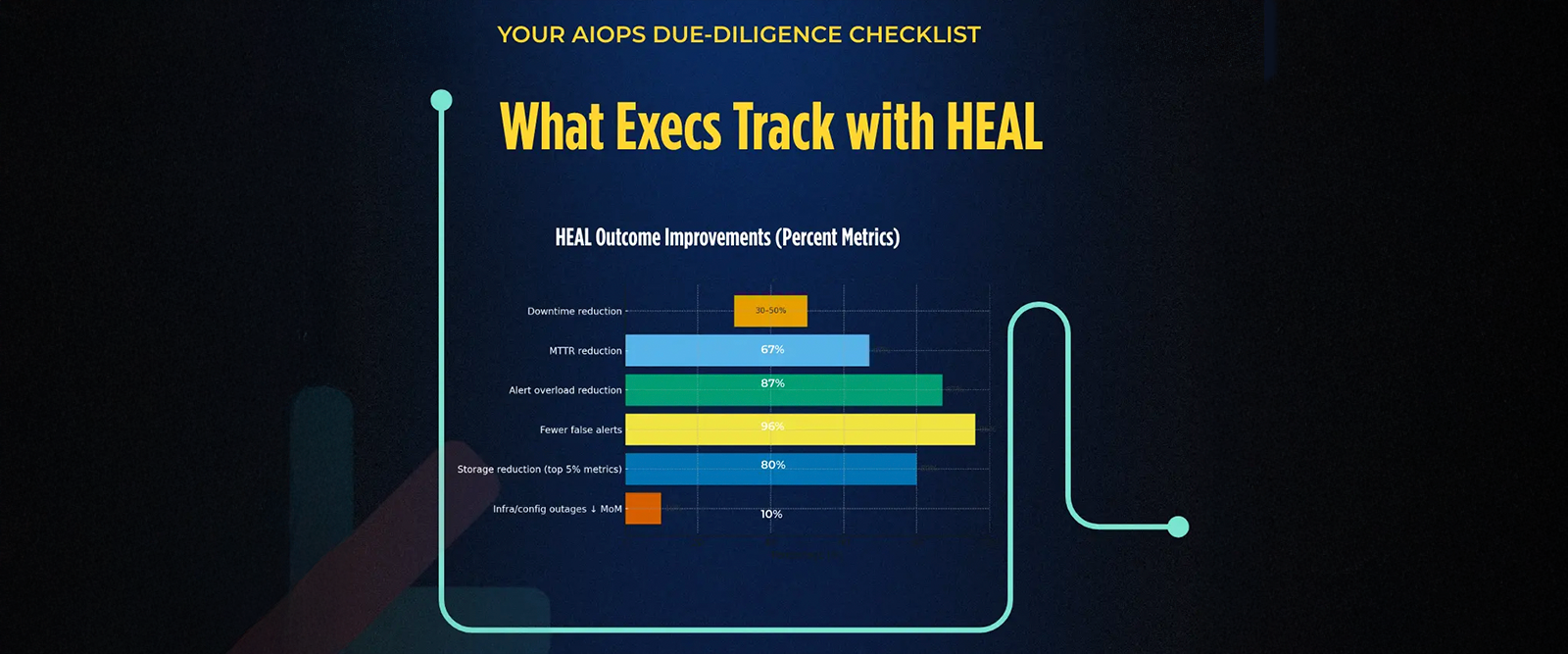
The business case for AIOps is no longer theoretical. Organisations that successfully adopt AIOps platforms report measurable returns: an average reduction in IT downtime of 30 to 50 percent and savings of 15 to 25 percent in overall IT operational costs. These outcomes are driven by the fundamental economics of intelligent automation — replacing hours of manual correlation, diagnosis, and remediation with AI-driven processes that operate at machine speed and machine consistency.
Several structural factors are accelerating adoption. The explosion of cloud-native architectures — microservices, Kubernetes, serverless computing — has created operational complexity that exceeds human-scale management capability. The growing regulatory burden — RBI operational resilience guidelines, DPDP compliance, CERT-In directives, SEBI mandates — demands audit-ready, continuously compliant operations that manual processes cannot sustain. And the persistent talent shortage in IT operations means that enterprises cannot simply hire their way out of the complexity challenge.
North America currently accounts for approximately 48 percent of the global AIOps market, reflecting the concentration of early adopters and large technology companies. However, APAC adoption is accelerating rapidly, driven by India’s unique combination of massive digital transaction volumes, sophisticated regulatory requirements, and a growing recognition among enterprise leaders that operational intelligence is not optional.
For Indian CIOs, the question is no longer whether to invest in AIOps but how to invest wisely — choosing platforms that deliver measurable ROI rather than adding another layer of complexity to an already complex technology landscape.
The Rise of the AIOps Copilot: GenAI Meets Operational Intelligence
The most significant recent development in AIOps is the integration of generative AI — not as a marketing feature, but as a practical tool that accelerates incident resolution and knowledge management.
Traditional AIOps platforms surface insights: ranked probable causes, correlated incidents, anomaly detections. But interpreting these insights still requires domain expertise. An engineer needs to understand the service topology, recall previous incidents, assess the remediation options, and make a decision. This interpretation step is where resolution speed bottlenecks in practice.
GenAI-powered copilots address this bottleneck by providing conversational access to operational intelligence. Instead of navigating dashboards and reading correlation reports, an engineer can ask natural language questions — ‘What changed in the last deployment?’, ‘What is the blast radius of this incident?’, ‘What fixed this issue last time?’ — and receive contextual, data-driven answers that draw on the full breadth of the AIOps platform’s intelligence.
iStreet Network’s solutions, powered by HEAL Software’s GenAI ‘Talk to Incidents’ copilot, anchor this conversational intelligence to specific outcomes: RCA acceleration, fix guidance, and impact assessment. The copilot is not a generic chatbot. It is an operational interface that understands your environment’s topology, your incident history, your remediation patterns, and your service dependencies — and uses that understanding to provide answers that are immediately actionable.
This represents a meaningful evolution in how operations teams interact with their intelligence platforms. Rather than requiring operators to extract insights from data, the copilot delivers insights proactively and contextually — reducing the cognitive load on engineers and enabling faster, more confident decision-making during high-pressure incidents.
Choosing Wisely: What Indian Enterprise Leaders Should Prioritise
For enterprise technology leaders evaluating AIOps investments, the consolidating market demands a disciplined approach. Five considerations should guide the evaluation process.
First, apply the five-point capability test rigorously. Verify that the platform delivers genuine cross-domain ingestion, topology assembly, correlation, causality determination, and remediation — not just AI labels on conventional monitoring.
Second, assess architectural coherence. Platforms assembled through acquisition carry integration risk and architectural inconsistency. Purpose-built platforms deliver more predictable deployment timelines and more consistent operational behaviour.
Third, evaluate India-specific compliance readiness. RBI operational resilience, DPDP, CERT-In, and sector-specific regulatory frameworks create unique requirements around audit trails, data sovereignty, and governance. The platform must support these requirements natively, not as afterthought configurations.
Fourth, demand measurable ROI evidence. The platform should demonstrate specific, quantifiable outcomes — MTTR reduction percentages, alert noise reduction ratios, capacity optimisation savings, downtime prevention metrics — from comparable enterprise deployments.
Fifth, consider the vendor’s strategic trajectory. In a consolidating market, the vendor’s independence, innovation roadmap, and commitment to the platform’s continued development are as important as the current feature set.
iStreet Network’s Resilient Operations portfolio — spanning AIOps and GenAIOps, Full-Stack Observability, Digital Experience Monitoring, and the Resiliency Operations Centre — is designed to meet all five criteria for India’s most demanding enterprise environments.
Talk to our advisors to evaluate how iStreet delivers measurable AIOps outcomes in your environment.
Originally inspired by insights from HEAL Software, an iStreet Network AIOps product. Learn more at healsoftware.ai.