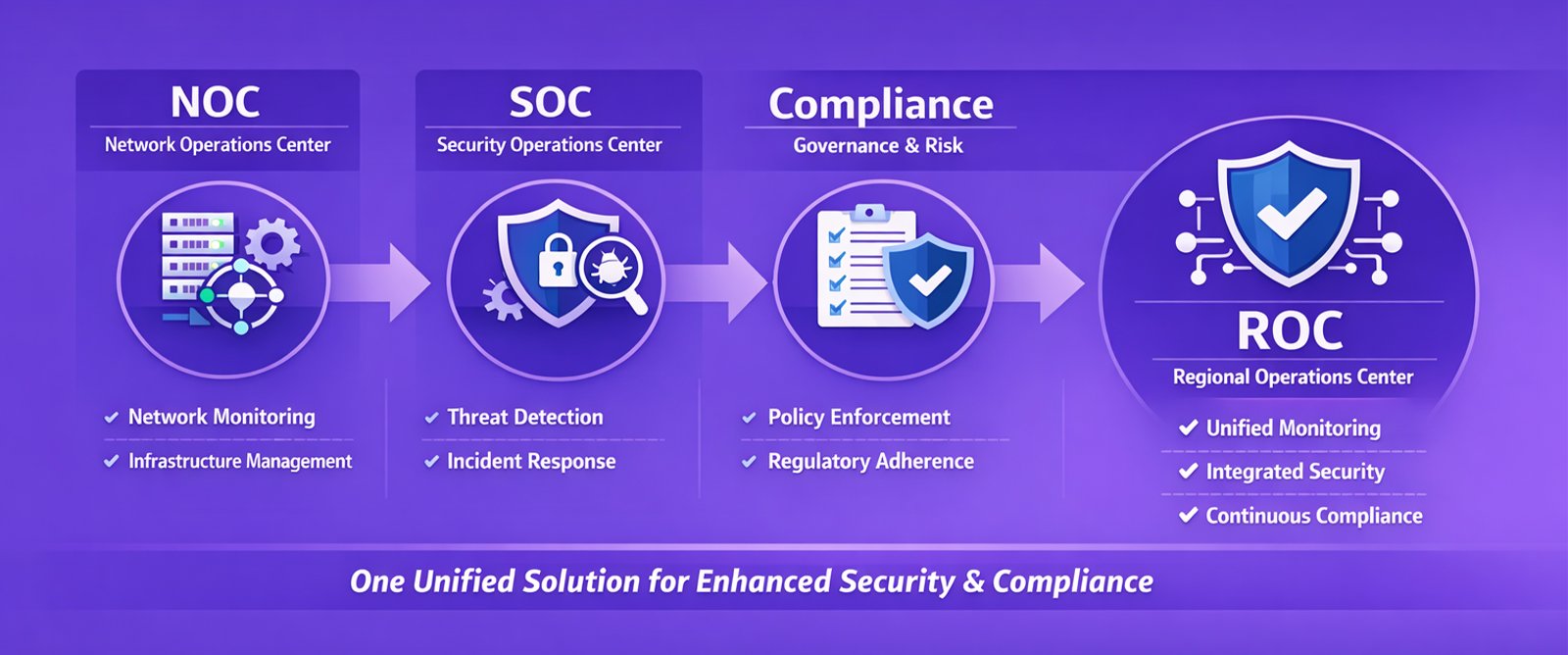
A NOC focuses on infrastructure and service health. A SOC focuses on cyber threats and security incidents. Compliance teams focus on controls, evidence and regulatory obligations. A Resilience Operations Center brings these perspectives together by correlating operational, security and compliance signals around the same business service, helping teams move from parallel investigations toward coordinated resilience.
NOC sees the latency spike. SOC sees the anomalous traffic. compliance team sees the audit deadline. Three teams. Three tools. Three tickets. Same root cause. Nobody knows.
This scenario plays out regularly in enterprises operating at scale. Not because the teams aren’t competent. Not because the tools aren’t sophisticated. But because the operating model that separates infrastructure operations, security operations, and compliance into three independent functions was designed when these functions operated with far less interdependence.
The operating environment has evolved. The operating model has not always kept pace
Why NOC, SOC and Compliance Were Built as Separate Functions
The NOC evolved around infrastructure environments that were more centralized, physical, and comparatively predictable. Servers largely operated within enterprise data centers. Applications were monolithic. When infrastructure components failed, response workflows were often more direct and contained. Incidents were often more contained, with dependencies easier to isolate, and NOC teams focused primarily on monitoring, detection, troubleshooting, and escalation. The NOC model was effective because infrastructure operations were more clearly bounded within its domain.
The SOC evolved when enterprise security placed greater emphasis on perimeter-based defense. Enterprise environments had more clearly defined internal and external network boundaries, protected through controls such as firewalls and VPNs. Many security architectures focus heavily on external threats, with controls designed to detect and restrict them at defined network boundaries. SOC analysts investigated anomalies, classified threats, and escalated confirmed risks. SOC teams often operated largely independently from infrastructure operations because security and infrastructure operations were managed as distinct operational disciplines.
Compliance existed as a periodic governance exercise. Regulations were fewer, audits were annual, and the evidence-gathering process while tedious was manageable because the environment was stable enough that a quarterly snapshot could reasonably represent reality.
Each function made sense in isolation. Each had its own tools, team, its own budget, its own leadership structure, and its own escalation path. And for decades, this model worked, not because it was optimal, but because the problems it addressed were simple enough to stay in their lanes.
The ROC does not replace the NOC or SOC. It creates a shared resilience layer across them so incidents can be understood in business context rather than handled as disconnected technical events.
Enterprises evaluating how NOC, SOC and ROC differ can refer to ROC vs NOC vs SOC: Understanding the Three Pillars of Enterprise Operations for a clearer view of how each function contributes to enterprise operations and resilience.
When Operational Boundaries Are Blurring
A compromised API credential is simultaneously a security breach, an operational outage, and a compliance violation. A misconfigured cloud load balancer is both an infrastructure issue and a security exposure. A container resource leak degrades application performance while creating the exact vulnerability pattern attackers exploit. A failed deployment triggers error spikes that your APM flags as a performance issue, your SIEM flags as anomalous behaviour, and your compliance platform doesn’t see at all until the next quarterly review.
Every serious incident your enterprise has dealt with in the last 12 months has probably crossed the boundary between at least two of these functions. And every time it did, the same pattern unfolded: parallel investigations, duplicated effort, delayed correlation, and a bridge call where the first 45 minutes were spent building context that should have existed.
This isn’t an occasional coordination failure. It’s the predictable, structural outcome of running three independent functions against problems that are inherently unified.
Convergence isn’t a choice. It already happened at the incident level. Your operating model just hasn’t acknowledged it yet.
Modern incidents rarely stay within one operational domain. A compromised API credential can create a security event, service disruption and compliance exposure at the same time. A cloud misconfiguration can affect availability while increasing attack surface. A failed deployment can generate performance anomalies, security alerts and control exceptions simultaneously.
What Convergence Actually Means
In a ROC model, convergence does not mean merging every team into one function. Convergence means building an operating model where operations, security, and compliance share the same data, the same correlation engine, the same console, and the same objective: detect, correlate, resolve, and stay compliant as one discipline.
This is what a Resiliency Operating Centre delivers.
Shared data, not shared meetings. Today, your NOC telemetry lives in one platform, your SOC events in another, your compliance data in a third. A ROC pulls all of its logs, metrics, traces, security events, compliance signals into a single centralized data lake through open-telemetry standards. When an incident occurs, every team works from the same dataset. The correlation isn’t manual. It’s automatic, AI-driven, and real-time.
Shared intelligence, not shared screenshots. When application latency spikes at the same time anomalous API traffic appears and a compliance control stop generating telemetry, ROC doesn’t present these as three unrelated alerts on three dashboards. The AI correlation engine connects them as one event, one incident, one timeline, one root cause, one blast radius, one business impact score. The bridge call where six people share screenshots to build the picture becomes unnecessary because the picture is already assembled.
Shared resolution, not shared escalation. Every tool in the market today stops at detection and diagnosis. NOC detects infrastructure issues and escalates. The SOC investigates threats and escalates complex cases. Compliance tracks posture and escalates violations. Everyone escalates. Nobody resolves. A ROC closes the loop. Every incident your team resolves, root cause, fix, outcome feeds into an AI-driven knowledge base. When a similar pattern reappears, the platform surfaces the resolution. The expertise that used to depend on one senior engineer being awake now lives on the platform and scales across every shift.
Shared Governance: Shared governance means incident decisions, control exceptions, remediation actions and evidence remain traceable across the incident lifecycle. This gives technical teams operational freedom while giving risk and compliance teams continuous visibility into what changed, why it changed and how it was resolved.
Why No Single Function Can Solve This Alone
The reason this convergence has not happened organically is that each function, by design, operates primarily within its own domain context.
NOC sees infrastructure health but is blind to security context. When CPU spikes on a server, the NOC investigates resource utilization. It can’t see that the spike is caused by a crypto mining payload that your SOC would recognize in seconds if they were looking at the same data. NOC treats it as a capacity issue. The SOC doesn’t know about it at all. The resolution takes hours instead of minutes because the two teams are solving different halves of the same puzzle without knowing the other half exists.
SOC sees threats but is blind to operational impact. When anomalous traffic hits your API gateway, the SOC classifies, investigates, and prioritizes, based on threat severity. But it doesn’t know that this specific API gateway serves your payment processing pipeline, that 12,000 transactions per hour flow through it, or that the operational team is simultaneously investigating a performance degradation on the same service. The SOC reports a “high-severity threat” while the business is losing revenue every minute and the connection between the two is invisible until someone manually pieces it together.
In banking and financial services, the ROC model becomes especially important because operational continuity, cyber risk and compliance are tightly interconnected. This is explored further in Resilience Operations Center for Banks and Finance Sector.
Compliance Functions May Lack Continuous Operational and Security Context
Compliance checks happen periodically, quarterly reviews, annual audits, scheduled assessments. Between those checkpoints, your compliance posture is unknown. A firewall rule change that violates your security policy. Your compliance team discovered it during the quarterly review three months later. A control stops generating telemetry. Nobody notices until the auditor flags it. The gap between what your compliance team knows and what’s actually happening in production is measured in weeks and months, not minutes. ROC does continuous compliance monitoring.
Each function has sophisticated tools, and each team brings specialized expertise. But when incidents span multiple operational domains, teams may still lack the shared context needed to understand the full impact, coordinate effectively, and accelerate resolution. These cross-domain incidents can create greater operational, financial, and leadership impact.
Convergence is the only model that gives every function full context.
Business Case for Convergence
Increased resolution time. When the time 45 minutes to 3 hours currently spent gathering context from different teams and tools, MTTR doesn’t improve by 10%. It affects the business. Audit preparation that consumed weeks becomes a report generated on demand in minutes. The time your engineers spent on coordination bridge calls, screenshot sharing, cross-referencing timestamps, is the time spent on resolution with ROC.
Dependence on individual expertise is reduced. The converged model captures institutional knowledge into the platform systematically. Relevant resolution patterns can be captured and made accessible across engineering teams. This helps transform knowledge that once depended on individual experience into reusable organisational knowledge.
Compliance shifts from periodic scramble to continuous state. When compliance data lives alongside operational and security telemetry in the same platform, compliance monitoring becomes continuous and automatic. Violations are detected the moment they occur. Evidence is always real-time. Audit preparation that consumed weeks becomes a report generated on demand in minutes. The compliance team stops scrambling and starts governing.
Leadership gets a unified risk view. Instead of receiving fragmented reports from three different functions, each using different metrics, different severity scales, and different definitions of impact, your CxO team gets one dashboard that shows operational health, security posture, and compliance status in real time, mapped to business services and financial impact.
The Shift Towards Converged Resilience Is Already Underway
The enterprises that are adopting the ROC model today aren’t doing it because a vendor told them to. They’re doing it because their incidents forced the conversation.
After repeated P1 incidents where NOC and SOC teams discovered during investigation that they were examining related symptoms of the same underlying issue, the question becomes: “Why isn’t this context connected earlier?” After recurring audit findings reveal control gaps that remained unidentified between reviews, another question emerges: “How can this be monitored more continuously?” And when the departure of an experienced engineer exposes dependence on individual institutional knowledge, the question becomes: “Why should resolution capability depend so heavily on one person?”
The answers to all three questions point to the same structural problem: three functions operating independently against problems that are inherently unified. And the answer to that structural problem is convergence into a Resiliency Operating Centre.
The ROC Operating Model
- Observe: ingest operational, security, application and compliance signals.
- Correlate: connect related events across services and domains.
- Prioritise: evaluate service impact, security risk and control implications.
- Coordinate: guide investigation and response across NOC, SOC and compliance teams.
- Govern: maintain approvals, evidence, accountability and post-incident learning.
What Convergence Looks Like In Practice
Convergence is phased, practical, and delivers value incrementally.
Phase 1: Unify the data. Integrate existing NOC, SOC, APM, and compliance tools into a centralized data lake through open-telemetry standards. The ROC starts ingesting their data and building the unified correlation layer on top. This alone having all telemetry in one place changes how your teams investigate incidents from day one.
Phase 2: Unify the intelligence. Deploy AI-driven correlation across the unified dataset. Events from infrastructure, security, application performance, and compliance are correlated automatically. 500 alerts to 3 incidents. Root cause surfaces in minutes. Business impact is mapped in real time. Your teams start working from one console instead of five dashboards.
Phase 3: Unify the resolution. Activate resolution intelligence using Generative AI to capture relevant incident and resolution context, and surface recommended actions when similar patterns reappear. Continuous compliance monitoring can support ongoing control visibility, while automated evidence collection strengthens audit readiness. As these capabilities mature, the ROC becomes a unified intelligence and coordination layer for enterprise resilience.
Phase 4: Scale. Expand across group companies, geographies, and business units. The AI gets smarter with every incident. The knowledge base compounds. The operational maturity accelerates. Each phase builds on the last, and ROI is measurable from the first quarter.
What Enterprises Gain from a ROC
- Unified incident context
- Faster cross-team coordination
- Better service-impact prioritisation
- More continuous compliance visibility
- Reusable incident and resolution knowledge
The Strategic Case for Converged Resilience
NOC, SOC and compliance overlap now. Every incident. Every audit finding traces back to an operational issue that had security implications that nobody connected to because the data lived in three different platforms monitored by three different teams.
The ROC is not an incremental improvement to this model. A single operating model where operations, security, and compliance share the same data, the same intelligence, the same console, and the same mission: enterprise resilience.
The convergence is already happening at the incident level. Your teams are already dealing with cross-domain problems. They’re just doing it manually, slowly, and expensively, because the operating model forces them to.
Operational, security and compliance risks increasingly converge around the same business services. The challenge is that enterprise operating models often still manage those risks through separate tools, teams and workflows.
A Resilience Operations Center creates a shared intelligence and coordination layer across those functions. It does not remove specialist teams; it gives them a common operating context for understanding impact, prioritising response and maintaining governance.
The result is a resilience model designed around the incident itself rather than the organisational silos surrounding it.
NOC + SOC + Compliance = ROC.
Math is simple. The only question is how many more bridge calls, how many more audit scrambles, and how many more hours of wasted MTTR your enterprise absorbs before the convergence becomes official.
About iStreet Network
iStreet Network’s Resilience Operations Center approach brings together AIOps, AI-Native SecOps, observability and compliance context within a unified enterprise resilience layer. Through the Sanjeevani of AI™ framework, operational, security and governance signals can be correlated around business services, helping teams move from isolated monitoring toward coordinated, governed resilience.