Enterprise operations increasingly depend on three specialized but interconnected functions. Understanding the roles of the Resiliency Operations Center (ROC), Network Operations Center (NOC), and Security Operations Center (SOC) and how they work together is important for building a resilient operating model.
As enterprise technology environments have become more distributed and complex, operational responsibilities have also become more specialized. Functions once managed by a single operations team are now distributed across centers focused on infrastructure performance, cybersecurity, and cross-domain resilience: the NOC, SOC, and ROC.
Yet despite this specialisation, many enterprise leaders struggle to clearly articulate the boundaries between these functions, understand how they should interact, and determine how to invest across them effectively. The result is often duplication of effort, gaps in coverage, and organisational friction that slows incident response precisely when speed matters most.
This guide provides a comprehensive breakdown of the ROC, NOC, and SOC: their distinct missions, capabilities, team structures, and tooling requirements. More importantly, it examines how these three pillars must integrate to deliver truly effective enterprise operations.
What Each Operations Centre Does
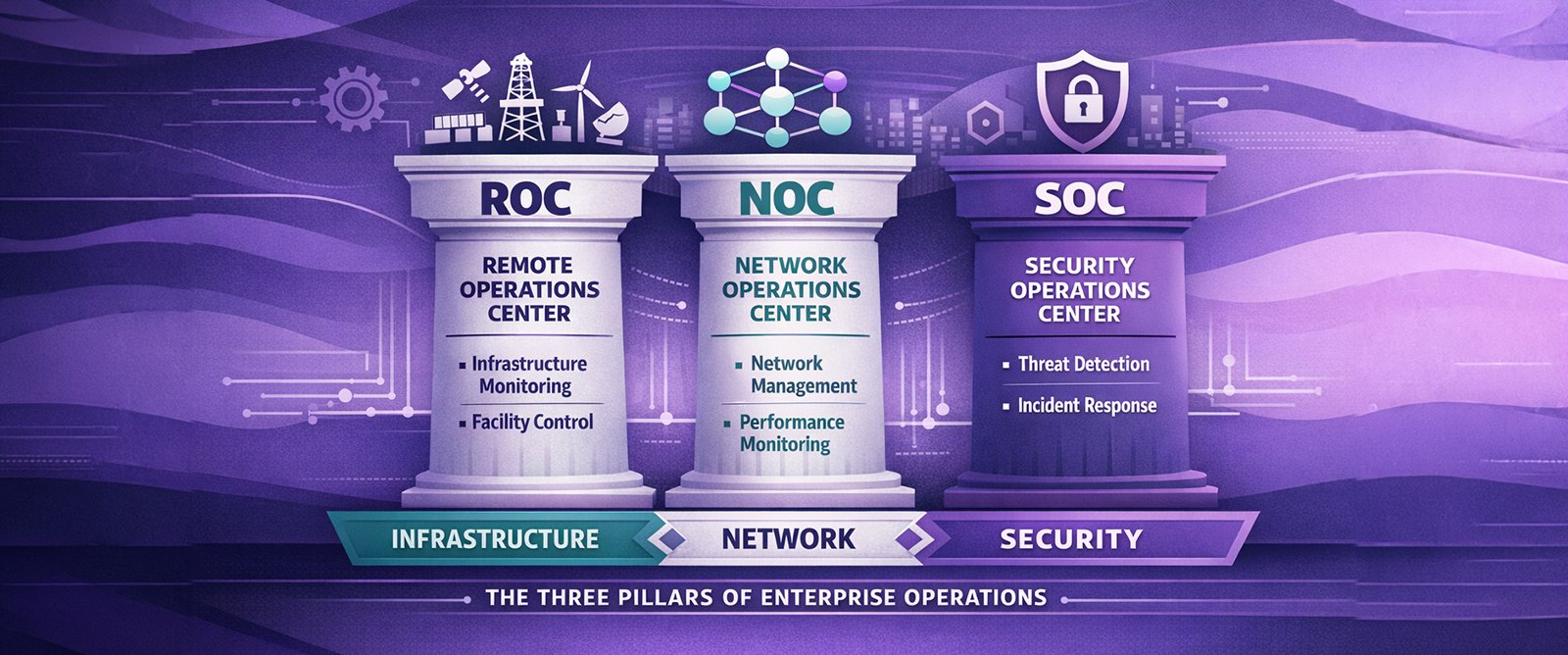
The NOC focuses on infrastructure availability and performance, monitoring networks, servers, cloud environments, databases, and other technology components to keep services stable and operational. The SOC focuses on cybersecurity, detecting, investigating, and responding to threats that could compromise enterprise systems, data, or users. The ROC connects operational and security intelligence across NOC and SOC environments, helping teams correlate cross-domain events, understand business impact, prioritise incidents, and coordinate remediation to strengthen overall enterprise resilience.
Core Capabilities of ROC
- Cross-domain correlation of operational and security events
- Business-impact and service-dependency analysis
- AI-assisted incident prioritisation
- Root-cause and blast-radius analysis
- Governed remediation and workflow orchestration
- Coordinated response across NOC, SOC, and enterprise teams
Typical Team Structure
The NOC team is usually led by an infrastructure or operations leader responsible for service availability, performance, incident response, and coordination across technology teams.
The SOC is typically led by a security operations leader responsible for threat detection, investigation, incident response, and coordination with cybersecurity, IT, risk, and compliance teams.
ROC teams combine deep expertise in AI and data engineering with strong operational backgrounds across both infrastructure and security domains. The team includes data engineers responsible for maintaining the operational data lake and ingestion pipelines, AI/ML engineers who build and refine the correlation and resolution models, and senior operations specialists who validate AI-generated insights and manage complex multi-domain incidents.
Key Differences: ROC vs NOC vs SOC
While all three centers contribute to enterprise resilience, they operate with different priorities, data, and responsibilities.
- The NOC asks: “Is the infrastructure healthy and performing within acceptable parameters?” Its focus is infrastructure health, availability, latency, capacity, and service performance. Relevant measures can include availability, service-level attainment, and recovery time for infrastructure incidents.
- The SOC asks: “Is the organisation protected against security threats?” Its focus is threat detection, investigation, containment, and response. Relevant measures can include detection coverage, investigation time, response time, and security-incident outcomes.
- The ROC asks: “What is the full picture across infrastructure and security, and how do we resolve it?” Its focus is cross-domain resilience. By bringing operational and security context together, the ROC helps teams correlate events, understand business impact, prioritize response, and coordinate remediation across NOC and SOC boundaries.
Why Integration Matters More Than Separation
The NOC, SOC, and ROC should not operate in isolation. Incidents can cross operational and security boundaries. A cybersecurity event may affect service availability, while an infrastructure change or outage may generate security signals or create additional exposure. When teams work with disconnected data and workflows, understanding the complete incident can take longer.
This is where the ROC provides its core value. By bringing NOC and SOC telemetry into a shared operational context and applying AI-assisted correlation, the ROC helps teams identify relationships across infrastructure and security events, assess their combined impact, and coordinate response across domains.
Building Your Operations Centre Strategy
Not every organization needs to establish all three centers at the same stage of operational maturity. The appropriate model depends on factors such as enterprise size, technology complexity, industry, risk profile, regulatory environment, and existing operational capabilities.
For most enterprises, the NOC is the foundational layer. It provides the core operational capability upon which SOC and ROC functions can be built. The SOC is typically the second priority, driven by the increasing prevalence and sophistication of cyber threats and the regulatory requirements that mandate security monitoring capabilities.
The ROC provides a convergence layer between these functions. Organizations that already operate NOC and SOC capabilities but continue to experience fragmented data, duplicated investigations, or delays during cross-domain incidents can use the ROC to create shared context and coordinated response. Its role is not to replace the NOC or SOC, but to connect their intelligence where operational and security risks intersect.
Common Anti-Patterns in Operations Centre Design
As enterprises build and evolve their operations centres, several anti-patterns frequently emerge that undermine effectiveness. Recognising and avoiding these patterns is as important as understanding the ideal structure.
The first is treating operations centers only as cost centers. When organizations focus primarily on reducing operational expenditure, investment in skills, integration, automation, and process maturity can fall behind the complexity of the environment. This can keep teams focused on reactive incident handling rather than on improving resilience and operational efficiency.
The second is operating NOC and SOC functions with disconnected data, tools, and incident processes. When teams lack shared context, cross-domain incidents require additional coordination and manual investigation. The ROC is designed to address this gap by connecting operational and security intelligence, enabling teams to understand the broader incident context and coordinate responses more effectively.
The third is combining NOC, SOC, and ROC responsibilities into one undifferentiated operations function. Convergence does not mean removing domain specialization. Infrastructure operations, cybersecurity, and cross-domain resilience require different skills, tools, responsibilities, and decision-making models.
When these responsibilities are combined without clear operating boundaries, teams may lose focus, specialist capabilities may be diluted, and complex incidents may be more difficult to coordinate. The objective should therefore be integration across specialized functions, not the elimination of specialization.
The Future: Converged Operations with Specialised Functions
A stronger enterprise operating model connects specialized NOC and SOC functions through a shared resilience layer. In this model, the NOC retains its focus on infrastructure availability and performance, while the SOC retains its focus on threat detection and response. The ROC connects these perspectives when incidents span both domains, helping teams understand dependencies, assess business impact, and coordinate remediation using shared operational intelligence.
For enterprises operating complex, interconnected environments, this convergence can reduce fragmented investigations and improve coordination across operations and security teams. The objective is not to replace established NOC and SOC capabilities, but to connect them through a more resilient and intelligence-led operating model.
iStreet Network’s Resiliency Operations Center brings this convergence through the Sanjeevani of AI™ framework, connecting operational and security intelligence to help enterprises correlate cross-domain events, understand their impact, and coordinate governed remediation across NOC and SOC environments.