The transition to SIEM++ is not a simple software upgrade; it is a fundamental shift from a log-centric compliance model to an AI-driven, autonomous security operations center (SOC). As legacy architectures fracture under the weight of cloud-scale telemetry, the ‘++’ represents the convergence of security data lakes, the open schema framework, and agentic AI.
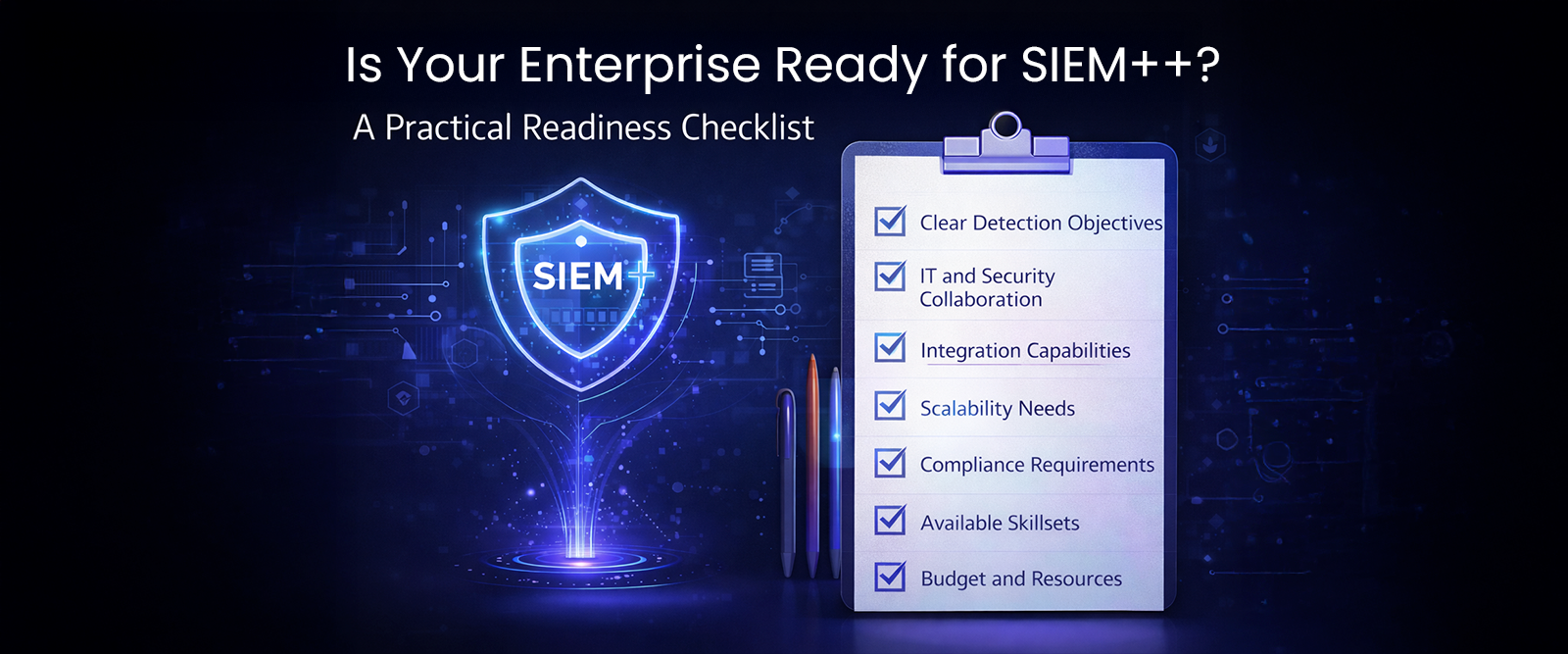
To determine if your organisation is prepared for this evolution, evaluate your maturity against this practical readiness checklist.
- Data architecture beyond centralised ingestion
Traditional SIEMs fail because of ‘ingestion-based’ pricing and performance bottlenecks. SIEM++ requires a decoupled architecture that separates storage from compute.
- Decoupled Data Lake: Is your data stored in a low-cost, open-format (e.g., Parquet) environment rather than a proprietary, index-heavy database?
- OSF normalisation layer: Are your logs normalised at the source or in-stream. using the open schema framework / normalisation layer, agentic aI have you ensure ‘write once, query anywhere’ detection logic?
- Federated Search Capability: Can your analysts query data where it resides (cloud buckets, SaaS logs) without moving petabytes of telemetry into a central repository?
- Security Data Pipelines (SDPP): Do you have the infrastructure to filter, deduplicate, and enrich logs before they hit your storage layer?
- Intelligence & automation from rules to agents
Legacy systems rely on static correlation rules that require constant manual tuning. SIEM++ leverages AI as an active participant in investigations.
- Agentic AI Preparedness: Is your security data ‘agent-ready’ (formatted for Model Context Protocol) to allow autonomous AI agents to plan and execute investigations?
- Behavioral Baselines (UEBA): Have you established machine-learning-driven baselines for user and entity behavior to detect ‘living-off-the-land’ attacks that bypass static rules?
- Autonomous Playbooks: Do your SOAR playbooks operate with ‘human-on-the-loop’ oversight, allowing AI to handle 90% of Tier-1 triage tasks?
- High-Fidelity Triage: Can your system reduce false positives by 95-99% through AI-driven environmental context?
- Human capital- the workforce skill shift
The resurrection of SIEM changes the job description of a security analyst.
- Prompt Engineering Proficiency: Is your team trained to use natural language to search data, generate detections, and interact with AI assistants?
- Strategy-First Mindset: Has your SOC shifted from a ‘queue of alerts’ model to a proactive threat modelling approach where humans focus on strategic risk?
- Cross-Functional Collaboration: Are your analysts capable of collaborating with DevOps and IT to understand system behaviors for refined AI training?
- Strategic & economic readiness
SIEM++ must be a strategic asset, not just a cost center.
- Defined ROI Metrics: Are you measuring Mean Time to Investigate (MTTI) and Mean Time to Respond (MTTR)? SIEM++ should target a 50-65% reduction in these metrics.
- TCO Visibility: Have you modelled the 40-60% cost savings associated with decoupled storage and automated triage?
- Executive Alignment: Does leadership view the SOC as an intelligent system focused on ‘Breach Risk Reduction’ rather than just ‘Log Retention’?
The bottom line
If you are still spending more time tuning rules than investigating threats, your enterprise is likely stuck in the legacy SIEM era. SIEM++ readiness is defined by the ability to ingest petabytes of data, normalise it through osf, and defend at machine speed using agentic AI.
If you are interested to know more, we would be happy to help