India’s digital enterprises are scaling faster than ever, from UPI-powered fintech to cloud-native BFSI platforms to mission-critical healthcare systems. Yet beneath the surface, most IT operations teams are still trapped in a decades-old paradigm: wait for something to break, then scramble to fix it.
This reactive model was tolerable when systems were simpler. Today, with distributed applications running across hybrid cloud, on-premise, and edge environments and with regulatory mandates like DPDP and regulatory bodies compliance adding layers of complexity, the break-and-fix approach is no longer just inefficient. It’s a strategic risk.
At iStreet Network, we believe the future belongs to enterprises that predict failure, prevent disruption, and recover automatically. Here’s why and how the shift is already underway. For Indian enterprises, this shift is central to building resilient IT operations across increasingly complex digital environments.
The Break-and-Fix Model: A Legacy Liability
In the traditional break-and-fix model, IT teams rely on static thresholds, fault alarms, and reactive tooling. The typical workflow looks like this: a customer encounters a service disruption, a crashed payment gateway, a failed booking form, a frozen dashboard, and then IT is alerted. By the time the team triages the problem, the damage is already done — revenue lost, eroded trust, and a compliance exposure that grows by the minute.
The underlying challenge is complexity. Modern enterprise IT stacks are a web of distributed microservices, APIs, databases, and infrastructure layers running across multiple environments. Finding the root cause of an incident in this landscape is, as practitioners often say, like finding a needle in a haystack.
The default response? Over-provision resources, maintain excess capacity for redundancy, and assign expensive engineering teams to firefighting duty. This approach is capital-intensive, operationally draining, and fundamentally unsustainable for enterprises looking to scale efficiently in a regulated market like India. This is the limitation of traditional monitoring: it reacts to symptoms after impact instead of connecting signals early enough to support proactive intervention. In distributed environments, automated root-cause analysis can help narrow the probable fault domain across applications, databases, infrastructure and networks.
The Predict-and-Prevent Model: Resiliency by Design
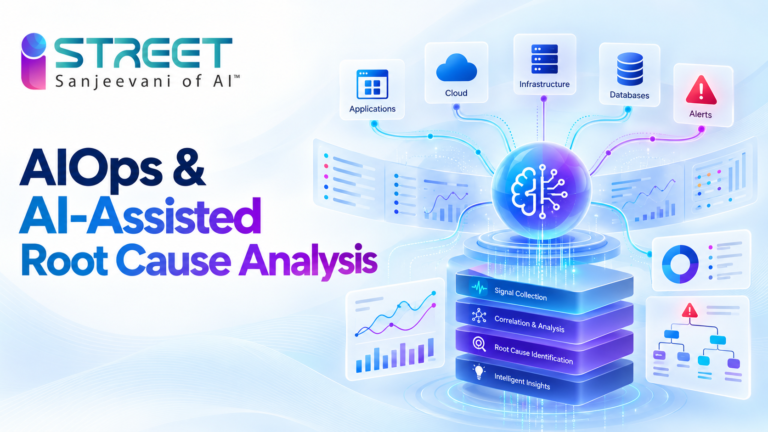
The predict-and-prevent model represents a paradigm shift, from risk mitigation to risk elimination” with “from reactive risk response toward earlier detection and proactive risk reduction. Instead of reacting to outages, Observability provides the telemetry foundation, while AIOps applies correlation, behavioural analysis and probable root-cause intelligence to that data. AIOps anomaly detection uses behavioural baselines and event correlation to identify emerging issues before they become larger incidents. AIOps event correlation helps connect related alerts, anomalies and changes into a common incident context.
This is not a theoretical future.
For end users, the experience is seamless, with fewer disruptions, faster performance, and the kind of digital reliability that builds loyalty.
For IT teams, the transformation is liberating. Instead of sifting through an avalanche of alerts and alarms, operations teams can focus on innovation, service optimisation, and strategic initiatives. The AI handles the noise.
For business leaders, predictive systems unlock a forward-looking view of infrastructure health. By analysing growth data and modelling future states, enterprises can forecast capacity bottlenecks, optimise resource deployment, and reduce both capital and operating expenditure all while maintaining compliance posture.
Why This Matters for India’s Regulated Sectors
For BFSI and other regulated sectors, operational resilience depends on detecting degradation early, maintaining service continuity and preserving traceable incident context. Where security incidents affect service continuity, this model also supports broader cyber resilience across BFSI environments.
The predict-and-prevent model aligns naturally with the governance- first philosophy the pillar of iStreet’s framework built for exactly this: continuous, provable compliance instead of a quarterly scramble.
This is what we mean when we talk about moving from reactive operations to self-stabilising, resilient enterprises.
The iStreet Advantage: AI-Native Resilient Operations
iStreet Network’s Sovereign AI Enterprise Platform, built on the Sanjeevani of AI™ framework, enables this shift through its ROC solution. Through its HEAL AIOps capabilities, iStreet brings together automated root cause analysis, predictive anomaly detection, capacity intelligence, event correlation, and AI-driven resolution recommendations. Together, these capabilities help enterprises move from reactive incident management towards predictive, intelligent, and resilient operations—identifying emerging risks earlier, accelerating resolution, and reducing the impact of service disruptions. Enterprise AIOps provides the intelligence layer for this transition by combining event correlation, anomaly detection, probable root-cause analysis, capacity intelligence and guided resolution. By reducing manual correlation and investigation effort, these capabilities can help reduce MTTR and improve consistency in incident response.
This is resilience by design. This is the future iStreet is building.
Ready to move from break-and-fix to predict-and-prevent? Talk to our advisors to explore about how iStreet’s Resilient Operations and Sanjeevani of AI™ framework of modernize, secure, operate and governance can transform your enterprise.
Originally inspired by insights from HEAL Software, an iStreet Network AIOps product.