The Days of Simple Cause-and-Effect Are Over
For those of us managing enterprise IT infrastructure in India’s rapidly evolving digital landscape, the days of simple cause-and-effect relationships are long gone. A performance dip in one application might destabilise interconnected microservices across the entire service mesh. Alerts flood in from a dozen monitoring tools. Logs pile up by the millions. And even the most sophisticated monitoring dashboards often leave IT leaders asking the one question that matters most: where do we even begin?
This is the reality for CIOs, CTOs, IT Infrastructure Heads, and Application Heads tasked with ensuring system reliability in an environment that grows more complex by the day. Banks processing millions of UPI transactions. Healthcare platforms managing patient data under DPDP compliance. Government digital services serving hundreds of millions of citizens. E-commerce platforms that must be flawless during festive season traffic. The stakes are high, the systems are intricate, and the margin for error is vanishingly small.
While we have come far with observability and AIOps, it is time to acknowledge a truth that many enterprise leaders are discovering: these tools, while indispensable, can only take us so far. The next step — the one that bridges the gap between insights and action — is Generative AI. This is not just another step in IT evolution. It is a transformation that changes how leaders make decisions, allocate resources, and guide their teams through crises.
When Visibility Is Not Enough
Think about the last major incident you managed. The first alert likely came from your observability stack. A latency spike, a failed API call, maybe a resource saturation warning. The dashboards lit up. Your team was thrust into action. But alerts do not solve problems — they highlight them.
In a complex, distributed environment, knowing something is wrong is just the starting point. The real challenge lies in navigating the interconnected layers of infrastructure and application dependencies to identify not only where the problem is but why it is happening. Observability platforms give us the ‘what.’ AIOps provides the ‘where.’ Yet too often, the ‘why’ remains a puzzle until hours — and sometimes days — of manual effort have passed.
For leaders responsible for IT strategy in Indian enterprises, this gap is not just frustrating. It is unacceptable. In a world where downtime can mean crores in losses, SLA penalties, regulatory scrutiny, and customer attrition, ‘figuring it out later’ is a luxury no enterprise can afford.
Observability: The Foundation, but Not the Solution
Observability tools have come a long way in helping us manage complexity. They gather telemetry data — logs, metrics, traces — and transform it into meaningful visualisations. When a system anomaly occurs, they alert us immediately, often before the end user notices.
When these tools first entered the enterprise landscape, they felt revolutionary. But as systems became more distributed, as microservices replaced monoliths, and as the volume of data exploded, their limitations became evident. Observability tells us what is happening. It stops short of telling us why.
Consider a sudden spike in response times. The observability platform flags the issue, showing that latency has increased in a specific API. But is the root cause a database bottleneck? A sudden traffic surge? A misconfigured service? A network issue? A deployment regression? Observability alone leaves you guessing. And as leaders, we know that guessing is not strategy.
AIOps: Bridging Gaps, but Not Completely
AIOps platforms promised to revolutionise IT operations by automating analysis and correlation. And in many ways, they have delivered. AIOps identifies patterns in telemetry data, correlates events across services, and often pinpoints where the issue lies.
Revisiting the response time example: AIOps might correlate the latency spike with a recent code deployment or a surge in database queries. This intelligence saves teams hours of manual analysis. It is a genuine and meaningful advancement.
But even AIOps falls short when it comes to context and causality. It excels at pattern recognition and anomaly detection. But it often cannot explain why the anomaly occurred. It can tell you that a database is slow. It cannot tell you that the database is slow because a newly deployed API is executing unoptimised queries that were introduced in last night’s release, and that this specific pattern matches a similar incident three months ago that was resolved by rolling back the deployment and indexing two specific tables.
That depth of contextual understanding — combining current telemetry with historical patterns, deployment data, configuration changes, and institutional knowledge — is where Generative AI enters the conversation.
Generative AI: Moving from Insight to Action
Generative AI does not just analyse data. It synthesises it, contextualises it, and transforms it into actionable intelligence. It is the missing piece in the observability-to-AIOps continuum — the capability that bridges the gap between identifying problems and reasoning about them.
Where observability highlights the anomaly and AIOps traces it to a specific microservice, Generative AI goes deeper. It analyses deployment logs, configuration changes, and historical performance trends to identify that the issue was caused by a newly deployed API consuming excessive database resources. More importantly, it does not just identify the cause. It provides potential solutions — rolling back the deployment, optimising database queries, adjusting resource allocation — and predicts their impact on the system.
This is not just automation. It is augmentation. Generative AI works alongside your team, empowering them to make informed decisions faster and with greater confidence. This means fewer late-night escalation calls, faster time to resolution, and a more resilient IT operation.
How Observability, AIOps, and Generative AI Work Together
These technologies are not competing for dominance. They are components of a larger ecosystem that iStreet Network has architected to work in concert.
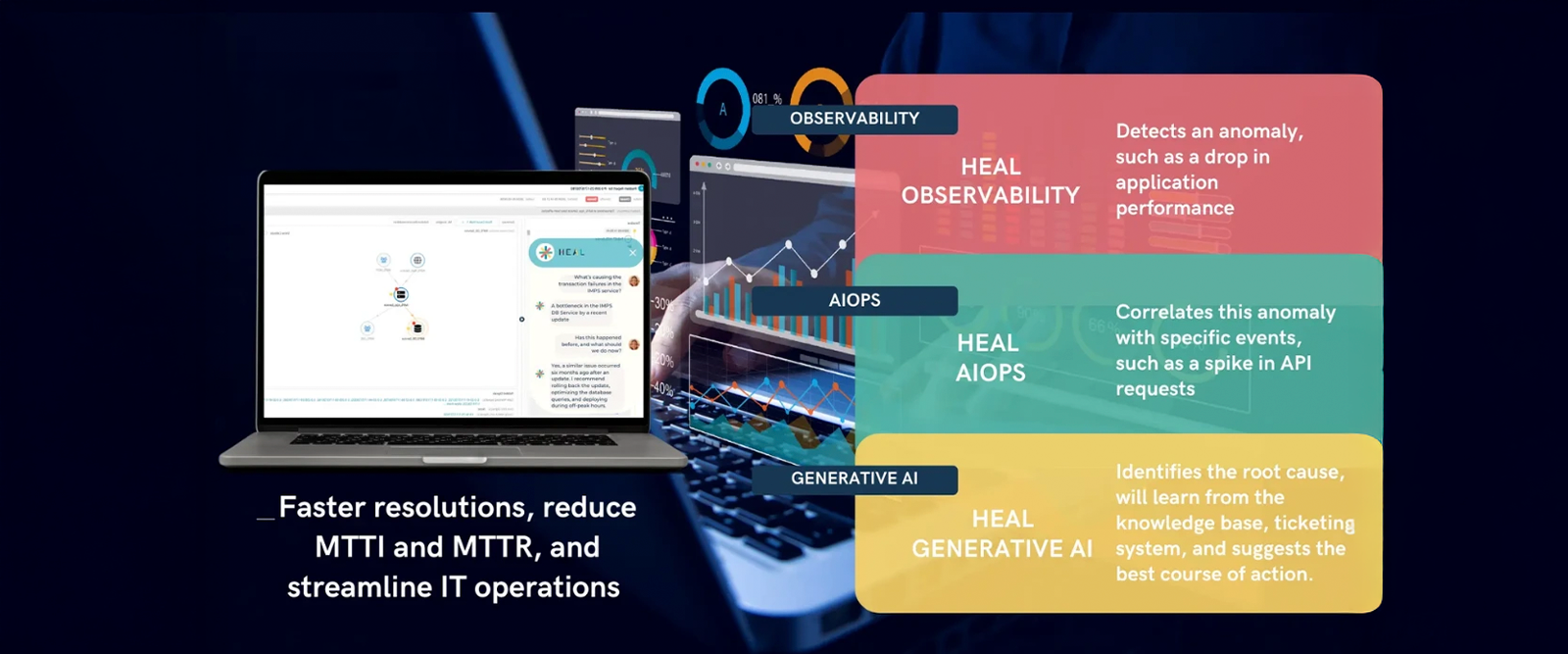
Observability provides the raw data and initial alerts — the comprehensive visibility that forms the foundation. AIOps refines this data, identifying patterns, correlating events, and locating the issue within the service topology. Generative AI closes the loop, offering contextual insights and actionable solutions — drawing on historical incidents, knowledge bases, ticketing systems, and operational runbooks to provide guidance that is specific to your environment and your situation.
Together, they create a workflow that is greater than the sum of its parts. Observability detects an anomaly — a drop in application performance. AIOps correlates this anomaly with specific events — a spike in API requests correlated with a recent deployment. Generative AI identifies the root cause, draws on institutional knowledge, and suggests the best course of action — with confidence levels and predicted impact. The result: faster resolutions, fewer escalations, and a more proactive approach to IT management.
The Market Imperative: What Industry Analysts Are Saying
Market analysts reinforce this trajectory. By 2026, the majority of IT operations teams in large enterprises are expected to rely on AIOps platforms for critical decision-making. The growing adoption of generative AI in observability is increasingly viewed as a strategic differentiator — not a technology experiment.
The numbers confirm the business case. Companies that adopt the convergence of observability, AIOps, and generative AI report significantly lower Mean Time to Detect and Mean Time to Resolve. This translates directly to reduced downtime, better customer experiences, fewer SLA penalties, and stronger compliance posture. For Indian enterprise leaders driving IT strategy, this convergence is not a trend to watch. It is a mandate to act on.
iStreet’s GenAIOps: Conversational Intelligence Anchored to Outcomes
iStreet Network’s GenAIOps solutions embody this convergence. The platform’s GenAI copilot acts as a conversational interface to the entire operational intelligence stack. It does not merely summarise logs or translate metrics into natural language. It narrates incidents with context, impact, confidence levels, and remediation memory.
When something breaks, an engineer can ask: ‘Why is the transaction service experiencing latency?’ The copilot does not return a dashboard screenshot. It provides a contextual narrative: the service began degrading after a specific deployment, the pattern matches a previous incident, the most likely root cause is a configuration change in the upstream cache layer, and the recommended fix — based on the resolution that worked last time — is to revert the cache configuration and redeploy during the next maintenance window.
This is operational intelligence that meets engineers where they are — in the middle of a high-pressure incident — and gives them the context and confidence to act decisively.
Leading Through Transformation
The journey from observability to generative AI is not just about adopting new tools. It is about transforming how enterprise leaders approach IT operations. These technologies give us the visibility, intelligence, and actionability we need to navigate complexity with confidence. But their true value lies in the space they create for leaders and teams to focus on what matters: enabling growth, fostering innovation, and delivering value to the organisation.
iStreet Network is building this future for India’s most demanding enterprises. From Full-Stack Observability to AIOps and GenAIOps to the Resiliency Operations Centre, we provide the unified architecture that transforms IT operations from a reactive cost centre into a strategic competitive advantage.
Talk to our advisors to explore how this journey can begin in your organisation.
Originally inspired by insights from HEAL Software, an iStreet Network AIOps product.