The Journey That Defines Modern IT Operations
Every enterprise that operates mission-critical digital infrastructure faces the same fundamental journey. It begins with the recognition that systems are too complex for manual management. It progresses through the adoption of monitoring and observability tools. It encounters the limitations of visibility without intelligence. And it arrives — if the enterprise is forward-looking — at the integration of AI-driven operations that transform how incidents are detected, diagnosed, and resolved.
This is not a theoretical progression. It is the lived experience of hundreds of Indian enterprises that iStreet Network works with across BFSI, healthcare, government, and technology sectors. And it reflects the unified approach that iStreet has built through its Resilient Operations portfolio — an approach that addresses every stage of the IT operations maturity journey, from foundational visibility to autonomous self-healing.
At iStreet Network, we believe that the most effective approach to IT operations transformation is not adopting individual point solutions for individual problems. It is building a cohesive operational architecture where each capability reinforces the others — where observability feeds intelligence, intelligence drives action, and action generates learning that makes the entire system smarter over time. This unified philosophy guides everything we build.
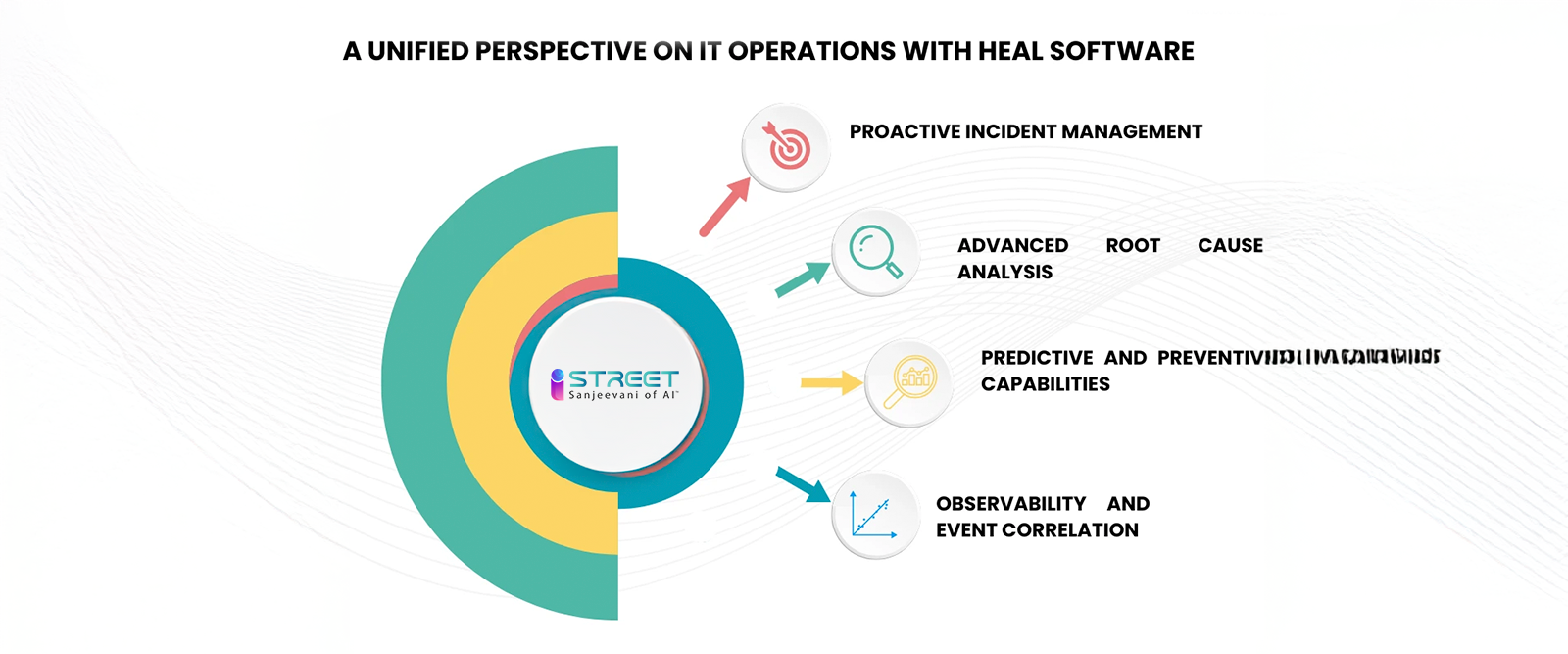
Stage 1: Proactive Incident Management — The Foundation
The starting point for every enterprise is the recognition that reactive incident management — waiting for things to break and then scrambling to fix them — is unsustainable. The cost is too high, the customer impact too severe, and the compliance risk too great.
Proactive incident management shifts the operational posture from ‘respond after impact’ to ‘detect before impact.’ It requires real-time observability that captures signals across the full technology stack — applications, infrastructure, network, databases, and user experience — and automated workflows that route, prioritise, and initiate resolution before incidents escalate.
For Indian enterprises, this foundation is particularly critical. The scale of digital transactions — billions of UPI payments monthly, millions of banking interactions daily, healthcare platforms managing patient workflows around the clock — means that even brief detection delays translate into substantial customer impact. A five-minute delay in detecting a payment gateway degradation during peak hours can affect hundreds of thousands of transactions and trigger regulatory scrutiny under RBI’s operational resilience guidelines.
iStreet’s Full-Stack Observability provides this foundation — comprehensive visibility across every layer of the IT environment, with automated detection and routing that ensures issues are identified and assigned to the right teams within seconds of onset.
Stage 2: Advanced Root Cause Analysis — Digging Deeper
Detection is necessary but insufficient. When an incident occurs, the critical question is not ‘what is happening?’ but ‘why is it happening?’ — and specifically, what is the root cause that, if addressed, will resolve the incident and prevent recurrence?
Traditional approaches to root cause analysis are manual, time-consuming, and expertise-dependent. Engineers examine logs, review metrics, trace dependencies, check deployment histories, and test hypotheses sequentially. In complex distributed environments, this process can take hours and requires coordination across multiple teams — each looking at their own slice of the infrastructure while the full picture remains invisible.
AI-driven root cause analysis transforms this process by automating the cross-domain correlation, causal inference, and historical pattern matching that manual investigation requires. When a cascading failure occurs, the platform traces the causal chain through the service dependency graph — from the observed symptoms through the infrastructure topology to the originating event — in seconds rather than hours.
Real-world examples illustrate the depth of this capability. Memory leaks in legacy C++ applications that manifest as intermittent performance degradation. Application patch malfunctions in core banking environments that introduce subtle data processing errors. Configuration drifts that gradually shift system behaviour away from tested parameters. Each of these root causes is invisible to conventional monitoring but diagnosable through AI-driven analysis that combines current telemetry with historical patterns and infrastructure context.
iStreet’s AIOps and GenAIOps solutions deliver this advanced RCA capability — ensuring that resolution addresses root causes rather than symptoms, and that every incident generates learning that prevents future recurrence.
Stage 3: Predictive and Preventive Capabilities — The Next Step
Root cause analysis, however advanced, still operates within a reactive framework — an incident has occurred, and the AI helps diagnose it faster. The next stage of maturity shifts the operational posture from ‘diagnose faster’ to ‘prevent entirely.’
Predictive capabilities use machine learning to identify the precursor signals that indicate an issue is developing — patterns in metric trajectories, log anomalies, and behavioural deviations that historically precede specific failure modes. By detecting these precursors early enough, the platform enables intervention before any customer-facing impact occurs.
The ambition of zero unexpected downtime — once dismissed as unrealistic — is becoming achievable for enterprises that combine comprehensive observability with mature predictive analytics. Indian banks that have deployed iStreet’s predictive capabilities report measurable reductions in unplanned outages, with the most mature deployments preventing the majority of incidents that would have previously caused customer impact.
This preventive capability connects naturally to iStreet’s Early Warning features — where predictions are enriched with business impact scoring, routed to the appropriate teams with full context, and often linked to pre-authorised remediation workflows that execute automatically when confidence thresholds are met.
Stage 4: Integrated Observability and Event Correlation — Seeing the Big Picture
Modern IT systems generate telemetry from dozens of sources — APM tools, infrastructure monitoring, log aggregators, network monitors, security platforms, and user experience analytics. Each source provides a valid but partial view. The challenge is not data scarcity but data fragmentation.
Event correlation addresses this fragmentation by ingesting data from across all monitoring sources, normalising formats and timestamps, and applying temporal, topological, and semantic analysis to identify relationships between events that originate from different tools. A database issue that causes API timeouts that trigger health check failures that escalate into load balancer rerouting — this causal chain spans four different monitoring domains. Without correlation, each domain reports its own symptoms. With correlation, the entire chain is visible as a single incident with a clear root cause.
This correlation capability serves as critical connective tissue within iStreet’s unified architecture. It enables effective RCA by providing the cross-domain context that causal analysis requires. It improves predictive accuracy by identifying compound patterns that span multiple monitoring systems. And it reduces alert noise by 85 to 95 percent — consolidating hundreds of individual alerts into the small number of meaningful incidents that actually require attention.
Stage 5: Automation and Generative AI — Transforming the Operational Experience
The most advanced stage of IT operations maturity integrates automation and generative AI to fundamentally transform how teams interact with their operational environment.
Automation addresses the repetitive, well-understood incidents that consume disproportionate engineering capacity. When the platform identifies a known failure pattern — a service that requires restart, a cache that needs clearing, a deployment that needs rollback — pre-authorised workflows execute the remediation automatically, without waiting for human intervention. This is not blind automation. The platform assesses incident classification certainty, verifies remediation prerequisites, and halts if conditions do not match expected patterns. This conditional execution ensures that automation resolves known issues reliably while escalating novel situations to human operators.
Generative AI takes this further by providing a conversational interface to the platform’s operational intelligence. Instead of navigating dashboards, running queries, and interpreting graphs, engineers interact with the platform through natural language. ‘What caused this incident?’ ‘Has this happened before?’ ‘What was the resolution last time?’ ‘What is the blast radius?’ The GenAI copilot draws on the full breadth of the platform’s intelligence — topology, incident history, causal analysis, resolution patterns — to provide contextual, data-driven answers that accelerate decision-making.
iStreet’s GenAIOps capabilities deliver this conversational intelligence — anchored to specific operational outcomes rather than generic AI capabilities. The copilot is not a chatbot. It is an operational interface that understands your environment and provides answers that are immediately actionable.
Stage 6: The Resiliency Operations Centre — Governed, Closed-Loop Operations
The final stage brings all capabilities together under a governance framework — the Resiliency Operations Centre. Where observability sees, AIOps reasons, GenAI remembers, and automation acts — the ROC governs the entire loop. It aligns telemetry from all systems into a causally indexed timeline. It assigns confidence scores to automated remediation based on incident memory and SLO impact. It governs action through role-based, policy-scoped automation. It tracks every resolution path as structured memory to inform future decisioning. And it surfaces the operational metrics — MTTR, MTTD, change failure rate, automation coverage, resilience trajectory — that leadership needs to assess progress and direct investment.
iStreet’s Resiliency Operations Centre represents the architectural culmination of this unified journey — where every capability reinforces the others, every incident generates learning, and the operational posture continuously improves.
The Unified Architecture: Greater Than the Sum of Its Parts
The power of iStreet’s approach lies not in any individual capability but in the architecture that connects them. Observability provides the data foundation. Event correlation reduces noise and surfaces connected incidents. Root cause analysis traces from symptoms to causes. Predictive analytics identifies emerging issues before impact. Automation resolves known patterns with machine speed and consistency. GenAI provides conversational access to operational intelligence. And the ROC governs the entire loop with policy awareness and continuous learning.
Each capability is valuable individually. Together, they create an operational architecture that transforms IT from a reactive cost centre into a strategic asset — one that prevents failures, resolves incidents intelligently, and continuously improves its own effectiveness.
For India’s most complex and regulated enterprises, this unified approach is not a technology luxury. It is the operational architecture that modern digital business demands.
Talk to our advisors to explore how iStreet’s unified approach can transform your IT operations.
Originally inspired by insights from HEAL Software, an iStreet Network AIOps product.