The Evolution Is Not Optional
As Indian enterprises accelerate their digital transformation, IT systems are evolving into complex, distributed ecosystems. Applications run across multi-cloud environments. Microservices power critical processes from UPI payments to insurance claims processing. Data flows in real time across countless touchpoints. While this transformation drives agility and scalability, it introduces a class of operational challenges that traditional monitoring was never designed to handle: hidden anomalies that develop slowly, span multiple systems, and disrupt operations long before any static threshold is breached.
The traditional approach of monitoring — where IT teams set fixed thresholds and wait for alerts — served enterprises well in the era of monolithic applications running on managed servers. But in distributed, elastic, cloud-native architectures, static alerts fail structurally. They cannot identify anomalies that do not align with pre-defined rules. They cannot account for the dynamic nature of modern workloads where ‘normal’ changes by hour, by day, by season. And by the time they flag an issue, the damage is often done — customers have experienced degradation, transactions have failed, and compliance posture has been compromised.
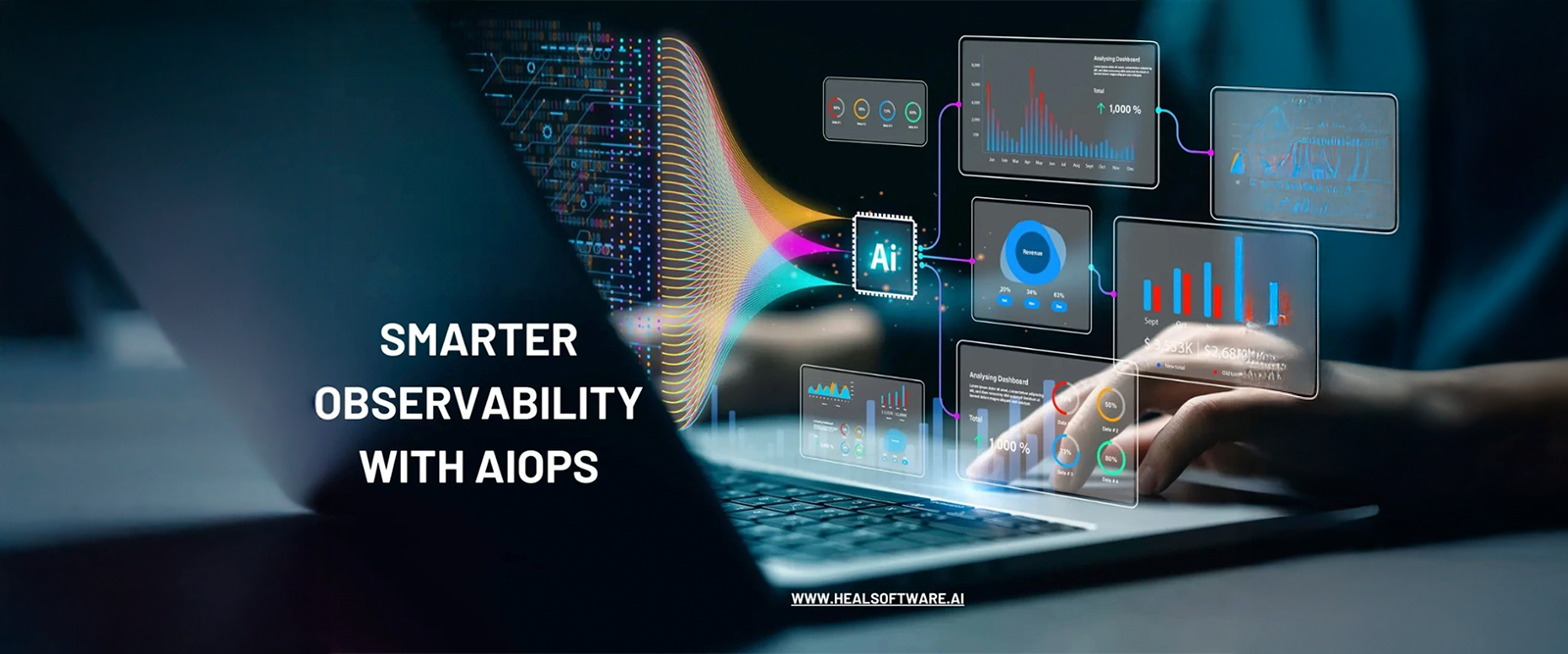
This is why enterprises across India’s regulated sectors are embracing the convergence of observability and AIOps. Together, they enable real-time anomaly detection while automating the identification of patterns, predicting issues, and accelerating root cause analysis. This shift is not just a technological evolution — it is a strategic necessity for organisations operating in an increasingly dynamic and competitive environment.
The Challenges That Force the Transition
Modern IT infrastructures present four structural challenges that make conventional monitoring inadequate.
Siloed monitoring tools create blind spots. Enterprises use fragmented tools for specific layers — servers, applications, networks, databases — each providing a valid but isolated view. IT teams lack a single unified perspective across the ecosystem. When a failure spans multiple domains — a network latency issue causing database timeouts that trigger application errors — no individual tool can see the complete picture. The engineer investigating the application errors does not see the network issue. The network team sees latency within acceptable bounds. The actual causal relationship remains invisible.
Data overload overwhelms human analysis. Modern systems generate massive telemetry — millions of log lines per hour, thousands of metric data points per minute, traces spanning dozens of microservices per transaction. Traditional tools cannot handle this volume effectively. IT teams are overwhelmed by noise and irrelevant alerts, unable to distinguish genuine anomalies from expected variations in the flood of data.
Dynamic systems invalidate static thresholds. Cloud-native architectures are elastic by design — auto-scaling, self-provisioning, dynamically routing. What constitutes ‘normal’ changes constantly based on traffic patterns, deployment state, time of day, and workload composition. Static rules and thresholds cannot define ‘normal’ for systems that are never the same twice. This results in frequent false positives during expected high-activity periods and undetected anomalies during periods when the threshold is irrelevant.
Manual root cause analysis cannot keep pace. When anomalies occur, IT teams spend hours manually correlating data across tools, leading to prolonged Mean Time to Identify and Mean Time to Resolution. The investigation process is sequential, expertise-dependent, and fundamentally unscalable. For Indian enterprises processing billions of digital transactions monthly, this investigation latency translates directly into customer impact and revenue loss.
Why Observability Alone Is Not Enough
Observability was a genuine advancement over basic monitoring. By collecting and correlating metrics, logs, and traces, observability platforms provide real-time visibility into distributed systems. They answer the question ‘what is happening?’ with unprecedented detail and immediacy. When a system anomaly occurs, observability tools alert teams immediately — often before end users notice.
But observability stops short of answering ‘why is it happening?’ and ‘what should we do about it?’ A sudden spike in response times is visible. But is the root cause a database bottleneck? A sudden traffic surge? A misconfigured service? A network issue? A failed deployment? Observability alone leaves teams guessing. And in high-stakes environments — BFSI platforms processing crores in transactions, healthcare systems managing patient data, government digital services serving millions — guessing is not strategy.
How AIOps Completes the Picture
AIOps builds on the observability foundation by adding intelligence, automation, and predictive capability. The convergence of these two technologies creates an anomaly detection capability that is qualitatively different from either operating independently.
Pattern identification through machine learning. Observability tools capture data across multiple layers. AIOps analyses this data to identify unusual patterns — deviations from learned baselines that indicate emerging problems. A surge in CPU usage is flagged as unusual not because it crosses a static threshold but because it deviates from the historical pattern for that specific server, at that specific time, under that specific workload condition.
Outlier detection that catches the invisible. AIOps detects anomalous events that would otherwise go unnoticed. A sudden drop in transaction throughput that correlates with a subtle latency increase in an upstream service. A gradual shift in error rate distribution that indicates a deployment regression. These are compound anomalies — visible only when signals from multiple sources are analysed together — that individual monitoring tools cannot detect.
Cross-domain correlation. While observability captures data across multiple layers, AIOps correlates events to identify root cause. If a spike in user errors occurs simultaneously with database timeouts, AIOps connects the dots to surface actionable insights — rather than presenting them as two separate, apparently unrelated incidents.
Noise reduction. IT teams are overwhelmed by redundant alerts. AIOps reduces alert fatigue by analysing patterns, filtering false positives, and prioritising critical anomalies that require immediate attention. Typical deployments see alert noise reduction of 60 to 85 percent — transforming the operational experience from drowning in notifications to responding to meaningful incidents.
Predictive anomaly detection. By analysing historical data and trends, AIOps predicts anomalies before they occur. A memory leak that will cause a crash in 48 hours. A capacity trend that will breach SLA thresholds in five days. A performance degradation pattern that historically precedes service failure. These predictions enable proactive intervention — addressing the issue during a planned maintenance window rather than responding to an emergency during peak business hours.
Automated remediation. Beyond detection, AIOps enables automated workflows to resolve anomalies. A failing service is restarted with appropriate resource allocation. Resources are scaled automatically in response to emerging demand patterns. Microservices are rolled back to stable versions when deployment regressions are detected. All without human intervention, and all before users are impacted.
The Future: Proactive, Self-Healing Systems
The convergence of observability and AIOps points toward a future where enterprise IT systems are proactive, intelligent, and self-healing. AI will move beyond identifying anomalies to understanding their business impact — correlating technical issues with real-world outcomes like lost revenue, degraded customer experience, or compliance exposure. Systems will not just detect problems and alert engineers. They will predict problems, assess their business impact, determine the optimal remediation, and execute it autonomously — with human oversight governing the policies and boundaries within which autonomous action operates.
For IT teams across Indian enterprises, this means less time firefighting and more time innovating. Anomalies will no longer be disruptive surprises but predictable events that are detected, understood, and resolved automatically. Operational posture will shift from reactive to genuinely resilient.
iStreet Network’s Resilient Operations solutions — combining Full-Stack Observability with AIOps and GenAIOps intelligence — deliver this transformation for India’s most complex enterprise environments. Observability provides the foundation. AIOps adds the intelligence. Together, they create anomaly detection that is not just faster but fundamentally smarter.
Talk to our advisors to explore how this convergence can transform your operations.
Originally inspired by insights from HEAL Software, an iStreet Network AIOps product.