The Real Problem: AIOPS Without Operational Intelligence
Your monitoring stack produces extensive telemetry. Logs stream continuously across the environment. APM tools track latency across distributed applications and services. Infrastructure metrics continuously populate operational dashboards. You have extensive telemetry and visibility into system behavior. What may still be missing is operational intelligence: the ability to determine what matters now, understand why it is happening, and identify actions that can reduce the likelihood of recurrence.
The gap between visibility and operational intelligence can contribute to longer investigation and resolution cycles and allow recurring issues to reappear when their underlying patterns are not fully understood. Monitoring tells you when a predefined condition or threshold has been breached. AIOPS goes further by correlating signals across services and dependencies to identify probable causes, business impact, and recurring operational patterns.
That distinction, between high-volume telemetry and actionable operational intelligence, is the gap AIOPS platforms are designed to address. Here are practical AIOPS use cases delivered through iStreet Network’s Resilient Operations solutions, powered by HEAL Software’s AIOPS capabilities. These enterprise AIOps use cases show how IT teams can move from high-volume telemetry toward actionable operational intelligence.
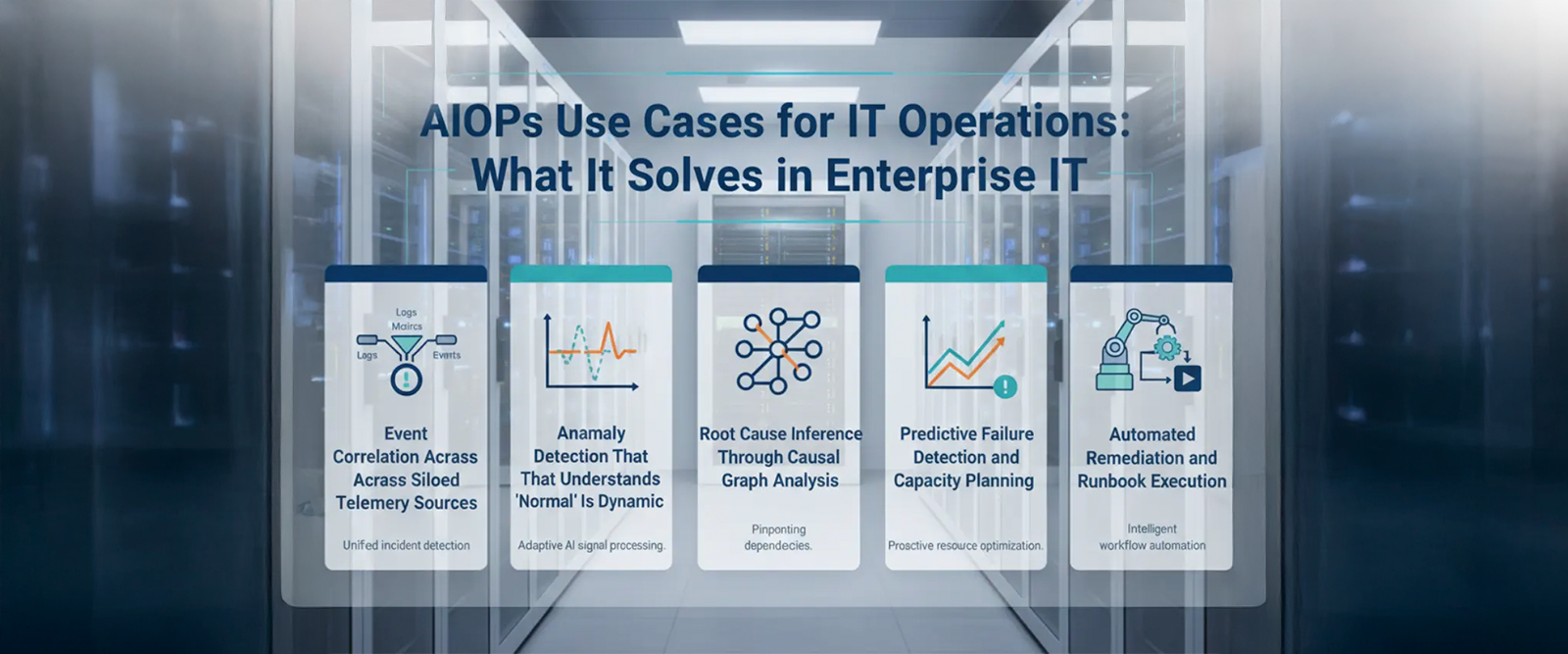
Use Case 1: Event Correlation Across Siloed Telemetry Sources
The operational gap: A production checkout failure triggers a burst of alerts across monitoring and ITSM systems. Your on-call engineer receives notifications from multiple channels simultaneously. Which alert points to the root cause? Which alerts are symptoms of the same underlying issue? The engineer spends valuable time correlating timestamps, manually tracing dependencies, and ruling out false positives before the appropriate remediation path becomes clear.
What AIOps solves: The correlation engine ingests events from heterogeneous sources, normalises timestamps and metadata, then applies temporal and topological analysis to correlate related alerts into a single incident with ranked probable causes. The alert burst is correlated into a single incident, with the API gateway timeout identified as an affected-service signal and upstream database saturation surfaced as a probable contributing cause. AIOps event correlation helps consolidate related alerts across monitoring, ITSM, infrastructure and application sources into a smaller number of meaningful incidents. This also helps reduce alert fatigue by preventing analysts from treating every downstream symptom as a separate issue.
Topology awareness is critical here. The AIOps platform uses topology-aware service dependency mapping, which can be derived dynamically from observed service relationships and traffic patterns. When an alert occurs in the authentication layer, the correlation engine can identify downstream services that may be affected based on their dependency relationships. Alerts are not correlated solely by temporal proximity; they are also analysed using dependency relationships and historical event patterns. Topology-aware correlation helps distinguish probable root causes from downstream symptoms.
Measurable outcome: Enterprises typically see alert noise reduction between 60 and 85% after correlation tuning. More importantly, MTTR drops by 30 to 50% because engineers start diagnosis with a ranked hypothesis rather than raw alert lists.
Why it matters to your IT team: You have already invested in observability. AIOps extends the value of that investment by turning telemetry into correlated operational intelligence and actionable decisions. Faster incident resolution can reduce customer impact while freeing engineering capacity for higher-value work.
Use Case 2: Anomaly Detection That Understands Normal Is Dynamic
The operational gap: Static thresholds fail in elastic infrastructure. CPU at 75% is normal during batch processing windows but critical during checkout traffic. A human-tuned alert either fires constantly creating alert fatigue or misses genuine degradation, leading to missed SLA breaches. Your team adjusts thresholds quarterly, but seasonal traffic patterns and feature releases keep invalidating those baselines.
What AIOps solves: Behavioral anomaly detection establishes dynamic baselines that account for metrics, services, and time-based patterns. Machine learning models learn expected ranges of system behavior under different operating conditions, such as higher latency during peak traffic periods and lower latency during off-peak periods. When observed latency exceeds the learned expected range for a given condition, the model can flag the deviation against the behavioral baseline rather than relying solely on a static threshold. This is a core AIOps anomaly detection use case for dynamic enterprise environments where static thresholds generate too much noise.
Context matters profoundly. The AIOps platform correlates anomalies with deployment events, infrastructure changes, and external dependencies. If cloud storage latency increases while the upload service shows elevated error rates, the platform can surface these signals together with their probable relationship and dependency context, rather than treating them as separate, unconnected incidents.
Advanced implementations can use unsupervised learning to identify anomalous patterns that do not match known incident signatures but deviate from learned normal behaviour. This can surface unfamiliar degradation patterns that existing thresholds or runbooks may not anticipate, giving operations teams earlier visibility into emerging risks.
Measurable outcome: Dynamic baselining can reduce false-positive alerts by 40–70% compared with static threshold-based approaches. It can also identify emerging capacity constraints and performance degradation minutes or hours before they would trigger conventional threshold alerts, giving operations teams additional time to investigate and intervene before broader service impact develops.
Why it matters to your IT team: False-positive alerts can erode on-call engineers’ trust in alerting systems and slow response. When teams are repeatedly exposed to low-value alerts, alert fatigue can reduce the urgency with which new notifications are assessed. Dynamic anomaly detection improves signal quality by reducing unnecessary noise and prioritising meaningful deviations, helping strengthen response consistency and analyst confidence in the alerts they receive. By improving signal quality, behavioural baselines can help enterprises reduce alert fatigue with AIOps while surfacing meaningful deviations earlier.
Use Case 3: Governed Automated Remediation and Self-Healing
The operational gap: Your team may already have documented remediation procedures for known failure modes, with runbooks covering database failover, cache clearing, pod restarts, and traffic rerouting. Yet incident response can still depend on an engineer diagnosing the issue, locating the appropriate runbook, executing the required steps, and verifying recovery. Even for known issues with documented remediation, these manual steps can add response time and increase the operational burden on on-call teams.
What AIOps solves: Closed-loop automation connects incident detection to remediation execution. When the platform identifies a known failure pattern database connection saturation matching historical signature it triggers predefined remediation workflows. The system executes the runbook: scales connection pool capacity, terminates long-running queries, alerts secondary on-call if remediation fails. For enterprise IT teams, automated root-cause analysis becomes more effective when AIOps can correlate signals across servers, databases, applications and network dependencies. This helps teams identify the probable root cause of an issue and move more quickly toward the appropriate remediation path.
The critical distinction from simple automation is conditional execution based on diagnostics. The AIOps platform does not just trigger scripts on alerts; it assesses incident classification certainty, verifies remediation prerequisites, and halts if conditions do not match expected patterns. This prevents automation from amplifying novel failures a critical safety requirement in regulated environments.
Integration with collaboration platforms closes the loop. Automated remediation posts actions taken, metrics affected, and verification results directly into incident channels, so on-call engineers maintain visibility even when automation handles resolution. The audit trail is complete and compliance-ready.
Measurable outcome: For known, automatable incident classes, MTTR can improve by 40–60%, while on-call interruptions can decrease by 30–45% as repetitive, lower-severity incidents are handled through automated workflows. Automation can also improve remediation consistency by executing predefined actions in accordance with approved runbooks and operational policies.
Why it matters to your IT team: Engineering capacity is one of the most valuable resources in IT operations. Automated remediation can redirect time from repetitive incident response towards preventive reliability, optimisation, and engineering work. Reducing unnecessary on-call interruptions can also improve the on-call experience and help reduce operational fatigue, an important consideration for retaining experienced technology talent in India’s competitive market.
Use Case 4: Faster Root-Cause Analysis with Topology-Aware Intelligence
The operational gap: Incident investigation often slows down because teams must manually reconstruct what happened across applications, infrastructure, databases, networks and recent changes. Alerts and telemetry may show the symptoms, but identifying the underlying cause still requires engineers to trace dependencies, review change events and correlate activity across multiple tools.
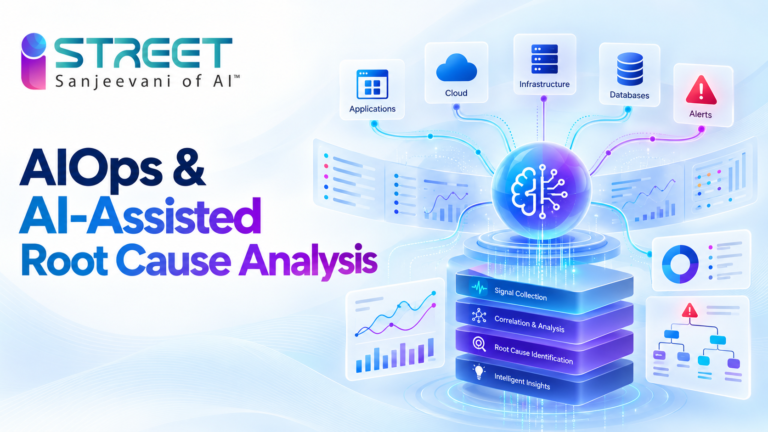
What AIOps solves: AIOps combines topology-aware event correlation, behavioural analysis and service dependency context to narrow the probable fault domain and identify likely root causes faster.
When an incident occurs, related alerts, anomalies and change events are correlated into a common incident context. Dynamic service topology helps teams understand how failures propagate across dependent services, while behavioural patterns help distinguish the initiating condition from downstream symptoms.
Over time, the platform learns recurring relationships between changes, service behaviour and incident patterns, helping teams move from manual investigation toward guided root-cause intelligence.
Operational outcome: Teams can reduce the time spent correlating evidence manually, narrow investigation faster and improve consistency in root-cause analysis. This also helps reduce repeat incidents by enabling teams to address the underlying fault rather than only resolving the visible symptom.
Why it matters to the IT team: Faster root-cause analysis reduces investigation effort and shortens the path from detection to resolution. It also gives engineering teams more time to focus on reliability improvements, capacity optimisation and preventive actions rather than repeated incident reconstruction.
Use Case 5: Predictive Failure Detection and Capacity Intelligence
The operational gap: Traditional monitoring often depends on static thresholds. A service may be degrading gradually even while individual metrics remain within acceptable limits, which means teams may only become aware of the issue after performance or availability is already affected.
The same problem applies to capacity. Infrastructure demand can grow over time, but if teams rely only on current utilisation thresholds, they may discover a capacity constraint too late.
What AIOps solves: AIOps uses behavioural baselines, anomaly detection and trend analysis to identify deviations and degradation patterns before they develop into larger service issues.
Instead of evaluating each metric independently, the platform analyses how multiple signals change together across time. Gradual increases in latency, memory utilisation, connection usage, disk activity or resource consumption can be assessed in context to identify emerging risk earlier.
Capacity intelligence extends this further by analysing historical utilisation, workload patterns and projected demand to help teams understand where capacity pressure may develop and plan scaling actions before service impact occurs.
Operational outcome: Teams gain earlier visibility into developing performance and capacity issues, giving them more time to investigate, validate and take corrective action before the condition escalates into an incident.
This supports a shift from reactive recovery toward more proactive and predictable IT operations.
Why it matters to the IT team: Preventing service degradation is more effective than responding after users are affected. Predictive intelligence gives operations teams the context needed to identify risk earlier, plan interventions more consistently and reduce dependence on threshold-based firefighting.
The Implementation Reality: Not Plug-and-Play
An AIOps platform requires operational preparation before its full value can be realised. It is not entirely turnkey; effective deployment depends on integration with existing telemetry sources, sufficient historical data, environment-specific tuning, and ongoing operational feedback.
Topology discovery requires sufficient operational context. Accurate service dependency mapping may depend on observed traffic patterns, telemetry, integrations, or manual configuration. Without a reliable topology context, event correlation may produce groupings that do not accurately reflect service dependencies. Behavioral anomaly detection also requires sufficient historical telemetry to establish meaningful baselines and learn normal operating patterns. Environments with strong seasonal or cyclical behavior may require broader historical context to distinguish expected variations from genuine anomalies. As a result, model accuracy can improve progressively as more environment-specific data and operational feedback become available.
Integration complexity can increase as the number and diversity of monitoring tools grow. Ingesting telemetry from multiple systems may require configuring connectors, authenticating, mapping fields, and normalizing data to create a consistent operational context. False-positive tuning is also iterative; early deployments may generate excessive alerts or inaccurately classify some events, making operational feedback essential for refining models and correlation logic across successive incident cycles.
Enterprises can approach AIOps deployment as an operational maturity programme rather than a conventional software installation. Begin with a focused, high-noise domain, such as Kubernetes infrastructure, an API gateway layer, or a core banking environment, then tune event correlation and anomaly detection against real operational patterns. As accuracy and operational value are demonstrated, coverage can be expanded progressively across additional services and domains.
When AIOps Solves Actual Problems
AIOps becomes valuable when enterprises face operational challenges that visibility alone cannot address. High alert volumes require intelligent event correlation. Recurring incidents that consume disproportionate engineering time benefit from root cause analysis and dependency-aware correlation. Infrastructure that has outgrown static thresholds requires dynamic anomaly detection to improve signal quality. And where documented runbooks exist but execution remains inconsistent, automated remediation can help standardize repeatable response workflows.
AIOps does not replace observability; it addresses a different gap: operational intelligence. If teams cannot answer “What is happening right now?” because telemetry coverage is incomplete, the priority is to strengthen monitoring and observability. If they can see what is happening but struggle to determine why it matters, what is causing it, and how to reduce recurrence, AIOps becomes the intelligence layer that connects those signals to operational decisions.
About iStreet Network
iStreet Network’s Sovereign AI Enterprise Platform, powered by HEAL Software’s AIOps capabilities, helps enterprises turn existing telemetry into actionable operational intelligence. Through intelligent event correlation, dynamic anomaly detection, topology-aware root cause analysis, predictive insights, and governed remediation, iStreet enables IT teams to move beyond fragmented monitoring towards faster investigation, informed resolution, and more resilient operations across complex enterprise environments.
Talk to our advisors to assess where AIOps can deliver the greatest operational impact across your enterprise environment.
Originally inspired by insights from HEAL Software, an iStreet Network AIOps product.