The Paradigm Shift: From Detection to Prevention
As IT environments grow increasingly complex — with on-premise data centres, multi-cloud deployments, microservices architectures, and hybrid applications creating a web of dependencies that no human operator can fully comprehend — the gap between what traditional monitoring can detect and what enterprises need to prevent grows wider every day. Traditional monitoring tools detect and alert IT teams after a failure occurs, often when the damage is already done. Customers have already experienced the outage. Revenue has already been lost. Compliance posture has already been compromised. The incident response that follows is necessary, but it is fundamentally a damage-control exercise.
Early Warning systems shift IT operations from this reactive posture to a genuinely proactive one. Instead of alerting when thresholds are breached and users are affected, an Early Warning capability uses AI-driven analytics to identify the precursor signals that indicate an issue is developing — and surfaces those signals with enough lead time to intervene before any customer-facing impact occurs. This is not incremental improvement. It is a categorical change in operational capability that redefines the relationship between IT teams and the infrastructure they manage.
At iStreet Network, our Resilient Operations solutions — powered by HEAL Software’s proven AIOps engine — embed Early Warning as a core operational capability. And the results from enterprises that have deployed it demonstrate why this capability has become essential for India’s most demanding regulated sectors.
Why Early Warning Is Essential in Modern IT Infrastructure
The case for Early Warning is rooted in a simple observation: the vast majority of IT failures do not appear instantaneously. They develop over time. A memory leak accumulates gradually over hours or days before causing an out-of-memory crash. Database connection pools trend toward exhaustion over a predictable trajectory before reaching saturation. Disk I/O patterns shift incrementally before reaching the tipping point that degrades application performance. Network latency creeps upward in patterns that correlate with specific traffic conditions before causing timeout cascades.
Each of these failure modes has a signature — a pattern of metric changes, log entries, and behavioural shifts that precedes the actual failure by a detectable margin. The challenge is that these precursor signals are subtle, distributed across multiple data sources, and often individually unremarkable. A 3 percent increase in API response time. A slight uptick in garbage collection frequency. A marginal reduction in connection pool availability. No single signal crosses a threshold. No single alert fires. But the compound pattern — visible only when signals from across the entire technology stack are analysed together — clearly indicates that a failure is developing.
This is exactly what Early Warning systems are designed to detect. By analysing historical and live data through machine learning models that learn the precursor patterns of your specific environment’s failure modes, the platform identifies emerging issues with enough lead time to enable planned intervention rather than emergency response.
How Early Warning Actually Works
The effectiveness of iStreet’s Early Warning capability, delivered through HEAL Software’s AIOps engine, rests on three core principles.
Predictive analytics powered by historical learning. The AI analyses millions of historical incidents and operational data points to identify the patterns that precede specific failure types. It learns that when database connection lifetime decreases while query latency increases over a 90-minute window, connection pool exhaustion follows within 30 to 45 minutes. It recognises that when memory consumption in a specific application server follows a particular trajectory, an out-of-memory condition will occur within a predictable timeframe. These learned patterns become the foundation for real-time prediction — the system continuously compares current telemetry against known precursor signatures and surfaces warnings when matches are detected.
Business impact scoring. Not all emerging issues carry equal business risk. A memory trend that will exhaust capacity on a development server in 72 hours is fundamentally different from the same trend on a production payment processing server during festival season. Early Warning prioritises alerts based on business impact — assessing which systems are affected, which customer-facing services are downstream, what revenue is at risk, and which compliance obligations could be compromised. This ensures that the most critical emerging issues receive attention first, regardless of the technical severity of the underlying metric.
Contextual intelligence that combines automation with human judgement. AI-driven Early Warning achieves its highest value when automated predictions are combined with human oversight and validation. Organisations that blend automated alerts with manual validation resolve incidents three times faster than those relying solely on legacy tools. The platform provides the prediction and the context. The engineering team provides the domain expertise and the judgement to determine the appropriate response. This collaboration between machine intelligence and human expertise produces consistently better outcomes than either operating alone.
Measurable Impact: Before and After Early Warning
The metrics tell the story clearly. Enterprises deploying Early Warning through iStreet’s Resilient Operations solutions report dramatic improvements across every operational dimension.
Critical incidents drop significantly — from twelve per month to five per month in typical deployments, a 58 percent reduction. Mean Time to Detect falls from 47 minutes to 12 minutes — a 74 percent improvement that fundamentally changes the incident experience. Mean Time to Repair improves from 2.1 hours to 1.3 hours — a 38 percent reduction that directly translates to less customer impact and fewer compliance events. And SLA compliance improves from 68 percent to 94 percent — a transformation that is visible at the board level and demonstrable to regulators.
These are not theoretical projections. They are operational outcomes measured in production enterprise environments where the difference between 68 percent and 94 percent SLA compliance can mean the difference between regulatory approval and regulatory action.
How Indian Enterprises Are Using Early Warning to Transform Operations
The practical applications of Early Warning span the full breadth of enterprise IT operations.
Anomaly detection powered by AI-driven monitoring. The platform tracks over 100 metrics continuously — CPU load, memory utilisation, disk I/O, network latency, API response times, transaction throughput, error rates, and more. Machine learning models establish dynamic baselines for each metric and flag deviations that indicate emerging problems. One Indian fintech institution reduced false positives by 70 percent after implementing custom-tuned anomaly detection thresholds that account for their specific traffic patterns and seasonal variations.
Smart escalation paths that route intelligence, not noise. Instead of overwhelming IT teams with irrelevant alerts, the AI routes early warnings to the right teams based on predicted root causes and business impact. If the Early Warning system identifies an emerging database performance issue, the alert is routed directly to the database operations team with full context — not broadcast to every on-call engineer across the organisation. This targeted escalation ensures that the right expertise is engaged immediately, without the coordination overhead that delays response in conventional escalation models.
Preemptive incident management. The AI does not just detect emerging issues — it schedules proactive interventions to prevent escalation. During high-traffic periods, Indian banking institutions have prevented crores in potential losses through early interventions that addressed capacity constraints before they impacted customer transactions. The difference between discovering a capacity bottleneck during Diwali sale traffic and addressing it three weeks beforehand through Early Warning is the difference between crisis management and strategic operations.
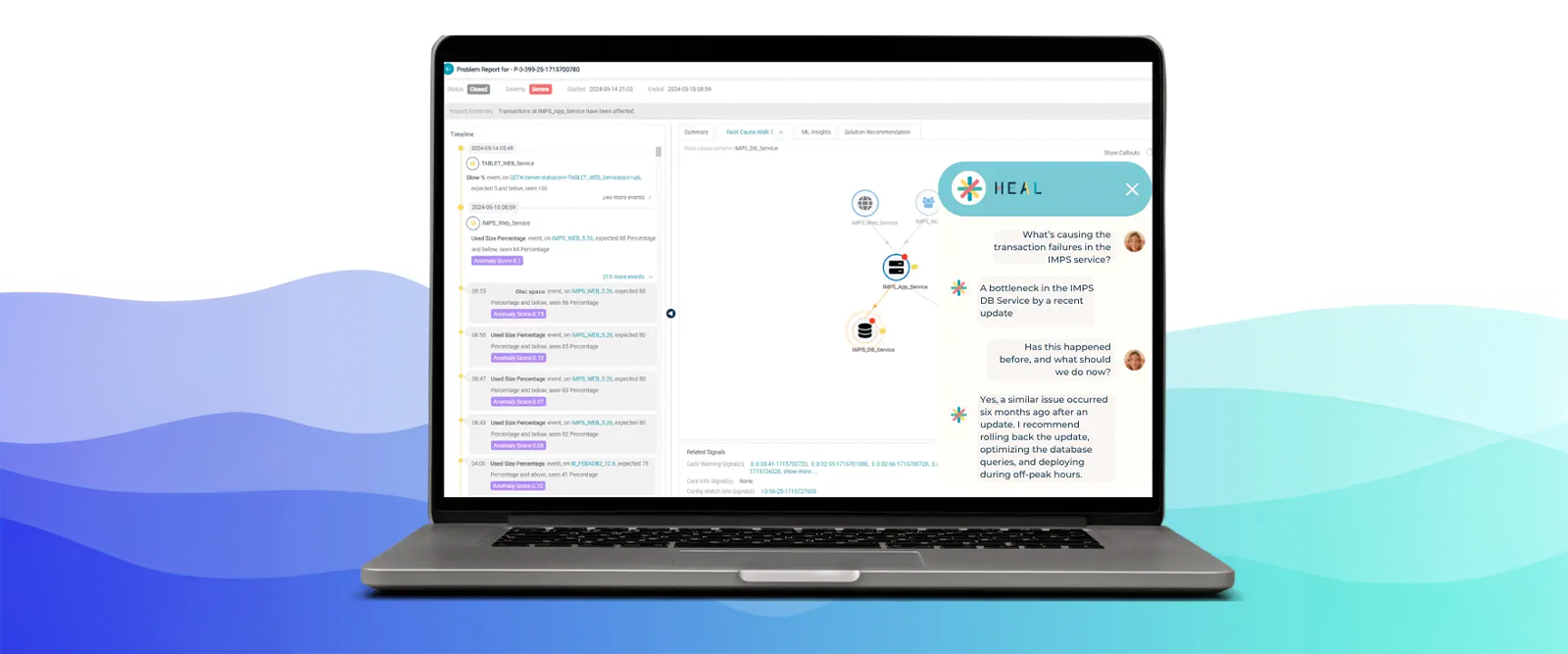
Automated root cause analysis integrated with prediction. When Early Warning identifies an emerging issue, the platform simultaneously initiates root cause analysis — correlating logs, traces, metrics, and historical patterns to identify the underlying cause before the issue manifests as a visible failure. One banking institution using iStreet’s solutions resolved 80 percent of potential incidents before any user impact by combining Early Warning detection with automated RCA and pre-authorised remediation workflows.
Maximising the Value of Early Warning
Deploying Early Warning technology is the starting point. Maximising its value requires operational practices that amplify the platform’s intelligence.
Enrich alerts with business context. Tag early warnings with business impact information — ‘Affects 10,000 active users,’ ‘Revenue at risk: ₹15 lakhs per hour,’ ‘Compliance: RBI SLA threshold in scope.’ This contextualisation ensures that engineering and leadership teams can immediately assess the urgency and allocate resources proportionally.
Improve AI models with feedback loops. Train the AI with real-world incident data by confirming or correcting its predictions. Organisations that establish disciplined feedback loops have improved alert accuracy by 48 percent within three months. Every confirmed prediction strengthens the model. Every corrected false positive refines its discrimination. This iterative improvement is what transforms a good prediction engine into an exceptional one.
Enable cross-team collaboration. Shared dashboards and unified incident channels ensure real-time coordination between DevOps, security, application, and infrastructure teams. Early Warning is most effective when it feeds into a collaborative resolution process rather than siloed team workflows.
Regularly refine alerting rules. Quarterly reviews align Early Warning thresholds with infrastructure changes, new deployments, and evolving application architectures. As your environment changes, the prediction models must evolve with it.
A Real-World Success Story: Preventing a Payment Gateway Crisis
A leading financial services institution — processing transactions worth hundreds of crores daily — struggled with recurring payment gateway latency issues that had resulted in substantial SLA penalties over six months. Their legacy monitoring tools generated over 500 false alerts per day, overwhelming the IT team and burying genuine warning signals in noise.
iStreet’s Resilient Operations solution, powered by HEAL Software’s Early Warning capability, analysed transaction logs and API latency patterns in real time. The AI dynamically adjusted detection thresholds based on peak trading hours, seasonal patterns, and historical failure signatures. The system detected a latency spike pattern 40 minutes before it would have caused a gateway failure — providing enough lead time for the operations team to implement a targeted intervention that prevented the outage entirely.
The result: a major outage prevented, SLA penalties reduced by crores annually, and a fundamental shift in the institution’s operational posture from reactive firefighting to proactive prevention.
Building Future-Proof IT Operations
Early Warning systems represent the operational frontier of AIOps — the point where IT operations evolve from detecting and responding to failures into preventing them entirely. With predictive analytics and human expertise working together, Indian enterprises can reduce downtime, lower IT costs, improve SLA compliance, and strengthen the customer trust that underpins competitive advantage.
iStreet Network’s Resilient Operations portfolio embeds Early Warning as a core capability within a comprehensive operational intelligence platform — ensuring that your organisation does not just react faster but prevents the failures that would have required reaction.
Talk to our advisors to explore how Early Warning can transform your enterprise operations.
Originally inspired by insights from HEAL Software, an iStreet Network AIOps product. Learn more at healsoftware.ai.