IT Service Management is one of the operational backbones of the enterprises. Every incident, change, and service request moves through it, and the records it holds are what service reporting, compliance evidence, and board-level assurance are built on. That discipline has matured considerably over the past decade; workflows are governed, and service levels are measured against evidence rather than recollection.
What has changed is the infrastructure that is governed by. Applications now span hybrid and multi-cloud infrastructure; a single business service depends on hundreds of components that change weekly, and every one of those layers emits its own telemetry. The workflow inside the ITSM platform is as disciplined as it has ever been. The volume reaching intake has outgrown the capacity of any team to work through it in sequence.
AIOps is the layer built to read that volume, and its integration with ITSM is where incident response improves.
What Is ITSM and How Does Incident Management Work Within It?
IT Service Management is the ticketing system an enterprise runs its IT operations through, and incident management is the function within it that restores a service when it degrades. The same platform holds request fulfilment, problem management, change management, and a CMDB that maps each business service to the components beneath it.
Incident management follows a set path: a ticket is raised, categorized against the affected service, prioritized by impact and urgency, and routed to the resolver group that owns the failing component. Every state transition is timestamped and every approval recorded, which is why the same ticket serves both the operations review and assurance reporting.
What Is AIOps and How Does It Detect Incidents?
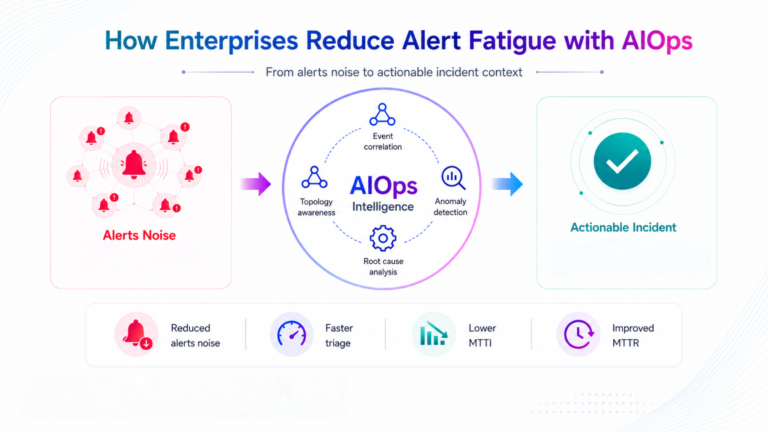
The ticket originates in the monitoring tool, and AIOps is the layer that reads it. It ingests metrics, logs, traces, events, and topology across infrastructure, application, database, and network tiers, baselines normal behaviour so deviation surfaces without static thresholds, suppresses duplicates and false positives, correlates related events into one incident using time and service dependency, and infers probable cause with the evidence behind it. The output is a small number of incidents, each carrying the affected business service, the blast radius, and the component at the origin.
Read more on What is AIOPS? A complete guide to Enterprise IT teams
What Is Slowing Incident Response Inside ITSM Today?
A single anomaly generates multiple alerts across every interconnected system it is connected to, including applications, middleware, gateways, and hosts. Those alerts are related to one incident.
An engineer reads these alerts across the consoles and manually determines the alerts belonging to the same event, opens the ticket, assigns a priority, and routes it. Every downstream step, routing, escalation, resolution time, inherits that judgement.
Priority follows the severity flag on a single alert rather than measured impact on the business service. Routing follows the component named in the ticket, which is often the noisiest rather than the faulty one, and each reassignment adds an escalation cycle before anyone with the right access joins the bridge call. The CMDB that should establish service impact drifts between discovery runs, so the dependency map used at triage lags the infrastructure it describes.
How Do AIOps and ITSM Work Together to Improve Incident Response?
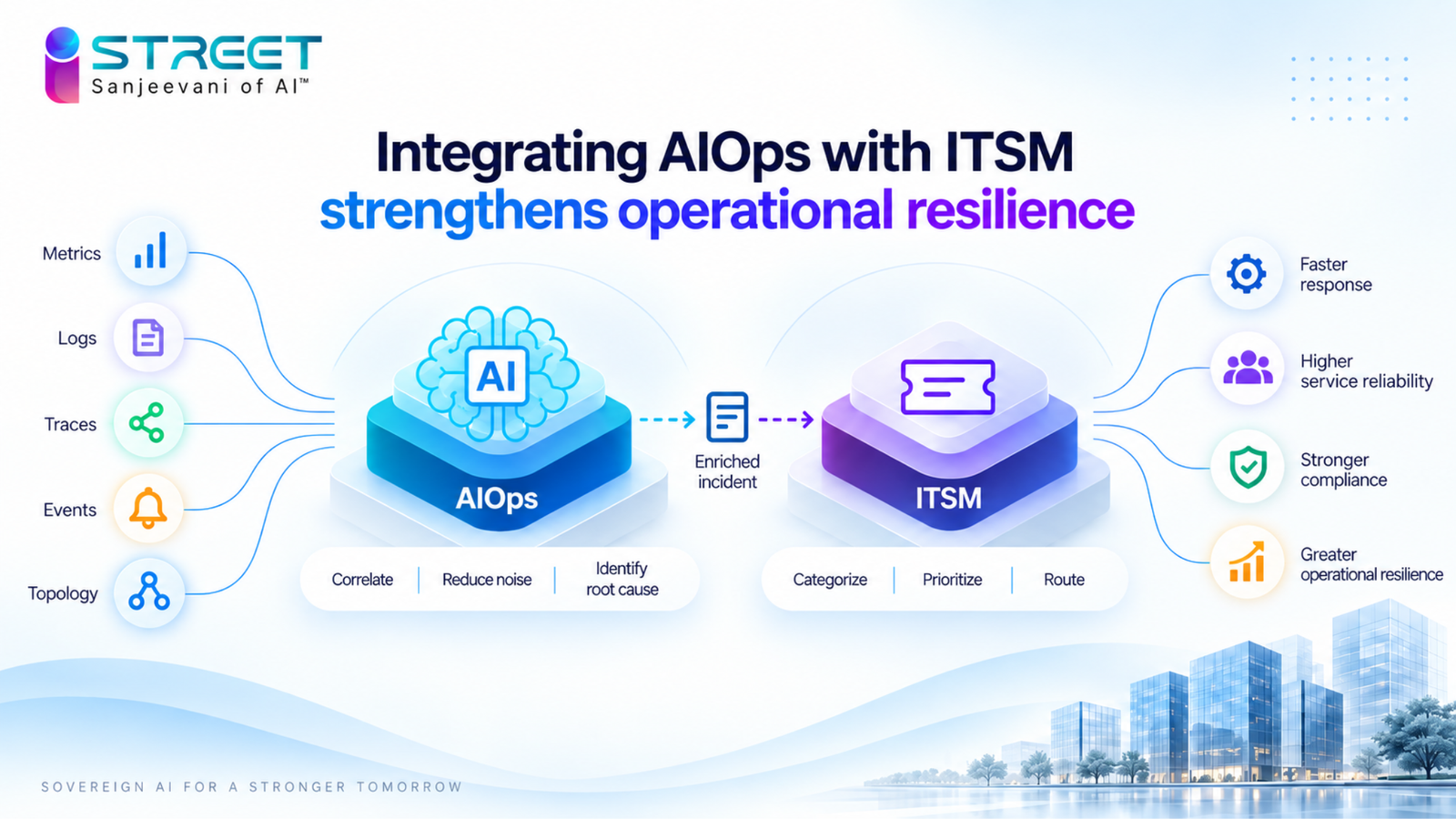
Integrating the two removes the manual step between detection and the ticket
Ingestion and noise reduction. AIOps monitors logs, metrics, traces, and events across the environment, filters false positives against learned baselines, and groups related alerts into one correlated event before anything reaches the ITSM platform.
Automated ticket creation. Once the correlated event is validated as a real incident, AIOps opens an enriched ticket in ITSM carrying the event name, first-seen timestamp, the correlated alert set, the affected systems, and the associated change record.
Routing and prioritization. ITSM applies business rules to enriched tickets. Because the correlated evidence identifies the failing component, the ticket reaches the owning resolver group on the first assignment, and priority reflects service impact analysis rather than the severity flag on a single node.
Root cause and remediation. AIOps compares real-time patterns against historical incident data to identify root cause and attaches the supporting evidence to the same ticket. Where the condition matches a known signature, it triggers a validated runbook, and the outcome is written back to the ticket as a timestamped record. Changes that carry risk are held for human approval before execution.
The ITSM workflow itself is unchanged, with the same approvals, same record, while each stage shortens. Detection moves earlier because anomaly detection works against learned baselines. Acknowledgement is faster because on call receives one enriched incident rather than a queue. Resolution is faster, since triage and diagnosis are complete before the engineer opens the ticket.
AIOPS and ITSM can be integrated without moving the telemetry outside the enterprise. That is the governing question for regulated operators, since correlation, inference, and automated remediation all require the most sensitive operational telemetry an enterprise holds.
HEAL AIOPS, powered by iStreet Network – Sovereign AI Native ecosystem, is deployed on-premises or in a sovereign private cloud, so telemetry stays within the operator’s own infrastructure. Agents and collectors gather metrics, logs, traces, and topology from the same network, and correlation, baselining, and root cause inference run on models trained and executed within that perimeter.
Integration with the ITSM platform runs over authenticated internal APIs to the system already in production. AIOPS opens and enriches the incident ticket, receives the workflow state back as it changes, and executes approved runbooks from within the same boundary.
ITSM holds workflow, accountability, and records. AIOps correlates with the alerts, identifies the affected service, and isolates the probable cause before the ticket reaches the workflow. Connected inside a sovereign perimeter, they shorten every stage of the incident lifecycle and strengthen the audit trail at the same time.
About iStreet Network
iStreet Network Limited is an enterprise-grade, AI-native Sovereign AI ecosystem. At its core is Sanjeevani of AI™, iStreet’s AI Centre of Excellence and integrated framework that brings together observability, security, governance, risk, and compliance to operationalize enterprise AI with greater control, resilience, and assurance.