Enterprise IT environments have become increasingly layered and distributed. Virtualization, containers, public cloud, microservices, and security platforms have each introduced their own monitoring systems, often configured with independent thresholds and alerting logic. As a result, large enterprises may operate multiple monitoring tools simultaneously, with limited context shared across them.
These disconnected monitoring environments create operational silos, where each tool sees only part of an incident. When a component degrades, dependent layer reacts independently. Middleware may raise queue build-up alerts, applications may report timeouts, and customer-facing services may flag rising error rates. One underlying fault can therefore generate hundreds of alerts, with no single tool recognising that they are all alerts of the same incident.
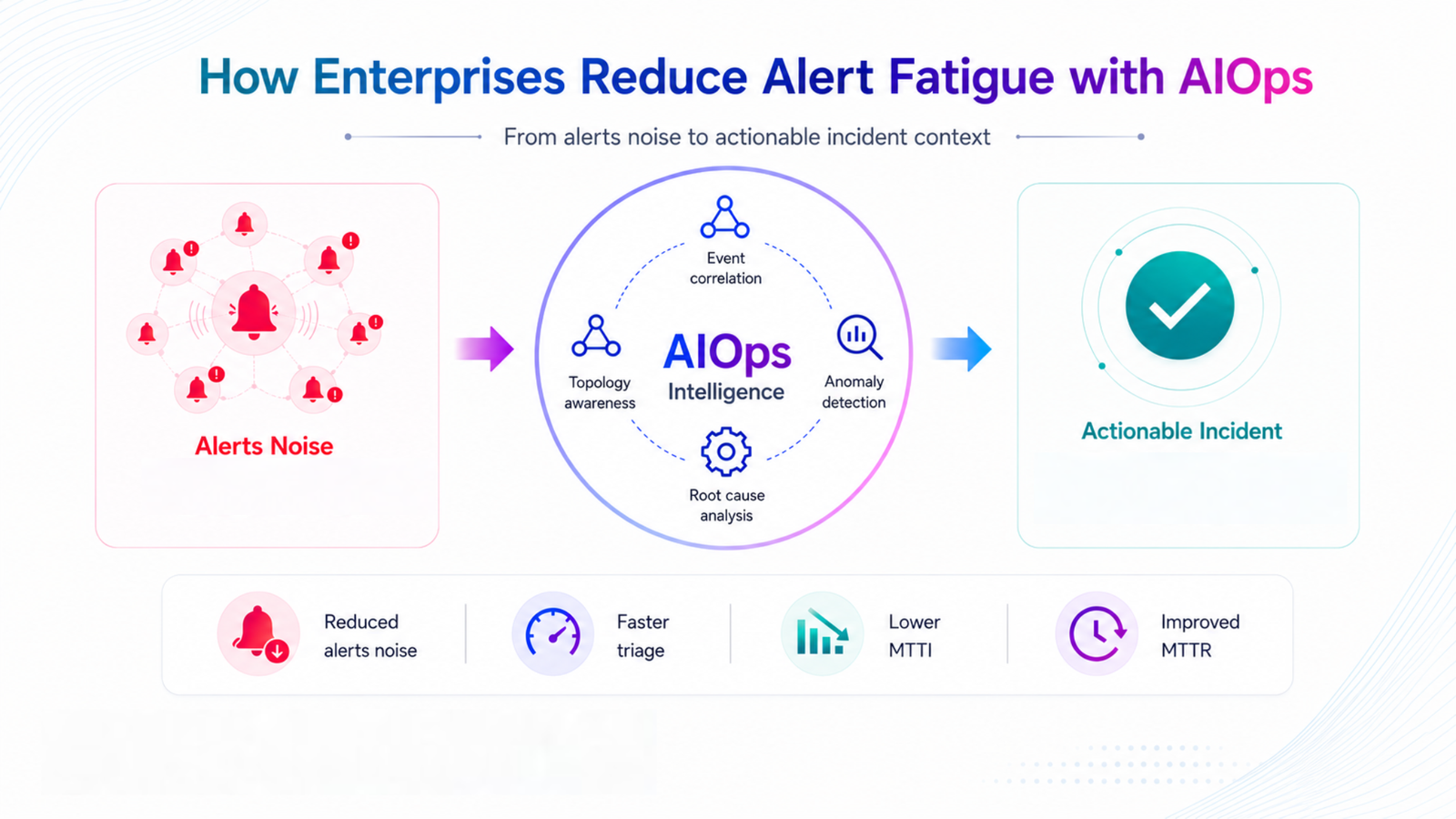
That is alert fatigue: monitoring tools raise more alerts than the team can work through. The alerts that signal real service impact are buried among duplicate and low-priority ones, and correlating them back to a single incident is left to the engineer. Manual correlation is slow, most of the response window is spent on it, and mean time to identify (MTTI) increases.
The impact begins with the time teams spend investigating and triaging alerts. High-priority signals can become difficult to distinguish from surrounding noise, increasing time to detection. Once an incident is identified, engineers may need to move across multiple consoles to establish context and determine the probable root cause. Detection slows, triage takes longer, and mean time to resolution (MTTR) increases as a result. That is where an operations problem becomes a commercial one.
Why Traditional Alert Reduction Approaches Fall Short
Most teams rely on one of two approaches: raising alert thresholds or reducing alerts from high-volume sources. Both can lower alert volume quickly, but neither addresses the underlying cause of alert fatigue. Raising thresholds may reduce lower-severity signals that could indicate early-stage degradation before it escalates into a service-impacting incident. Reducing or disabling noisy alert sources can create an even larger visibility gap, particularly when the environment changes but the monitoring configuration does not.
The deeper flaw is that a threshold is set once, while the environment it measures keeps changing. Every deployment, autoscaling event, and new service pushes the tuning out of alignment, which is why threshold maintenance never ends.
Tool consolidation does not fix it either. Routing five monitoring tools into one dashboard reduces the consoles an engineer checks without reducing the alerts they read.
How AIOps Reduces Alert Fatigue
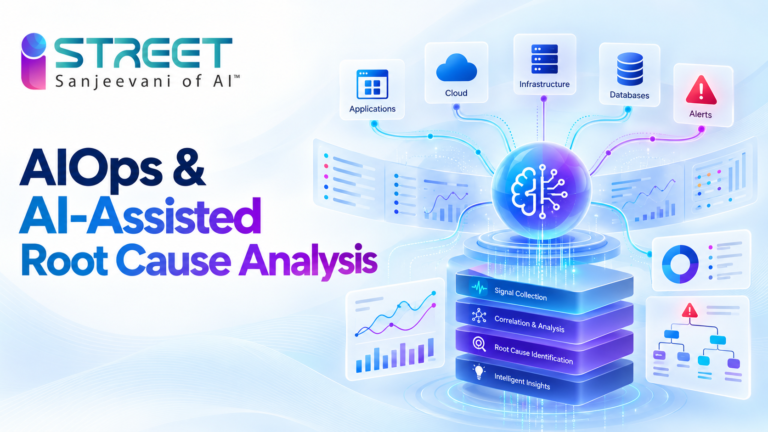
AIOps applies machine learning, event intelligence, topology context, and automation to continuously analyse operational data across applications, infrastructure, and services. It identifies relationships between signals, detects abnormal behaviour, and builds context around emerging incidents.
This is where AIOps fundamentally changes alert management.
Rather than simply filtering or reducing alerts, AIOps changes how they are interpreted. A threshold breach on a single component is no longer treated in isolation. Alerts are correlated into a single, contextual incident enriched with the probable root cause, affected services, and operational impact.
These capabilities work together to reduce alert fatigue.
Event correlation groups related alerts using time, topology, and historical co-occurrence.
Topology awareness establishes cause-and-effect relationships within the incident. Mapping service and infrastructure dependencies, the platform can distinguish an fault from symptoms and identify the root cause.
Anomaly detection based on baselines reduces dependence on static thresholds. Instead of evaluating every metric against a fixed value, AIOps learns the normal operating pattern of each service and identifies anomalies in context.
How AIOps Changes Alert Management
In practice, reducing alert fatigue requires more than reducing or prioritising individual alerts. It requires an AIOps operating model that continuously correlates events, understands service dependencies, detects anomalous behaviour, and identifies the probable root cause of an incident.
AIOps Solution, powered by iStreet Network, brings these capabilities together through event intelligence, topology awareness, dynamic baselining, anomaly detection, and automated root-cause analysis. This helps enterprises consolidate high-volume telemetry and related alerts into contextual, actionable incidents.
Teams that previously investigated multiple disconnected alerts now receive a correlated incident enriched with probable root cause, context, and evidence. This shifts operations from alert-centric monitoring to incident-centric management, reducing alert noise and accelerating triage.
About iStreet Network
iStreet Network Limited is an enterprise-grade, AI-native Sovereign AI ecosystem. At its core is Sanjeevani of AI™, iStreet’s AI Centre of Excellence and integrated framework that brings together observability, security, governance, risk, and compliance to operationalize enterprise AI with greater control, resilience, and assurance.