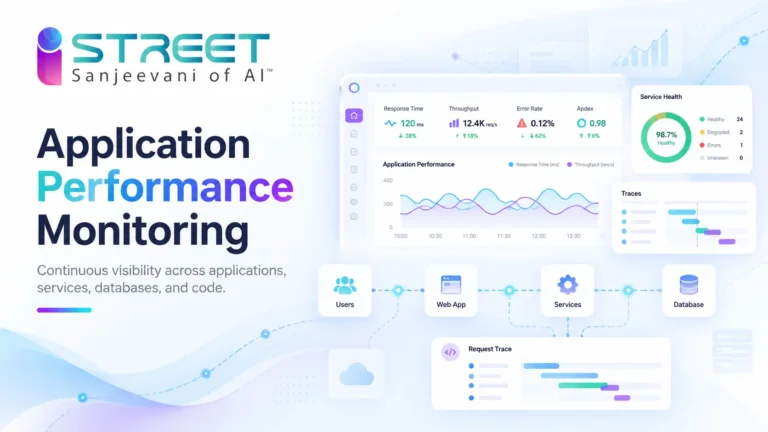
Your dashboards show healthy infrastructure and applications, yet customers still encounter slow logins, failed transactions or unresponsive workflows.
This gap occurs because component health does not always reflect the quality of an end-to-end digital journey. A server may remain available while an API responds slowly. An application may report no critical errors while users in one geography struggle to complete a payment. A branch system may remain online while network latency prevents employees from serving customers efficiently.
Infrastructure, network, and application monitoring remain essential. However, they primarily show what is happening within the technology environment.
Digital Experience Monitoring adds the user’s perspective. It measures how customers and employees experience digital services at the point of interaction and connects that evidence to the application, network, endpoint, and infrastructure conditions underlying it.
What Is Digital Experience Monitoring?
Digital Experience Monitoring (DEM) is an approach to measuring the performance and quality of digital services from the user’s perspective. DEM combines telemetry from actual user interactions with automated tests that simulate critical journeys. It can also collect experience signals from employee endpoints and distributed locations such as branches, kiosks, retail outlets, service centres and ATMs.
Among the various capabilities of Digital Experience Monitoring (DEM), the following three are particularly important because they provide complementary visibility into user experience across applications, networks, and devices:
Real User Monitoring (RUM)
RUM captures performance data from actual user sessions in real time. It measures page load times, interaction responsiveness, error rates, and user journey completion rates from the user’s actual browser or device. RUM provides ground truth about what users are actually experiencing, segmented by geography, device type, browser, network condition, and other contextual dimensions.
Synthetic Monitoring
Synthetic monitoring uses scripted transactions that simulate user interactions at regular intervals from distributed monitoring locations. It provides consistent, baseline measurements of application availability and performance, independent of actual user traffic. Synthetic monitoring is particularly valuable for detecting issues outside of peak hours, validating performance after deployments, and monitoring critical user journeys (login, checkout, payment) continuously.
Endpoint Monitoring
For organisations with significant internal users (enterprise applications, SaaS tools, VDI environments), endpoint monitoring captures the experience of employees interacting with business-critical applications. It measures device performance, application responsiveness, network quality, and authentication latency from the employee’s workstation or device.
Why CIOs Are Making DEM a Strategic Priority
It connects technology performance with business-service quality. CIOs do not manage infrastructure availability in isolation. They remain accountable for the digital services supported by the infrastructure.
DEM gives CIOs a service-oriented view by showing how technology conditions affect customer journeys, employee productivity, transaction completion, service accessibility, digital-channel reliability, business operationsThe Complexity of Modern Application Architectures
Modern digital journeys connect content-delivery networks, identity services, API gateways, microservices, databases, cloud platforms, third-party services, and local networks. Each component may appear healthy when viewed separately, while the journey as a whole remains slow or unreliable. DEM provides a signal that teams can correlate with application, network, and infrastructure telemetry. This helps reveal issues that averages and component-level dashboards may conceal.
Hybrid Work Has Expanded the Experience Surface
The shift to hybrid work means that employee productivity depends on the performance of SaaS applications, collaboration tools, and VPN connections accessed from diverse networks and devices. IT teams need visibility into the employee digital experience to diagnose and resolve productivity-impacting issues.
Regulatory and SLA Requirements
Increasingly, SLA commitments are being defined in terms of user experience metrics rather than infrastructure availability. Regulators in financial services and telecommunications are beginning to require evidence of customer experience monitoring. DEM provides the measurement framework to meet these requirements.
How DEM is Implemented
A comprehensive DEM implementation typically involves deploying lightweight JavaScript agents in web applications for RUM, configuring synthetic transaction scripts from geographically distributed monitoring points, integrating with existing APM and infrastructure monitoring platforms for end-to-end correlation, and establishing experience-level KPIs (Apdex scores, Core Web Vitals, user journey completion rates) as primary operational metrics.
Modern DEM platforms use AI and machine learning to establish experience baselines, detect anomalies, and correlate experience degradation with underlying technical causes. This is where DEM intersects with AIOps: the experience data from DEM enriches the AIOps platform’s ability to prioritise incidents based on actual user impact rather than technical severity alone.
DEM Use Cases Across the Enterprise
- E-commerce and digital platforms: Monitoring checkout flow performance, payment gateway latency, and search responsiveness across geographies and devices to protect conversion rates.
- Banking and financial services: Ensuring mobile banking, UPI, and internet banking experiences meet customer expectations and regulatory requirements across India’s diverse network conditions.
- SaaS providers: Measuring tenant-level experience quality to enforce SLA commitments and proactively identify experience degradation before customers report it.
- Enterprise IT: Monitoring employee experience with collaboration tools (Microsoft 365, Google Workspace), ERP systems (SAP, Oracle), and custom internal applications to maintain workforce productivity.
- Healthcare: Ensuring patient portal, telemedicine, and clinical application responsiveness for both patient-facing and clinician-facing digital experiences.
The DEM and AIOps Connection
DEM and AIOps are complementary disciplines that together provide a complete operational picture spanning from user experience to infrastructure health. DEM provides perspective about what users are experiencing. AIOps provides the perspective about what is happening across the technology stack. When integrated, they enable a powerful operational capability.
When DEM detects an experience degradation, for example, a spike in page load times for users in a specific geography, AIOps can automatically correlate this with underlying technical events: a CDN configuration change, an increased load on a specific microservice, or a database query performance regression. This cross-layer correlation dramatically accelerates diagnosis by connecting the user-visible symptom to the technical root cause.
Conversely, when AIOps detects a technical anomaly such as increasing memory pressure on an application server, DEM data can immediately answer the critical follow-up question: is this affecting users? If memory pressure is increasing but user experience metrics remain stable, the issue can be prioritised for proactive remediation without triggering an emergency response. If user experience is already degrading, the incident is escalated immediately with full business impact context.
Overcoming Common DEM Implementation Challenges
Data privacy and compliance considerations require careful attention. RUM agents capture detailed user session data, which may include personally identifiable information depending on the application. Organisations must ensure that their DEM implementation complies with applicable data protection regulations, including India’s Digital Personal Data Protection Act.
Performance overhead is another consideration. Poorly implemented RUM agents can themselves impact the user experience they are designed to measure. Leading DEM platforms minimise this through asynchronous data collection, sampling strategies, and lightweight agent architectures that add negligible latency.
Finally, organisational alignment is essential. DEM data is most valuable when it is shared across development, operations, and business teams. Establishing shared KPIs and review cadences ensures that experience data drives action rather than sitting in an unused dashboard.
Getting Started with DEM
iStreet Network’s Digital Experience Monitoring solution provides an experience-intelligence layer within its Resilient Operations portfolio. The solution combines Real User Monitoring, Synthetic Transaction Monitoring, Endpoint Performance Monitoring, and Branch and Distributed Location Monitoring.