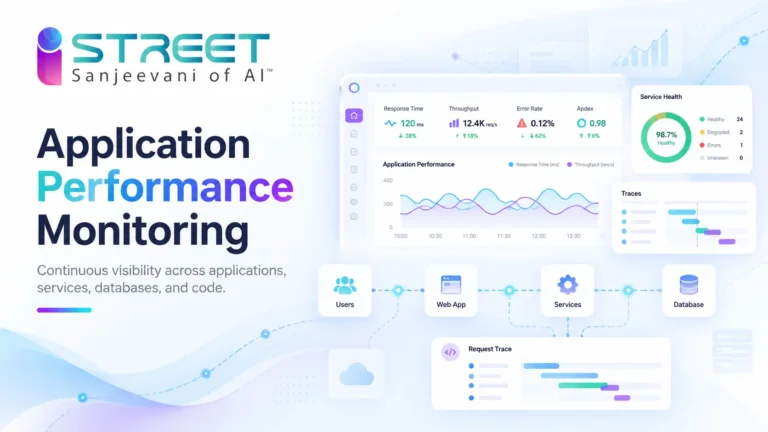
Full-stack observability is the ability to understand service health across the complete technology stack by correlating telemetry from user experience, applications, infrastructure, networks and dependent services. It connects metrics, logs, traces and events so teams can follow cause-and-effect across layers, investigate failures in context and understand how technical issues affect service and business outcomes.
As enterprise architectures span microservices, hybrid and multi-cloud infrastructure, APIs, containers, and third-party services, understanding why a service is degrading increasingly requires context across multiple layers. A single customer transaction may traverse multiple services, databases, APIs, infrastructure components, and delivery layers. When that transaction fails, experiences latency, or produces an unexpected outcome, the answer to “What happened?” may be distributed across multiple teams and tools. Infrastructure may appear healthy, application services may report normal status, and database performance may remain within expected ranges.
The underlying issue can therefore remain hidden between healthy components. Full-stack observability addresses this visibility gap by correlating telemetry across applications, infrastructure, networks, and digital experience, enabling teams to investigate system behavior in context rather than through isolated dashboards.
This blog explains what full-stack observability means, how it differs from conventional monitoring, the telemetry signals and correlation capabilities that support it, and how enterprises can build observability across complex technology environments.
Monitoring vs Observability vs Full-Stack Observability
Monitoring and observability are closely related but serve different purposes. Monitoring tracks known conditions through predefined metrics, checks, and thresholds. It answers questions such as: Is CPU utilization above the expected threshold? Has response time increased? Is the service unavailable?
Observability goes further by enabling teams to investigate system behavior through the telemetry it generates, including situations where the failure mode was not anticipated in advance. Instead of only identifying that a known threshold has been crossed, observability helps teams investigate why the system is behaving unexpectedly.
Full-stack observability applies this capability across the technology environment by connecting signals from applications, infrastructure, networks, and digital experience. The objective is not simply visibility into individual components, but the ability to correlate behavior across layers and trace an issue through the dependencies that contribute to it.
Core Telemetry Signals in Full-Stack Observability
Metrics, logs, and traces are three foundational telemetry signals used in observability. Each captures a different aspect of system behaviour, and their value increases when they can be correlated through shared context.
Metrics
Metrics are numerical measurements captured over time, such as CPU utilisation, request rate, error rate, latency percentiles, queue depth, and thousands of other quantitative indicators. They are effective for identifying trends, establishing baselines, visualizing service health, and alerting on known conditions.
Logs
Logs record discrete events and provide detailed context about what occurred within a system or application. They are particularly valuable during investigations because they can capture errors, state changes, requests for information, and other event-level details associated with system behavior.
Traces
Distributed traces capture the path of a request as it moves through services and dependencies, recording individual spans that show where time was spent and where errors occurred. This makes tracing particularly valuable in microservices and distributed architectures, where the source of a problem may be in a service
Events
Events capture significant state changes or operational occurrences such as deployments, configuration changes, service restarts, scaling activity or infrastructure changes. When correlated with metrics, logs and traces, events help teams understand whether a change in the environment contributed to a degradation or incident.
Observability Across the Technology Stack
- Digital Experience: Real-user monitoring, synthetic monitoring, availability, latency and transaction experience.
- Applications and Services: Application performance, service calls, APIs, databases and distributed transactions.
- Infrastructure and Cloud: Hosts, VMs, containers, Kubernetes, cloud resources and platform services.
- Network and Dependencies: Network behaviour, service dependencies, upstream/downstream systems and third-party services.
Connecting Technical Telemetry to Business Context
Technical telemetry explains how systems are behaving; business context helps teams understand why that behavior matters. Connecting service performance with transaction completion, user journeys, service-level objectives, or other business indicators allows technology teams to assess operational issues in terms of their broader impact. For example, an increase in application latency becomes more actionable when teams can see that it is affecting digital payment completion, customer logins or another business-critical service.
Service Dependency Mapping and Cross-Layer Correlation
Full-stack observability becomes more effective when telemetry is connected to service relationships. Service dependency mapping shows how applications, databases, APIs, infrastructure components and external services contribute to a business service. When degradation occurs, teams can correlate anomalies with the affected dependency chain instead of investigating each component independently.
Full-Stack Observability Architecture
Building full-stack observability in a large enterprise requires coordinated capabilities across instrumentation, telemetry collection, correlation, analysis, and operational workflows.
Instrumentation and Telemetry Collection
Observability begins with instrumentation: enabling applications and infrastructure to generate useful telemetry about their behavior. OpenTelemetry provides a vendor-neutral, open-source framework for instrumenting, generating, collecting, processing, and exporting telemetry such as traces, metrics, and logs.
- Application instrumentation using OpenTelemetry.
- Service and platform telemetry for communication.
- Infrastructure telemetry across hosts, containers, Kubernetes, and cloud services.
- Real-user and synthetic monitoring to capture digital experience and service availability.
Data Correlation and Storage
Collecting telemetry alone does not create full-stack observability. Its value comes from connecting signals through shared context, for example, linking a metric anomaly to the affected service, a trace to relevant log events, and technical degradation to user or business impact. This requires an observability platform that preserves contextual relationships across telemetry and supports cross-signal analysis.
How Full-Stack Observability Feeds AIOps
Full-stack observability provides the telemetry and dependency context AIOps needs to move beyond isolated alerts. By analysing behavioural baselines, anomalies, service relationships and related events, AIOps can correlate multiple signals into a smaller number of meaningful incidents, identify probable root causes and prioritise issues according to service impact.
Explore this progression in From Observability to AIOps: How Indian Enterprises Are Transforming Enterprise Operations.
Full-Stack Observability in Practice
Consider a digital banking transaction that suddenly experiences increased latency. Infrastructure metrics may appear normal, while traces reveal increased response time in an API call and digital experience monitoring shows customers abandoning the transaction. Full-stack observability correlates these signals with the affected service dependency so teams can isolate the issue faster and understand both the technical cause and business impact.
iStreet’s Full-Stack Observability Solution
iStreet Network’s Full-Stack Observability solution provides a correlated operational view of logs, metrics, traces, application performance, infrastructure health, and digital experience across hybrid enterprise environments. This helps teams move from isolated monitoring signals to contextual investigation across the technology stack:
- Unified telemetry ingestion: OpenTelemetry-native collection of metrics, logs, and traces across cloud, on-premise, and hybrid environments with sovereign data residency.
- Root cause analysis: Automated correlation of anomalies across telemetry helps to identify root cause, reduce mean time to diagnose from hours to minutes.
- Business KPI correlation: Native integration of business transaction metrics with technical observability data, providing end-to-end visibility from infrastructure health to customer experience.
- On-premise and sovereign deployment: Full observability capability deployable within enterprise perimeters, satisfying Indian regulatory requirements for data localisation.
Full-stack observability is not simply a monitoring toolset; it is an operational capability built through instrumentation, shared telemetry context, correlation, and processes that enable teams to act on what the data reveals. Enterprises that establish this capability can investigate incidents more effectively, understand service dependencies more clearly, and connect technology performance with customer and operational outcomes.
Start Your Observability Journey with iStreet
iStreet offers an Observability Readiness Assessment, evaluating your current telemetry coverage, identifying visibility gaps, and providing a roadmap toward full-stack observability across your enterprise environment.
- Contact us to learn more about iStreet’s full-stack observability solutions.