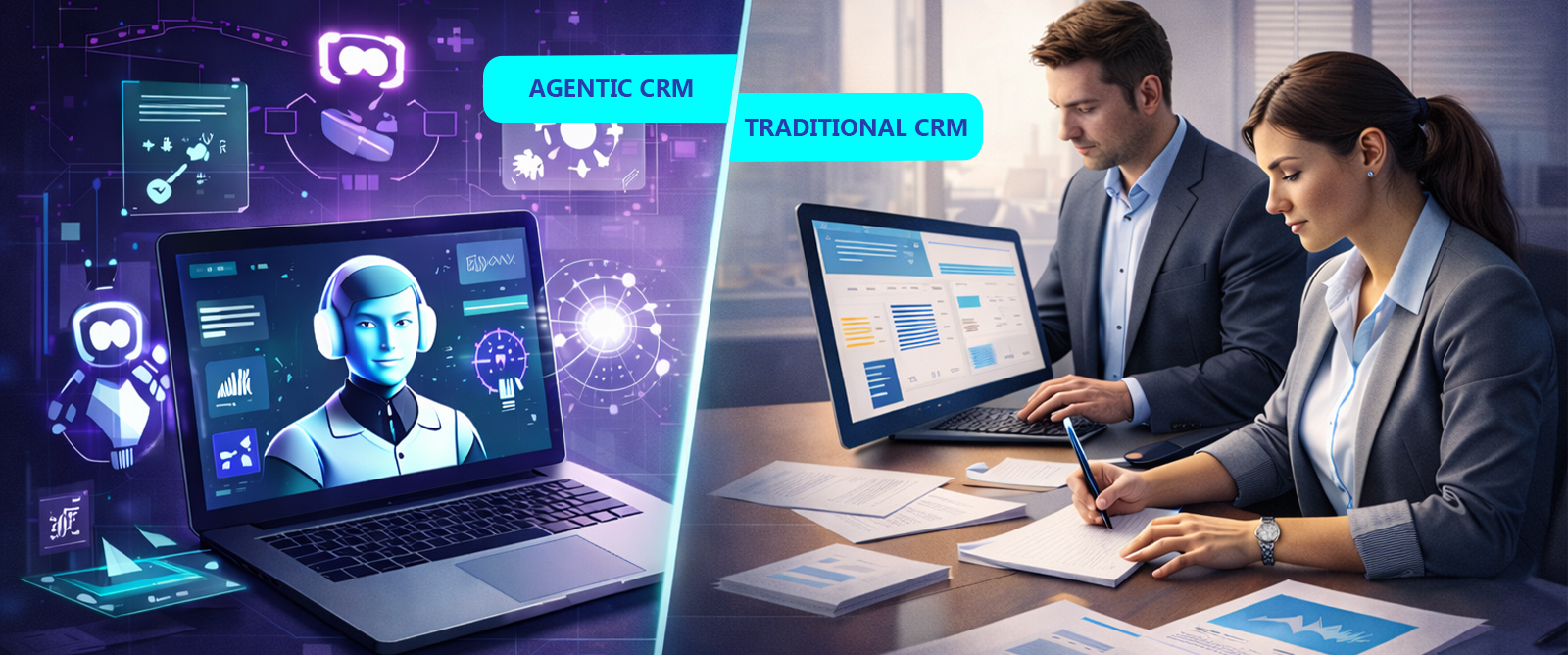
Traditional CRM systems primarily organize and manage customer information. Agentic CRM extends this model by applying AI-driven intelligence and action to customer workflows, changing how enterprises engage, prioritize, and respond across the customer lifecycle.
CRM systems have been a foundation of enterprise commercial operations for decades. From early contact management tools to modern cloud CRM platforms, their core role has remained consistent: providing a centralized system of record for customer data, interactions, opportunities, and pipeline management.
These systems have created significant value by improving sales visibility, centralizing customer information, and bringing greater structure to pipeline management. However, as commercial operations become more complex, with larger customer bases, longer buying journeys, growing volumes of interaction data, and increasing expectations for personalization, the limitations of predominantly record-driven CRM models become more apparent.
Agentic CRM represents the next evolution of this architecture. By applying agentic AI to customer relationship management, it enables AI agents to interpret customer and business context, recommend next-best actions, coordinate workflows, and execute approved tasks across sales, marketing, and customer success. This extends CRM from a system of record towards an intelligent system of engagement and action.
The Limitations of Traditional CRM
Traditional CRM systems are fundamentally passive, they store and display information, but they do not independently analyse, decide, or act. This passivity creates several systemic limitations as commercial operations scale:
Data and Quality Degradation
CRM systems often depend on sales and customer-facing teams to keep key records up to date. In practice, customer data can become outdated as contacts change roles, deal stages evolve, and valuable context from customer interactions remains fragmented across communication channels. As data quality declines, the CRM becomes less reliable as a foundation for segmentation, forecasting, prioritization, and customer engagement.
Insight Gap
Traditional CRM platforms provide valuable reporting and analytics, but deeper predictive insights often depend on additional models, integrations, or manual analysis. Identifying which leads are more likely to convert, which customers may be showing churn signals, or which opportunity patterns indicate a higher probability of closure can require data and analysis beyond standard CRM reporting.
Action Gap
Even when traditional CRM platforms surface insights through dashboards, reports, or alerts, acting on those insights often requires manual follow-through. A system may flag that a key account has not been engaged for an extended period, but determining the appropriate next action, timing, and communication still depends on the sales team.
What is an Agentic CRM?
An agentic CRM replaces the passive architecture of traditional CRM with an active intelligence layer powered by AI agents that continuously analyse customer data, identify opportunities and risks, and take autonomous action, within defined parameters, to advance commercial outcomes.
The key shift is from ‘records and reports’ to ‘intelligence and action.’ An agentic CRM does not wait for a human to query its data, it continuously monitors the entire customer relationship landscape and acts on what it finds.
Six Ways Agentic CRM Differs from Traditional CRM
| Traditional CRM | Agentic CRM |
| Manual data entry | Autonomous data capture and enrichment |
| Static records | Dynamic, self-updating intelligence |
| Reactive alerts | Proactive opportunity detection |
| Human-driven follow-up | Autonomous engagement orchestration |
| Retrospective reporting | Predictive intelligence and forecasting |
| Single system silo | Integrated action across entire commercial stack |
1. Autonomous Data Capture and Enrichment
Agentic CRM eliminates the data entry burden by continuously capturing and enriching customer data from all interaction channels, emails, calls, meetings, support tickets, web behaviour, and third-party signals. AI agents read every customer interaction, extract structured data, update records in real time, and enrich profiles with external intelligence, without any manual input from sales reps.
2. Continuous Opportunity and Risk Monitoring
AI agents continuously monitor all customer accounts for signals that indicate opportunity or risk, detecting buying intent signals, churn risk indicators, competitive threat signals, and cross-sell/upsell readiness. Rather than relying on periodic manual account reviews, agentic CRM surfaces these signals in real time as they emerge.
3. Autonomous Engagement Orchestration
When agents identify opportunities or risks requiring action, they can autonomously execute engagement actions within predefined parameters, sending personalised follow-up messages, scheduling calls, creating tasks for account managers, or escalating high-priority situations.
4. Predictive Pipeline Intelligence
Agentic CRM applies machine learning to historical deal data to generate accurate probability-weighted pipeline forecasts, identify deals at risk of slipping, and predict close timing with significantly higher accuracy than traditional stage-based forecasting.
5. Intelligent Next-Best Action
For every customer relationship in the portfolio, agentic CRM continuously calculates and recommends the highest-value next action, based on deal stage, customer behaviour, competitive context, and historical patterns. Sales teams receive intelligent guidance on where to focus their time for maximum commercial impact.
Agentic CRM for Indian Enterprises
For Indian enterprises, agentic CRM addresses several specific challenges that make traditional CRM particularly limiting:
- Language diversity: Indian commercial teams operate across multiple languages and regional contexts. Agentic CRM with Indic language support can capture and analyse customer interactions across regional languages, not just English.
- High-velocity SMB sales: Indian enterprises serving SMB customers at scale require automated engagement orchestration to manage large customer portfolios with lean commercial teams.
- DPDP compliance: Agentic CRM deployed on sovereign infrastructure ensures that the rich customer data captured and analysed remains within India’s regulatory jurisdiction.
- Complex relationship hierarchies: Indian enterprise sales frequently involve multi-stakeholder, long-cycle deals with complex organisational relationships. Agentic CRM can map and navigate these relationships intelligently.
iStreet’s Agentic CRM Solution
iStreet’s agentic CRM is built on its sovereign AI-native platform, providing Indian enterprises with a purpose-built agentic intelligence layer for commercial operations:
- Omnichannel interaction capture: Autonomous capture of email, call, meeting, and digital interaction data with AI-powered structured extraction.
- AI-driven opportunity scoring: Real-time opportunity and churn risk scoring across all accounts with actionable intelligence surfaced to the right team members.
- Autonomous engagement agents: AI agents that execute pre-approved follow-up actions, manage routine touchpoints, and escalate exceptions to team members.
- Predictive revenue intelligence: ML-based pipeline forecasting with deal-level risk analysis and close probability scoring.
- Sovereign deployment: All CRM data, interactions, and AI inference are within the enterprise’s Indian regulatory perimeter.
The enterprise CRM of the next decade is not a bigger database or a cleaner dashboard. It is an intelligent, autonomous commercial partner that never sleeps, never misses a signal, and never lets a follow-up fall through the cracks.
Traditional CRM gave enterprises visibility. Agentic CRM gives enterprises velocity, the ability to act on every commercial opportunity and risk, at the speed and scale that a digital-first Indian market demands.
iStreet Network’s Sovereign AI Enterprise Platform enables enterprises to explore Agentic CRM opportunities across sales, marketing, and customer engagement workflows. By combining AI-driven intelligence, next-best actions, and governed automation, iStreet helps organizations identify where Agentic CRM can improve decision-making, engagement, and operational efficiency.