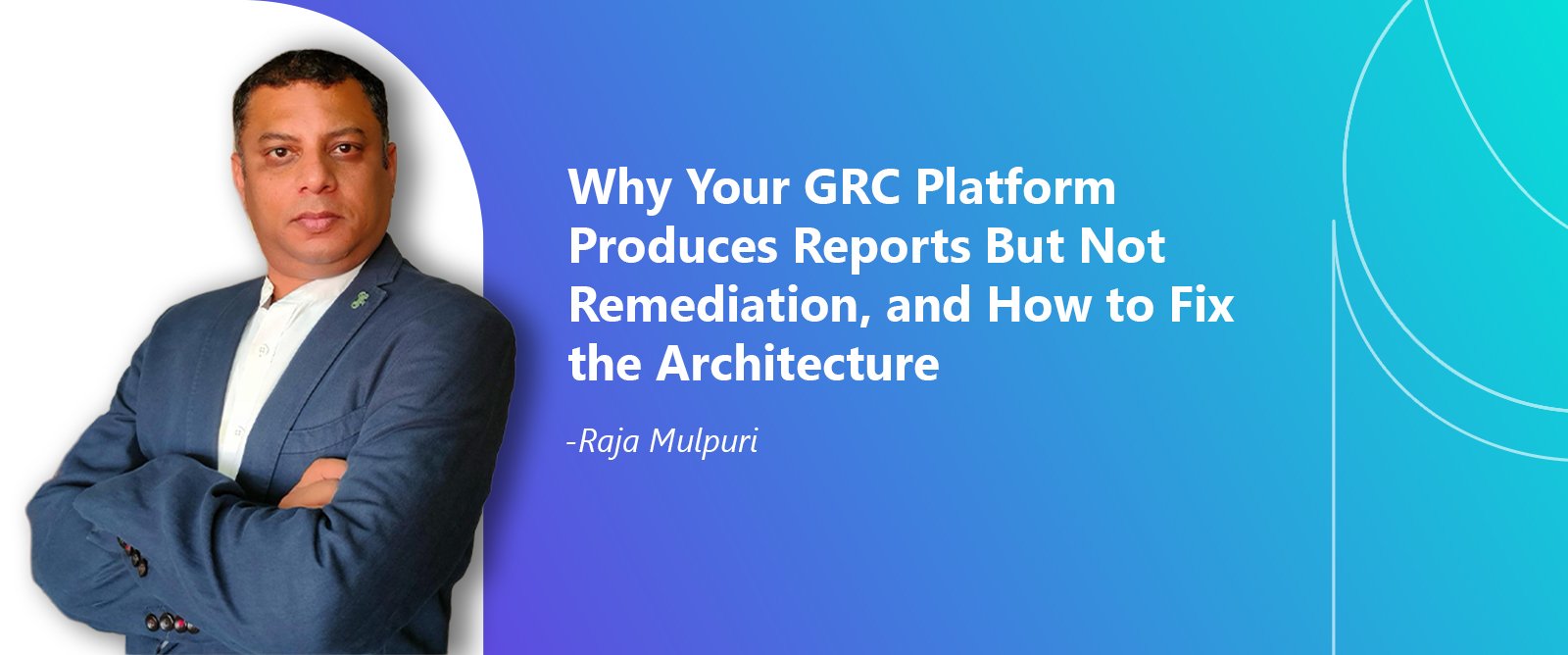
The Conversation I Have Had Too Many Times
In nearly every GRC discussion I’ve had over the past 10 years, there’s a point when the formal presentation wraps up, and the real issue comes to light. The compliance leader puts aside the slides, the CISO steps back, and someone says, “We passed the audit, but nothing actually changed.” I’ve heard this concern from compliance leaders at banks, insurance companies, NBFCs, and large enterprises.
They are not complaining about their GRC vendor. They are describing a deeper architectural limitation. The platform maps frameworks, collects evidence, generates reports, and supports audit preparation. However, after the report is generated, the organization’s underlying compliance and risk posture may remain unchanged.
What Compliance Teams Actually Buy When They Buy GRC
When an organization evaluates a GRC platform in India, the RFP typically focuses on the platform’s coverage of frameworks and the number of regulatory standards it supports. It also looks at dashboard quality, reporting flexibility, and integration with existing enterprise systems.
What few RFPs examine closely is what happens after the platform identifies a control failure:
- Does the platform assign the finding to a specific remediation owner?
- Does it initiate a remediation workflow with defined actions, deadlines, escalation rules, and verification steps?
- Can compliance and operational teams track remediation within the same system?
- Does the platform reassess the control after remediation to verify that the organisation has closed the gap?
Many GRC evaluations give limited attention to these questions. As a result, organizations may select platforms that clearly report their compliance posture but provide limited support for improving it when controls fail.
Indian enterprises should therefore evaluate more than framework mappings and reporting capabilities. They should determine whether the platform can translate applicable regulatory requirements into operational workflows that are accountable. Requirements relating to risk management, incident response, evidence, and remediation demand demonstrable action, not documentation alone.
The Design Assumption the Entire GRC Category Got Wrong
Traditional GRC architecture has largely treated the compliance record as its primary output. Platforms map frameworks, document controls, collect evidence, generate reports, and support audits. This model creates an auditable view of the organization’s posture at the time of assessment.
The goal of a GRC platform should not be a compliance record. It should be a compliant operational posture. Those are fundamentally different things.
- A compliance record shows the organisation’s posture at a specific point in time, but it does not improve that posture.
- It does not automatically connect a finding with the team responsible for resolving it.
- It does not confirm that the assigned team completed the required action
- It does not reassess the control after remediation to verify closure.
- It documents the problem but does not necessarily provide the mechanism to resolve it.
The remediation gap exists between identifying a control failure and verifying that the organization has resolved it. This is where compliance moves from documentation to accountable operational action.
In regulated environments, organizations must often demonstrate how they addressed previously identified gaps. They need evidence of assigned ownership, corrective action, progress tracking, approvals, and verification. A GRC platform that produces reports without supporting remediation leaves a critical part of the compliance lifecycle outside the platform.
The Question That Reframes the Entire Evaluation
A key question to ask when evaluating a GRC platform is how well it helps your organization move from a failed control to verified remediation. It is important to look not just at how failures are documented, but also at how quickly, reliably, and transparently they are resolved.
This changes the evaluation criteria. Framework coverage remains important, but organizations must also assess the depth of remediation workflows. Dashboards must do more than visualize findings; they should help teams assign, track, escalate, and verify corrective action. Audit readiness should include the operational journey from finding to closure.
When compliance leaders and CISOs examine their current processes through this lens, many recognize that remediation tracking sits outside their GRC platform. Teams manage it through project-management tools, spreadsheets, email chains, or separate ticketing systems that remain disconnected from the compliance data that identified the gap.
The compliance team identifies the failed control, but it is up to the technology or business team to fix the issue. These teams often use different systems, have separate responsibilities, and may not have a shared way to track progress. Sometimes, the compliance team also lacks clear proof that the organization reviewed the control again after it was fixed.
My Conviction
I have seen the consequences of selecting a GRC platform that stops at reporting. The cost extends beyond license fees. Over time, organizations lose confidence that their compliance investment is reducing risk or improving control effectiveness. The distinction between a platform that generates reports and one that supports remediation is not simply a feature comparison. It is an architectural decision that determines whether compliance remains a record-keeping exercise or becomes an operational capability.