Organisations invest heavily in robust systems, talented personnel, and sophisticated tools to ensure smooth operations. Yet small anomalies often escape attention, minor glitches in applications, occasional lags in processes, or subtle irregularities in performance metrics. These may appear insignificant in isolation. But when left unaddressed, they follow the principle of compounding effects, cascading into significant disruptions that lead to operational inefficiencies, financial losses, and reputational damage.
For Indian enterprises operating mission-critical systems, banks processing millions of UPI transactions daily, healthcare platforms managing patient data under stringent compliance requirements, government digital services serving hundreds of millions of citizens, the compounding cost of ignored anomalies is not theoretical. It is the root cause behind some of the most costly incidents in recent years.
The Domino Effect of Overlooked Anomalies
A small irregularity in one part of an enterprise system might initially appear inconsequential, a delayed API response, a misconfigured server setting, or a minor discrepancy in data synchronisation. However, these small issues often escalate as they propagate across interconnected systems, creating consequences far disproportionate to their apparent severity.
Subtle performance drops create compounding revenue impact. A 2% increase in page load time may not raise alarms initially, it does not breach any threshold, does not trigger any alert, and does not appear in any dashboard as a red indicator. However, if the delay is consistent, it creates a measurable drag on user experience. For e-commerce platforms, research consistently shows that every additional second of load time reduces conversion rates. Over weeks and months, what appeared to be an insignificant performance variation translates into millions in lost revenue, higher bounce rates, and reduced customer engagement, all without a single incident ticket ever being filed.
Data integrity errors corrupt decision-making silently. A small error in data migration or synchronisation may go unnoticed initially, a timestamp format inconsistency, a rounding error in financial calculations, or a missing field in a data pipeline. Over time, such errors corrupt analytics insights across the organisation. Business decisions are made on flawed data. Forecasts are inaccurate. Compliance reports contain discrepancies that surface only during audits, months after the original error occurred. For Indian financial institutions subject to regulatory bodies reporting requirements, these silent data integrity issues carry regulatory consequences that far exceed the effort that would have been required to catch them early.
Systemic overload builds from minor inefficiencies. A misconfigured database query causing minor lags might function perfectly under normal load. But under peak conditions, month-end batch processing, festival season traffic, salary day transaction volumes, that same minor inefficiency becomes the bottleneck that brings the entire system to its knees. The lag that was ‘not worth fixing’ becomes the outage that costs crores.
Why These Anomalies Go Undetected
The challenges are structural, not individual. They reflect fundamental limitations in how most enterprises approach operational monitoring.
Volume and complexity of data overwhelm human analysis. Enterprises generate massive amounts of data daily. Sifting through logs, metrics, events, and traces, collectively known as MELT data, to identify small but meaningful anomalies is genuinely difficult at scale. The sheer volume means that minor deviations are buried under layers of information. A subtle increase in garbage collection frequency on one of fifty application servers is invisible when you are looking at aggregate dashboards.
Lack of contextual correlation hides impact. Small anomalies in isolation often appear harmless. A minor network latency increase. A slight uptick in database connection times. A marginal increase in API error rates. Each, viewed independently, falls well within acceptable ranges. Without tools to correlate these anomalies across systems, to recognise that the network latency increase and the database connection time increase and the API error rate increase are all connected through a shared infrastructure component, teams cannot identify the pattern or understand the broader impact until it escalates into a visible outage. AIOps event correlation helps connect these seemingly unrelated signals into a common operational context.
Human oversight naturally prioritises the visible. Manual monitoring relies on human judgement, which is inherently biased toward visible, immediate problems. When a dashboard shows a red alert and a yellow warning simultaneously, the team addresses the red alert. The yellow warning, which might be the early signal of a far more serious problem, gets deferred. Over time, this deferral creates a backlog of unaddressed minor issues that compound into systemic fragility.
Resource constraints force trade-offs. Monitoring every minor irregularity with the same attention as major incidents requires resources that many enterprises cannot spare. Teams are understaffed relative to the complexity they manage. They prioritise high-impact, visible areas, production applications, customer-facing services, revenue-critical transactions, and less visible parts of the system receive less attention. It is in these less-monitored corners that small anomalies fester.
Inadequate tooling creates blind spots. Traditional monitoring tools often operate in silos, each covering a specific layer of the stack. The infrastructure monitoring tool sees server metrics but not application behaviour. The APM tool sees transaction traces but not network performance. Without cross-layer visibility and correlation, small issues that span multiple domains go undetected until they cascade. This is one of the key differences between AIOps and traditional monitoring: AIOps looks for relationships across signals rather than evaluating each threshold independently.
The Cost of Operational Blind Spots
Financial impact is direct and measurable. Unresolved operational issues can lead to service disruption, productivity loss, and increased operational costs. For enterprises running business-critical digital services, the financial impact of downtime can extend beyond direct revenue loss to include recovery costs, customer disruption, regulatory exposure, and engineering effort. In highly digital environments such as banking, healthcare, and public services, maintaining service resilience therefore becomes a significant business priority.
Reputational damage compounds over time. User expectations for digital performance and reliability continue to rise. Frequent latency, service degradation, or outages can contribute to customer dissatisfaction, churn, and reputational impact. In India’s highly competitive digital marketplace, operational unreliability can increase the risk of customer attrition and weaken brand trust, which may require significant effort to rebuild.
Operational inefficiencies drain strategic capacity. Small anomalies, when compounded, create inefficiencies across departments. Recurring delays in data processing disrupt workflows, delay project timelines, and affect overall productivity. Engineering teams spend 30 to 40% of their time on incidents and troubleshooting, time that could be invested in building new capabilities, improving architecture, and driving the digital transformation that the business depends on.
Missed opportunities represent hidden losses. Flawed analytics or delayed insights caused by data anomalies result in missed business opportunities. Market trends are not capitalised on because the data was corrupted. Supply chain optimisations are not implemented because the analysis was based on inaccurate inputs. Product decisions are made on flawed customer behaviour data because a data pipeline error went undetected for weeks. These blind spots can weaken operational resilience because teams often discover the broader impact only after service degradation has already spread.
Proactive Anomaly Management with AIOPS: The iStreet Approach
Addressing small anomalies before they compound requires a fundamentally different operational approach, one that replaces manual, threshold-based monitoring with intelligent, continuous, context-aware detection and response.
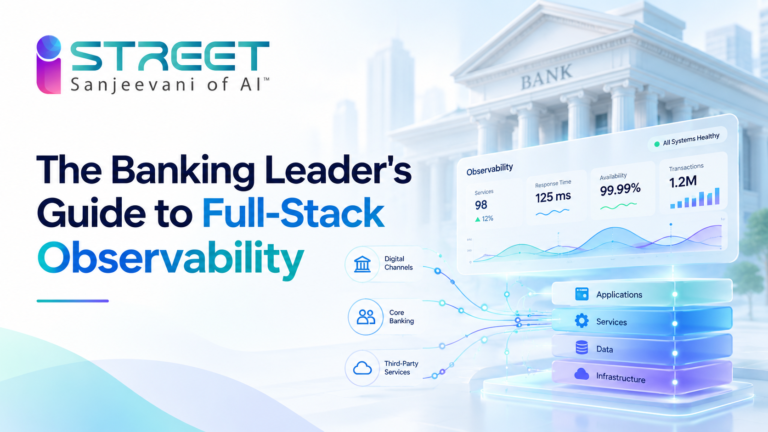
Centralised observability integrates logs, metrics, events, and traces across systems into a unified view of system health. This eliminates the blind spots created by siloed monitoring tools and allows teams to detect anomalies in real time with full cross-layer context. When a minor network issue correlates with a minor database issue and a minor application issue, the centralised view reveals the connection that isolated tools miss. Full-Stack Observability provides the cross-layer telemetry needed to understand how anomalies propagate across applications, infrastructure, databases and networks.
Machine learning-driven anomaly detection goes beyond static thresholds to identify patterns that deviate from learned normal behaviour. These models detect subtle issues that escape human observation, gradual performance degradation, unusual usage patterns, slowly accumulating resource consumption, and flag them before they reach the tipping point of visible impact.
Predictive analytics leverages historical data to forecast potential issues before they occur. By recognising the precursor patterns that historically precede specific failure modes, the system enables preemptive action, scaling resources, optimising configurations, or alerting teams, before the failure.
Automated remediation resolves common issues without human intervention. When the system detects a known pattern, an application exceeding CPU usage thresholds, a database connection pool trending toward exhaustion, a cache nearing capacity, it executes predefined corrective actions automatically, maintaining system stability without requiring an engineer to investigate, diagnose, and manually intervene. For higher-risk actions, remediation can remain governed through predefined approvals and human oversight.
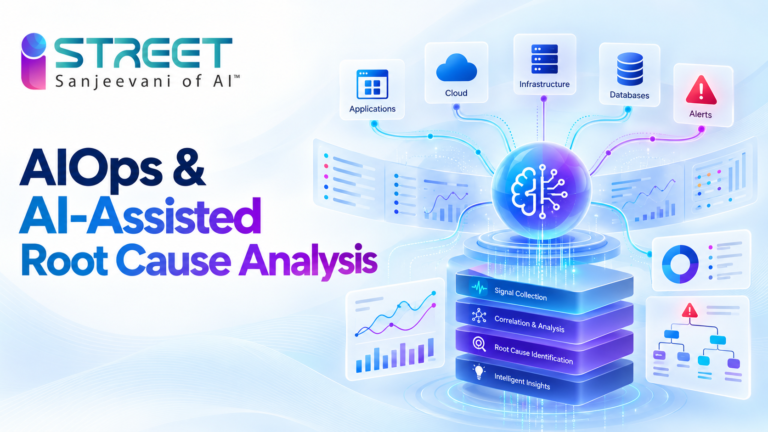
Automated Root-Cause Analysis with AIOps traces anomalies back to their origin, allowing teams to address the root cause rather than treating symptoms. This prevents recurrence and ensures long-term system health, breaking the cycle of recurring incidents that consumes engineering capacity quarter after quarter. This helps teams identify the probable root cause of an issue and determine the appropriate remediation rather than treating downstream symptoms independently.
Resolving High Memory Utilization for a Bank
A leading multinational bank, with 2,000 branches, 2,886 ATMs, and more than 25 million users, was experiencing recurring high memory utilization across its core banking environment powered by Infosys Finacle. Despite processing approximately 393 million transactions annually and having dedicated IT operations teams and infrastructure partners, identifying the underlying cause remained challenging.
Initially, the memory issue appeared intermittently and had a limited impact on day-to-day operations. It was treated as a lower-priority anomaly. Over time, however, the pattern became more frequent and began contributing to operational instability. The broader environment was experiencing more than 47 hours of downtime per month, with an estimated monthly business impact of $11.5 million across revenue loss, SLA penalties, and operational overhead.
AIOps solution, deployed as part of the bank’s operational resilience programme, applied anomaly detection and root cause analysis to identify misconfigured application parameters associated with the recurring memory spikes. The issue originated in an earlier deployment and surfaced only under specific workload conditions, making it difficult to identify solely through conventional threshold-based monitoring
Using the platform’s recommendations, the bank optimized the relevant parameter settings, reducing recurring memory-related issues. The program contributed to a 10% month-on-month reduction in outages and improved operational stability, demonstrating how AIOps can help identify and address recurring anomalies that may remain difficult to diagnose through traditional monitoring approaches.
Small Anomalies, Strategic Risk
Small anomalies in enterprise systems are not trivial. Like a slow leak in a dam, they may initially seem negligible but can lead to catastrophic consequences if ignored. The AIOps market’s projected growth, from 6.5 billion in 2022 to 21.1 billion by 2027, underscores the growing recognition that intelligent anomaly management is a necessity.
For Indian enterprises navigating rapid digital transformation alongside increasing regulatory scrutiny, proactive anomaly management is a governance imperative. Organisations without proactive frameworks incur 30% higher costs due to system failures compared to those with advanced monitoring solutions. The choice is clear: invest in prevention or pay for consequences. For enterprises running mission-critical services, resilient IT operations depend on identifying these patterns before they escalate into visible outages.
iStreet Network’s Sovereign AI Enterprise Platform, built on the Sanjeevani of AI™ framework and powered by HEAL Software’s AIOps capabilities, helps enterprises move beyond threshold-based monitoring towards intelligent, proactive operations. Through behavioral baselining, anomaly detection, event correlation, and AI-driven root cause analysis, the platform can surface emerging patterns, identify relationships across operational signals, and provide contextual recommendations for faster investigation and resolution. This enables enterprises to detect issues that conventional monitoring may overlook and strengthen resilience across complex, mission-critical environments.
Talk to our advisors to explore how iStreet Network helps enterprises detect and address emerging anomalies before they escalate into larger operational incidents.
Originally inspired by insights from HEAL Software, an iStreet Network AIOps product.