The Alert Flood: When Monitoring Creates More Noise Than Context
Enterprise IT environments rely on multiple monitoring tools to maintain visibility across servers, networks, databases, applications, and cloud services. Each tool monitors specific aspects of the technology environment and generates alerts when predefined conditions or abnormal behavior are detected. The challenge emerges when these tools operate independently, without sufficient context to correlate related signals.
A change in system behavior, such as increased CPU utilization, network latency, database contention, or slower API response times, can generate alerts across multiple monitoring systems. In complex IT environments, a single underlying issue may produce related symptoms across infrastructure, networks, applications, and user-facing services.
The result can be an alert flood: dozens or even hundreds of related notifications associated with the same underlying incident. Without effective correlation, operations teams must determine which alerts represent symptoms, which require attention, and where the probable cause lies, adding noise and complexity to incident investigation.
For Indian enterprises operating at scale, including banks supporting high volumes of digital transactions, e-commerce platforms managing peak traffic, and healthcare organizations running critical patient workflows, alert overload can become a significant operational challenge. High volumes of uncorrelated alerts can slow incident investigation, extend resolution times, and increase operational risk.
The challenge does not end with the alerts themselves. Related alerts can generate multiple incident tickets within IT Service Management systems, creating fragmented views of the same underlying issue. Duplicate or related tickets can complicate root cause investigation, increase coordination effort, and extend resolution time. Engineering teams may spend valuable time reconciling information across tickets and systems rather than focusing on diagnosis and remediation. During major incidents, different teams may be working from different symptoms and operational perspectives, making it more difficult to establish a shared understanding of the incident. This is the shift from alert-centric monitoring to incident-centric management.
The Structural Problems Alert Floods Create
The consequences of unmanaged alert floods are deeper than simple noise. They create structural operational dysfunction. AIOps helps enterprises reduce alert fatigue by correlating related alerts into a smaller number of contextual incidents rather than treating every signal independently.
Duplicate tickets multiply coordination overhead. Each alert raises a separate ticket, resulting in several tickets for a single incident. This duplication confuses IT personnel and increases workload because the same root cause information needs to be updated in each ticket. Engineers spend valuable time on administrative work, updating status, cross-referencing related tickets, closing duplicates, rather than solving the actual problem. AIOps event correlation groups related alerts using time, topology, historical co-occurrence and service dependencies to create a common incident context. The objective is not simply fewer alerts, but fewer, more actionable incidents.
Delayed root cause analysis extends customer impact. Identifying the root cause amidst a flood of alerts is genuinely difficult. The signal is buried in noise. The engineer who needs to trace the causal chain from symptom to root cause is instead triaging hundreds of individual alerts, determining which are genuine and which are symptoms. This triage process consumes the critical first minutes of every incident, the minutes when swift action could contain the blast radius and prevent escalation. Topology-aware correlation helps distinguish probable root causes from downstream symptoms, narrowing the investigation path for operations teams.
Alert fatigue degrades response quality. When teams receive multiple alerts everyday and the majority are duplicates or false positives, they develop alert fatigue. The natural human response to persistent noise is desensitisation. Engineers begin treating alerts as routine rather than urgent. The genuine critical alert, the one that indicates an imminent production failure, gets the same desensitised response as the hundredth duplicate notification. Alert fatigue does not just slow response. It creates the conditions for catastrophic misses.
Communication inefficiency diverts engineering capacity. IT teams spend valuable time manually communicating the same information across teams and tickets, diverting focus from actual problem-solving. In a multi-team operations environment, where database, application, infrastructure, and network teams each manage their own alert streams, the coordination overhead of a single incident can consume more engineering hours than the technical resolution itself. Conversational AI gives operators a natural-language interface to explore the incident, query dependencies, review previous resolution patterns and understand recommended next steps. For production incident management, this reduces the time spent searching across dashboards, tickets and knowledge bases for context.
Intelligent Correlation: Turning Multiple Alerts into Actionable Incidents
AIOps solutions address alert overload through intelligent event correlation that goes beyond basic deduplication.
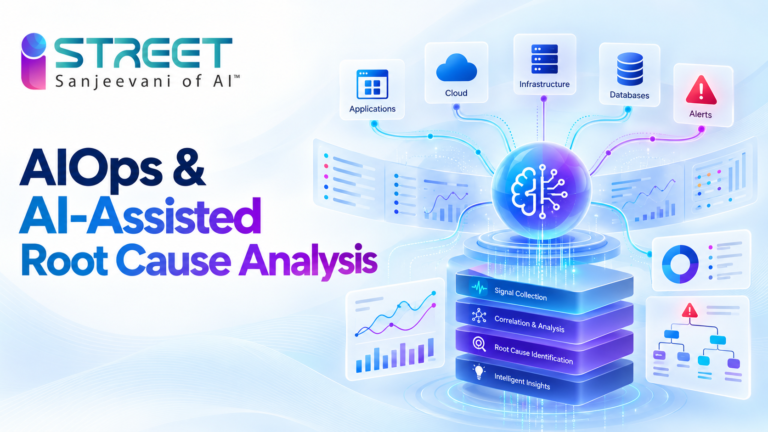
Advanced pattern recognition and predictive insights. Using machine learning, the correlation engine identifies recurring patterns across alerts, incidents, and historical operational data. By recognizing relationships associated with previous issues, it can surface predictive insights that help teams identify emerging risks and respond before they develop into broader service impact. When a similar alert pattern has occurred in previous incidents, the platform can correlate it with historical resolution outcomes and surface relevant remediation context. This enables operations teams to recognize recurring conditions more quickly and accelerate investigation and response.
Dynamic incident prioritisation. Not all alerts require immediate attention. The platform automatically prioritises incidents based on potential business impact, historical patterns, and real-time severity, directing IT teams’ focus to the most critical issues first. A database issue affecting the payment processing pipeline receives higher priority than the same database issue affecting a batch job.
Temporal, topological, and semantic correlation. The correlation engine groups related alerts across multiple analytical dimensions. Temporal analysis identifies alerts occurring within the same time window. Topology-aware analysis uses service dependency relationships to understand how an issue in one component, such as a database, may generate related symptoms across dependent services and correlate them within a common incident context. Semantic analysis examines alert content across different tools and terminology to identify signals that may be associated with the same underlying issue. Together, these capabilities can consolidate large volumes of related alerts into fewer context-rich incidents, with probable causes and affected-service relationships surfaced for investigation.
Real-time collaboration across teams. The platform enables seamless communication between IT and support teams by sharing correlated event data. This eliminates information silos and ensures that all relevant teams are aligned and have access to the same incident insights. Instead of each team investigating the incident from its own operational perspective, teams work from a shared, correlated view of the incident and its impact across the environment.
The GenAI Copilot: Conversational Intelligence for Incident Resolution
Intelligent correlation solves the alert flood. But the next challenge, understanding what happened, why it happened, and what to do about it, requires a different kind of intelligence.
The GenAI copilot provides a conversational interface to the platform’s operational intelligence. Rather than navigating dashboards and running queries, engineers interact through natural language, asking questions and receiving contextual, data-driven answers.
Contextual conversation, not generic chat. When an incident is correlated and surfaced, the copilot does not just relay the alert data. It provides contextual understanding by drawing on historical incidents, recent configuration changes, deployment logs, and service ownership data. If the engineer asks ‘Has this happened before?’, the copilot does not return a simple yes or no. It provides a detailed breakdown of similar past incidents, the circumstances around them, and the exact solutions that worked, turning a static investigation process into an interactive problem-solving session.
Real-time analysis that accelerates decision-making. The copilot leverages AIOps data to analyse the current situation in real time. It helps teams understand not just what the problem is but why it happened, offering detailed RCA insights and suggesting potential remediation actions based on current system state, not just generic runbook steps. This contextual analysis reduces Mean Time to Identify and enables faster, more confident resolution decisions.
Tailored recommendations based on current conditions. Unlike systems that rely on pre-set answers, the copilot generates recommendations that account for real-time conditions, current traffic volumes, system load, recent configuration changes, and workload characteristics. The suggested remediation is specific to the current incident context, not a generic playbook entry.
Continuous learning that improves over time. As the copilot processes each incident, it learns from the resolution. The next time a similar issue arises, it has improved insights and optimised solution recommendations ready, further accelerating resolution speed and accuracy with every incident cycle.
The Combined Effect: From Chaos to Governed Intelligence
When intelligent correlation and conversational AI operate together, the transformation is comprehensive.
Alert noise is reduced by 85 to 95 percent through intelligent correlation. The remaining incidents are enriched with full cross-domain context. The GenAI copilot provides interactive, contextual guidance for diagnosis and resolution. Automated remediation handles known patterns autonomously. And every resolution feeds back into the learning models, making the system progressively smarter.
The operational experience shifts from chaotic, reactive firefighting to focused, governed, intelligent operations. Engineers who previously spent hours triaging alerts now spend minutes on meaningful incidents. War rooms that used to run for hours now resolve in minutes. And the institutional knowledge that previously lived only in the heads of senior engineers is captured, codified, and available to every member of the operations team.
For Indian enterprises managing mission-critical digital infrastructure, where downtime is measured in lost revenue and regulatory compliance requires demonstrable operational governance, this transformation is not incremental improvement. It is the operational architecture that modern digital business demands. Correlated incidents can also be prioritised using service criticality, SLA exposure and business impact rather than alert severity alone.
About iStreet Network
iStreet Network’s Sovereign AI Enterprise Platform, built on the Sanjeevani of AI™ framework, addresses alert overload through its HEAL AIOps and GenAIOps capabilities. By correlating signals across applications, infrastructure, networks, and operational systems, iStreet consolidates fragmented alerts into context-rich incidents with probable causes and affected-service relationships. Conversational AI extends this intelligence by enabling teams to investigate incidents through natural-language queries, access relevant historical context and resolution patterns, and identify appropriate next steps. Together, these capabilities help enterprises reduce alert noise, accelerate investigations, and move from fragmented monitoring to more informed, resilient incident operations.
Talk to our advisors to explore how intelligent correlation and conversational AI can help reduce alert noise, accelerate incident investigation, and improve resolution across your enterprise environment.
Originally inspired by insights from HEAL Software, an iStreet Network AIOps product.