In a market that includes established security vendors, cloud-native platforms, and emerging AI-driven providers, choosing the right SIEM++ platform requires moving beyond feature checklists to evaluate architectural flexibility, data strategy, AI capabilities, governance, and operational maturity. A strong SIEM vendor evaluation should go beyond feature comparison and assess architecture, data strategy, AI maturity, governance and operational fit.
To navigate this landscape effectively, evaluate providers across these four strategic dimensions-
- Architectural Model → Decoupled vs. Monolithic
The primary failure of legacy SIEM is the ‘ingestion-based’ pricing model where data volume growth outpaces security budgets. This also helps CISOs evaluate whether the provider’s pricing model can scale predictably as security telemetry grows.
- The ‘++’ requirement- Seek providers that offer a decoupled architecture, separating storage (low-cost data lakes like S3 or Snowflake) from compute (on-demand analysis).
- Performance metric- Ensure the provider utilises an index-free architecture to maintain query speed at petabyte scale, avoiding the performance degradation common in traditional proprietary databases.
- Federated capability- Modern leaders must support federated search in SIEM, allowing analysts to query data where it resides (e.g., cloud buckets, SaaS logs) without moving it, which respects data sovereignty and avoids egress fees.
- AI Maturity → Agentic AI vs. Basic AI Assistance
Many AI-labeled security features provide limited operational value when restricted to basic chat interfaces, alert summarisation, or surface-level assistance, without improving investigation, decision-making, or response. The strongest platforms should support multi-step investigation and governed response rather than limiting AI to summarisation or chat.
- The ‘++’ requirement- Look for Agentic AI, autonomous systems capable of reasoning, planning investigations, and executing remediation with ‘human-on-the-loop’ oversight.
- Evaluation criteria- High-value AI should handle 90% or more of Tier-1 triage tasks and reduce false positives by 95-99%.
- Explainability- The provider must demonstrate transparency, showing the step-by-step logic. Explainability should include cited evidence, confidence and a replayable investigation trail.
- Standardisation: → The open schema framework Prerequisite
To avoid vendor lock-in and effectively manage a multi-vendor environment, the provider must natively support the open schema framework. Open-schema support improves SIEM interoperability and reduces dependence on proprietary data models. This is a key consideration for enterprises trying to avoid SIEM vendor lock-in across multi-vendor environments.
- The ‘++’ requirement – An open schema framework provides a common data model for normalizing security telemetry across disparate sources, enabling more consistent detection logic, querying, and investigation across the security data environment.
- Speed to value – Native open schema framework support drastically cuts data processing time and ensures that critical context is not lost during manual normalisation.
- Market Segmentation → Choosing Your Path
The market has split into distinct directions. Your choice depends on your current stack and team maturity. The best SIEM++ provider depends on your existing stack, data volumes, operating model and internal security maturity.
| Category | Best For |
| Unified Ecosystems | Organisations heavily invested in a specific stack seeking deep integration and a unified ‘Single Pane of Glass.’ |
| AI-Native SIEM | Teams prioritising vendor-agnostic autonomous analysts or specialised endpoint/identity telemetry. |
| Open Data Lakes | Large enterprises focused on high-volume data control, long-term retention, and custom analytics. |
Practical Decision Framework- The PDDIR Checklist
When running a Proof of Value (PoV), score each vendor using the PDDIR framework. Use this SIEM vendor evaluation checklist during a PoV to compare providers consistently.
- Pricing- Does the model offer predictable costs as data volumes surge? SIEM total cost of ownership
- Deployment- Can the solution be deployed in days (cloud-native) vs. months (on-premises/legacy)?
- Detection- Does it identify novel, behavioral threats (UEBA) rather than just static rules? Assess whether the platform supports behavioural detection and UEBA in addition to static rules.
- Investigation- Does the AI provide automated context enrichment and ‘natural language’ builders? Evaluate whether the platform provides contextual enrichment, natural-language investigation and evidence relationships.
- Reporting- Can it generate executive-ready risk reports and map to frameworks like MITRE ATT&CK?
About iStreet Network
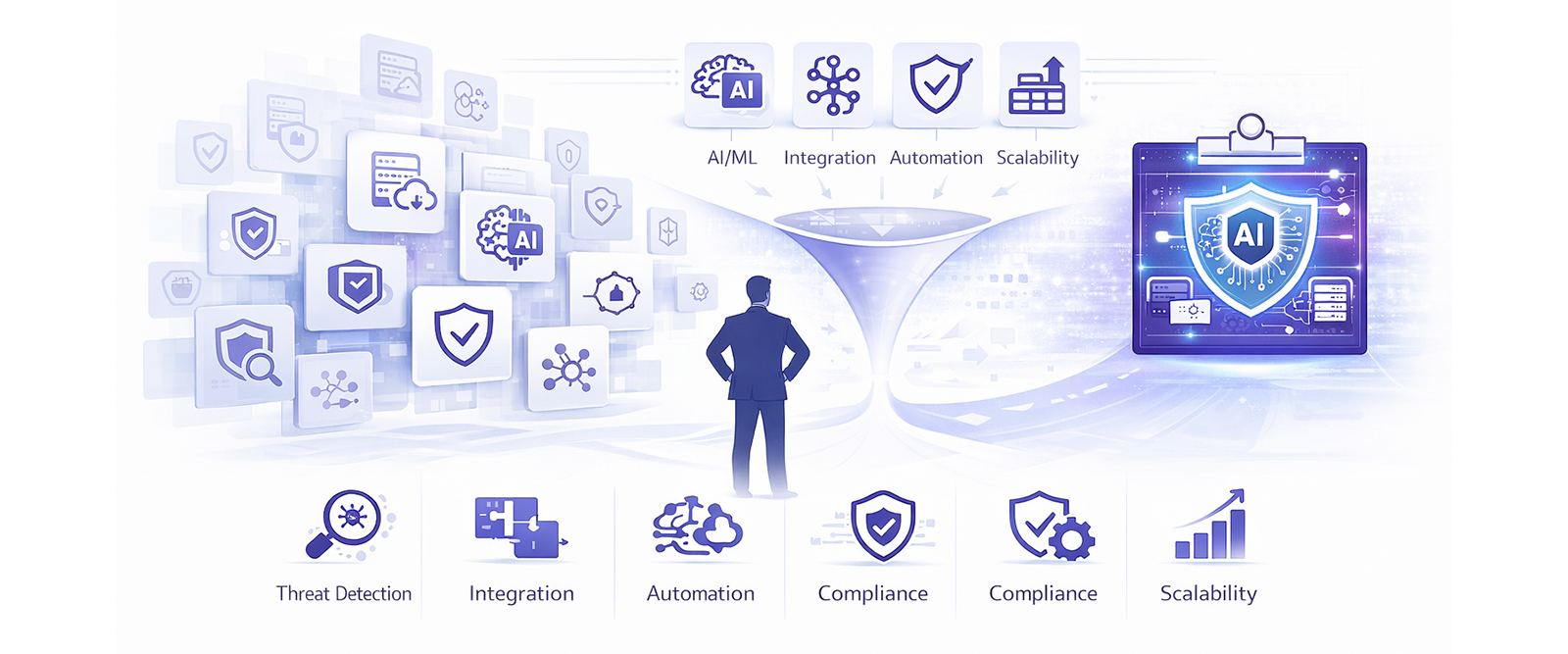
iStreet Network’s Sovereign AI Enterprise Platform, built on the Sanjeevani of AI™ framework. iStreet SIEM++ is designed to work with existing SIEM data while adding AI-driven detection, correlation, investigation intelligence and governed response.
If you are interested to know more, we would be happy to help