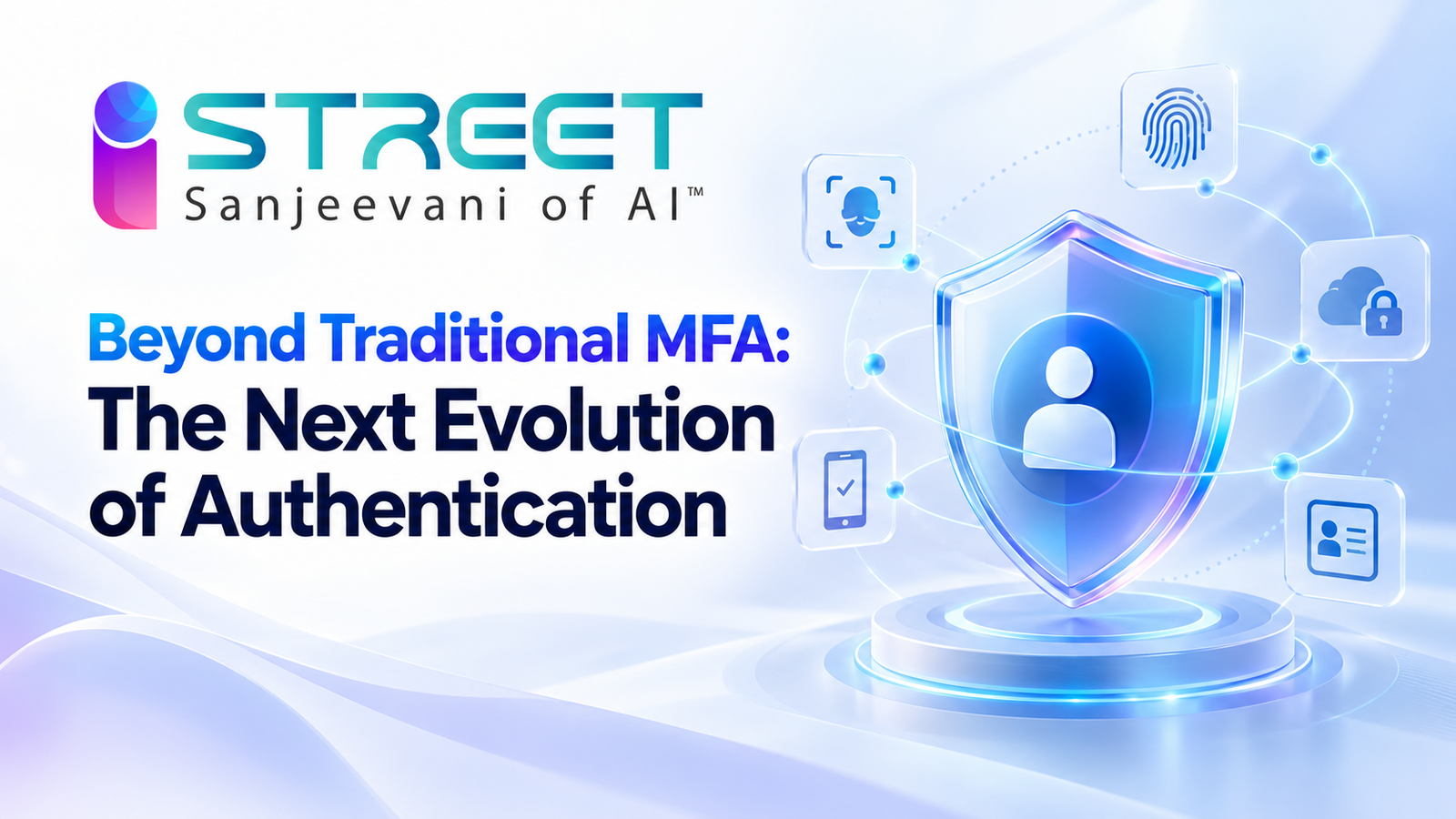
MFA was introduced because passwords alone could be stolen or guessed. It adds a second proof of identity, such as a one-time code or an approval request on the user’s phone. Attackers now bypass that second proof through phishing, repeated approval requests and session hijacking. In each case, the MFA does exactly what it was built to do, and the account is compromised all the same.
The pressure to act is regulatory as well as technical. Indian regulators have opened the way to authentication factors beyond the SMS one-time password, and enterprises are adding AI agents and service accounts that cannot respond to a prompt at all.
Moving beyond traditional MFA does not mean adding a third or fourth factor. It means changing what authentication is: from a single checkpoint to a phishing-resistant, continuously evaluated decision that covers people, machines and AI agents alike.
Where Traditional MFA Falls Short
Traditional MFA rests on two assumptions: that the factors cannot be intercepted, and that one successful check is enough for the whole session. Neither holds today.
The weaknesses fall into four groups:
- Relayable factors. An SMS code or an authenticator code is a shared secret that the user types in. A phishing proxy placed between the user and the genuine site can capture and replay that secret in real time.
- Approval fatigue. Push notifications ask to make a security decision with almost no context.
- Session theft. After logging in, the session token is the identity. Malware or a proxy that steals the token inherits access without ever facing a second factor.
- Weak recovery paths. Helpdesk resets, fallback codes, and re-enrolment flows are often protected by less than the login they restore.
The common thread is that traditional MFA authenticates an event, not a relationship. Once the event has passed, the control has nothing further to say.
What Lies Beyond Traditional MFA: Phishing-Resistant Authentication
Phishing-resistant authentication replaces codes and approvals with cryptographic proof that cannot be typed, read out over a call, or replayed on another site.
Passkeys and FIDO2
A passkey is a public-private key pair created for one specific service. The private key never leaves the user’s device, and the service holds only the public key. Because the credential is bound to the genuine domain, it does not respond to a lookalike site, which is what defeats the phishing proxy.
Device-bound credentials
Hardware-backed keys held in a secure chip tie the credential to a known device. Authentication then answers two questions at once: who is asking, and from which device. Device posture, such as patch level and encryption status, can be assessed alongside the credential.
Passwordless authentication as an outcome
Passwordless authentication is the result of these choices, not a product category. Users confirm with a biometric or a device PIN that never leaves the device, so there is no password to steal, reuse or reset. Sign-in becomes faster for the user and harder for the attacker, which is a rare alignment in security design.
From a Login Event to Continuous Authentication
A stronger login still leaves the session unguarded. Continuous authentication treats access as a decision that is re-evaluated for as long as the session lasts, using signals that change after the user has signed in.
Adaptive, risk-based authentication applies the same idea at the point of entry. A routine request from a known device proceeds without interruption, while an unusual one meets a step-up check or a block. Friction is spent where risk is, not spread evenly across every user.
This is the working form of zero trust: no request is trusted because of an earlier one. The quality of these decisions depends on the breadth of signals available, which is why authentication can no longer sit apart from security operations.
Authentication for Machine Identities and AI Agents
Traditional MFA was designed for a person holding a phone. Service accounts, workloads, APIs and AI agents now request access at a scale and speed no person matches, and none of them can answer a prompt.
These non-human identities are often secured with long-lived keys and static secrets embedded in code or configuration. That is the machine equivalent of a password written on a note. The alternatives follow the same principles as phishing-resistant authentication for people:
- Workload identity, where a service proves what it is through a signed attestation in place of a stored secret
- Short-lived credentials that are issued for a task and expire soon after it
- Scoped delegation for AI agents, so that an agent acting for a user holds only the permissions of that task, tied to the person who authorised it
- A complete audit trail that records which agent acted, on whose authority, and against which system
As agentic AI takes on operational work, the question shifts from “is this user who they claim to be” to “is this agent permitted to do this, for this person, right now”. An authentication strategy that covers only employees leaves the fastest-growing class of identity outside it.
The Indian Regulatory and Sovereignty Lens
Indian regulation now points in the same direction as the technology. India’s Authentication Mechanisms for Digital Payment Transactions Directions, 2025, keep the two-factor requirement for domestic digital payments while permitting alternatives to the SMS one-time password. The Directions also require risk-based checks on cross-border card-not-present transactions and place responsibility for the integrity of the mechanism on the issuer.
The sovereignty question follows directly. Continuous authentication generates a detailed record of how every employee and customer behaves. Where that record is processed, and who can reach it, is a board-level decision. For BFSI, government and critical infrastructure, identity telemetry belongs on infrastructure under Indian jurisdiction and the enterprise’s own control.
How iStreet Treats Authentication as a Security Operations Signal
iStreet Network treats every authentication event as security telemetry, correlated with everything else the enterprise observes. This is the practical difference between an identity control that stands alone and one that is part of AI-Native Enterprise Resilience.
Authentication events are read alongside endpoint, network and application signals within iStreet’s Agentic SOC and SIEM++ capabilities. A valid login followed by unusual data access is then seen as one sequence, not as two unrelated alerts in separate tools.
AI agents carry out the triage. They assemble the context around a suspicious session, assess the risk and recommend or initiate a response such as step-up authentication or session revocation, with analysts retaining oversight. The Resiliency Operations Centre (ROC), an AI-powered convergence layer above the NOC and the SOC, connects those identity decisions to service health and business impact.
The architecture is sovereign by design. Deployment on-premises or in a private cloud keeps identity telemetry, behavioural models and audit records within Indian jurisdiction, aligned with regulatory bodies requirements.
A Phased Path Beyond Traditional MFA
The shift is a programme carried out in stages, with the highest-risk access addressed first. A workable sequence for a regulated enterprise:
- Map every authentication flow. Include recovery, enrolment, helpdesk resets, service accounts and AI agents, not only employee login.
- Move privileged and high-risk users to phishing-resistant credentials. Administrators, treasury and operations teams, and third parties with remote access come first.
- Reduce reliance on relayable factors. Retain one-time passwords only as a fallback, and place risk checks around that fallback.
- Send authentication telemetry to security operations. Define the signals that trigger step-up checks and session revocation.
- Bring machine and agent identities under the same governance. Replace static secrets with short-lived, scoped credentials.
- Harden recovery to the level of login. An account is only as secure as the easiest way back into it.
Authentication as a Continuous Decision
Enterprises that go beyond traditional MFA replace a checkpoint with a continuous decision, and they keep the evidence behind that decision under their own control.
iStreet Network Limited is an enterprise-grade, AI-native Sovereign AI ecosystem. At its core is Sanjeevani of AI™, iStreet’s AI Centre of Excellence and integrated framework that brings together observability, security, governance, risk, and compliance to operationalize enterprise AI with greater control, resilience, and assurance.