Every enterprise lies somewhere on the resilience spectrum. The question isn’t whether the current model works, it’s how much it costs when it doesn’t. This maturity model helps leadership identify exactly where the organization stands today and what the next stage looks like.
Most enterprises don’t leap from siloed operations to a fully functioning Resilience Operating Centre overnight. The journey is incremental and understanding where the organization lies on the maturity curve is what separates a strategic investment from an impulse purchase.
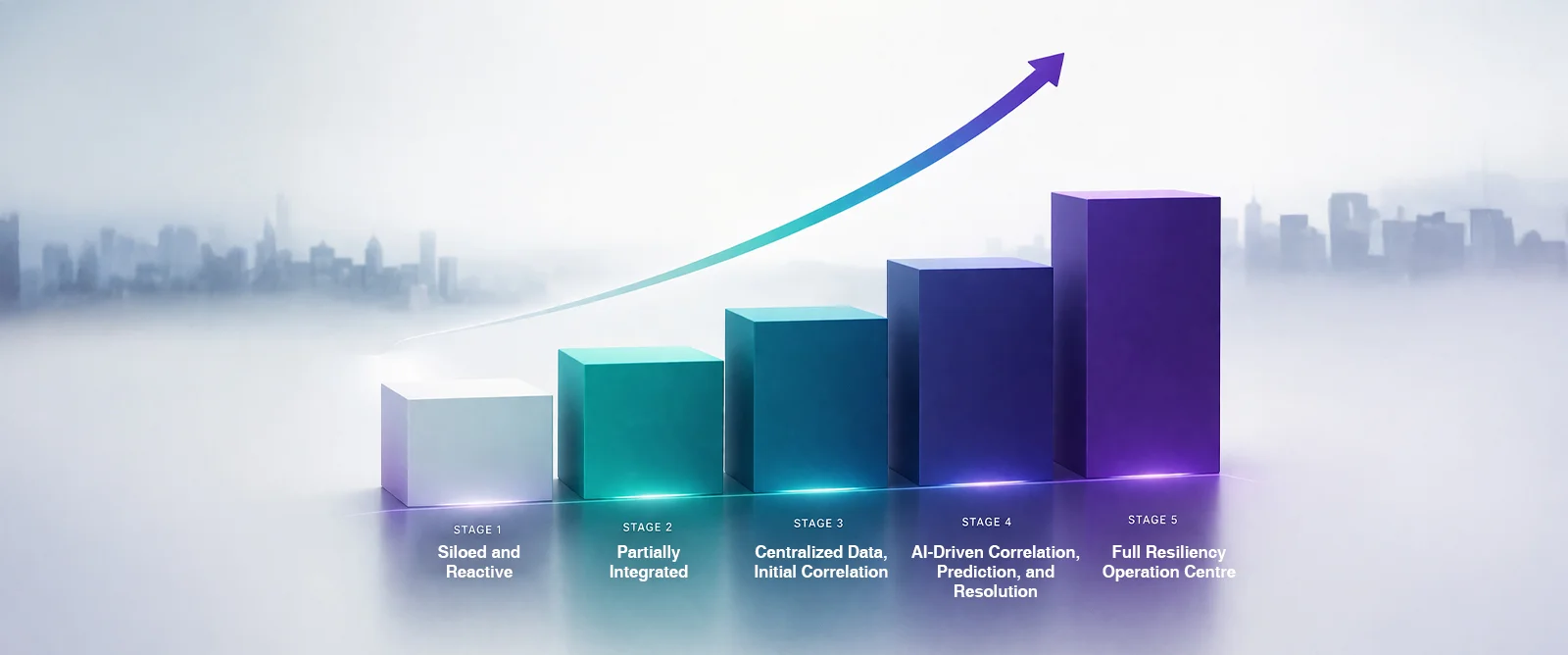
This framework defines five stages of ROC maturity. Each stage has observable characteristics, quantifiable costs, and a clear transition path to the next. The goal isn’t to reach Stage 5 in a quarter. The goal is to know which stage the enterprise currently occupies, understand what it costs, and take the specific steps that move it forward.
Review these questions with your leadership team to assess where operational silos, visibility gaps, and coordination challenges may be affecting enterprise resilience.
Stage 1: Siloed and Reactive
Characteristics: Infrastructure, security, application monitoring, and compliance operate independently. Each team has its own tools, dashboards, alert rules, and escalation paths. When a cross-domain incident occurs, the broader context is often assembled manually through cross-team coordination, after multiple teams may have already opened separate tickets and begun parallel investigations.
Compliance is periodic. Audits are annual or quarterly events that require weeks of preparation. Between reviews, the actual compliance posture is unknown. Risk is reported in separate formats by separate teams using separate metrics.
The institutional knowledge needed to resolve complex incidents lives in the heads of two or three senior engineers. When they’re unavailable, MTTR doubles or triples.
What it costs: This is the most expensive stage to operate in, not because of tool spending, but because of not utilizing. Engineering hours are consumed by bridge calls and manual correlation. Incidents that take 4–6 hours to resolve because 70% of that time is context-gathering. Compliance findings that repeat every audit cycle because violations persist undetected between reviews. MTTR spikes, that correlate directly with specific individuals’ availability.
Many enterprises believe they have moved beyond this stage, but cross-domain coordination may still depend heavily on manual processes. A useful test is to review the last major cross-domain incident and assess how quickly all investigating teams gained access to the same correlated context. If significant time was spent aligning data, timelines, and findings across teams, the operating model may still be at an early stage of convergence.
Transition to Stage 2: Acknowledge the structural problem. Stop treating cross-domain incidents as coordination failures and start treating them as architecture failures. Secure executives buy-in for a unified approach.
Stage 2: Partially Integrated
Characteristics: The enterprise has recognized the silo problem and started initial steps. Some data sharing exists, perhaps the SOC has read access to infrastructure logs, or the operations team receives a daily security summary. A shared incident channel exists for major events. The compliance team has begun using a GRC platform instead of spreadsheets.
But the integration is surface level. Data is shared, not correlated. Teams can see each other’s dashboards but still investigate independently. The bridge call is shorter to 30–45 minutes of context-gathering instead of 90 but still required. Compliance monitoring is more frequent but still periodic, not continuous.
Tool consolidation conversations have started but haven’t resulted in action. Everyone agrees that the tool landscape is fragmented. Nobody has totaled the cost or proposed an alternative.
What it costs: Lower than Stage 1, but the fundamental waste persists. Cross-domain incidents still require human correlation. Compliance still operates on a review cycle with gaps between checkpoints. Senior engineer dependency is still the primary resolution mechanism. The improvement is incremental to 20–30% faster resolution than Stage 1, but the structural gap remains.
Transition to Stage 3: Move from data sharing to data unification. Implement a centralized data lake that ingests telemetry from operational, security, and compliance tools through open-telemetry standards. This is the architectural foundation everything else depends on.
Stage 3: Centralized Data, Initial Correlation
Characteristics: The enterprise has deployed a centralized data lake. Logs, metrics, traces, security events, and compliance signals from across the tool landscape feed into a single repository. For the first time, all telemetry is accessible in one place.
Initial correlation capabilities are active. AI-driven event correlation connects related alerts across domains, the infrastructure latency spike and the security anomaly are identified as one event, not two. Event compression reduces alert volume meaningfully. The on-call engineer sees 3 correlated incidents instead of 500 raw alerts.
Compliance data lives alongside operational and security data on the same platform. Real-time compliance monitoring has begun for critical controls, not comprehensive yet, but the most important violations are detected when they occur rather than during the next review.
Root cause analysis is faster because the data is unified, but resolution still depends on human expertise. The AI identifies what went wrong and why. The “how to fix it” still comes from the senior engineer’s experience.
What it costs: Significantly lower than Stages 1 and 2. MTTR drops by 40–60% because the coordination phase is largely eliminated. Alert fatigue decreases as event compression takes hold. Compliance preparation time drops because evidence is partially automated. But the full value of the ROC is not yet realised because resolution intelligence, using historical incident and remediation context to surface recommended actions, has not yet been activated.
Many enterprises that have invested in unified observability platforms are at this stage: the data is consolidated, but cross-domain intelligence and resolution context are not yet fully connected.
Transition to Stage 4: Activate resolution intelligence. Begin capturing every resolved incident root cause, resolution steps, outcome, affected components into an AI-driven knowledge base. Enable generative AI to analyze past incidents and surface recommendations for current ones. Expand continuous compliance monitoring to cover all critical frameworks.
Stage 4: AI-Driven Correlation, Prediction, and Resolution
Characteristics: This is where the ROC becomes fundamentally different from any monitoring or observability platform.
The AI correlation engine operates across all domains in real time, not just connecting related alerts, but predicting emerging incidents before they materialize. Capacity forecasting flags bottlenecks weeks in advance. Anomaly patterns that historically preceded outages are detected and flagged proactively. The platform shifts from reactive detection to predictive intelligence.
Resolution intelligence is active. When an incident occurs, the platform doesn’t just identify root cause, it surfaces the recommended fix based on how similar patterns were resolved previously. Engineers validate and execute instead of diagnosing from scratch. The institutional knowledge that previously lived in individual heads is now embedded in the platform and available to every team member on every shift.Continuous compliance monitoring covers all critical frameworks. Violations are detected in real time. Evidence is generated automatically. Audit reports are available on demand.Security events are automatically categorized, grouped, enriched with operational context, and correlated with infrastructure and application telemetry. False positive rates have dropped dramatically. The security team focuses on confirmed threats and proactive threat hunting rather than manual triage.
What it costs: This is where ROI turns decisively positive. MTTR has collapsed from hours to minutes. Tool rationalization has reduced subscription and storage costs. Engineering time previously consumed by bridge calls and manual correlation has redirected to proactive reliability engineering. Compliance overhead has dropped from weeks per audit cycle to minutes per report.
The enterprise at Stage 4 can answer “are we resilient?” with a data-backed response in real time, not a two-week compilation exercise.
Transition to Stage 5: Scale across all group companies, geographies, and business units. Extend the AI knowledge base to learn from incidents across the entire enterprise. Integrate third-party and vendor risk telemetry into the unified platform.
Stage 5: Full Resiliency Operation Centre
Characteristics: Operations, security, compliance, and governance function as a single, unified resilience discipline across the entire enterprise. Every group company, every geography, every business unit operates within the same ROC platform, sharing the same data lake, the same correlation engine, the same resolution intelligence, and the same compliance monitoring framework.
The AI knowledge base has compounded across thousands of resolved incidents. Resolution recommendations are highly accurate and environment specific. Many incidents that previously required senior engineer intervention are now resolved by the broader team using AI-surfaced playbooks. The dependency on individual expertise has been replaced by organizational intelligence.
Compliance is continuous monitoring. The enterprise doesn’t prepare for audits, it’s always audit-ready. Regulatory framework alignment is monitored in real time. AI adoption risks are tracked across all tools, agents, and models with posture scores and exposure analysis.
Vendor and third-party risk are integrated into the unified platform. The blast radius of a vendor failure is mapped to business services in real time, not estimated from a procurement spreadsheet.
Leadership has a single dashboard that shows operational health, security, compliance status, and AI risk exposure, mapped to business services and financial impact, updated continuously.
What does it cost: The ROC at Stage 5 is a positive net investment. Ongoing ROI of 50 – 70%. The platform pays for itself through tool rationalization, MTTR reduction, compliance efficiency, and talent leverage. More importantly, the enterprise operates with a level of resilience confidence that the siloed model structurally cannot deliver.
The question at Stage 5 isn’t “is the ROC worth it?” It’s “how did the enterprise operate without it?”
Assessing Your Current Stage of Convergence
Based on industry data, the distribution looks roughly like this:
Stage 1 (Siloed and Reactive):A significant number of enterprises may still be operating at this stage. The issue is not the capability of the teams; it is whether tools, data, and operational context are sufficiently connected. Where they remain fragmented, cross-domain investigation and coordination continue to depend heavily on manual effort.
Stage 2 (Partially Integrated): Some enterprises have reached this stage, with greater data sharing and improved coordination across teams, while the underlying operating model remains partly siloed. Cross-team coordination becomes more efficient, but manual hand-offs and bridge calls may still be required.
Stage 3 (Centralized Data): Some enterprises have invested in unified observability or centralised data platforms, bringing more telemetry into a shared environment. However, the intelligence layer, cross-domain AI correlation, resolution guidance, and continuous compliance context, may still be limited or only partially implemented.
Stage 4 (AI-Driven): Early adopters are beginning to activate AI-driven correlation, resolution intelligence, and continuous compliance capabilities. At this stage, the focus shifts from connecting data to using correlated intelligence to accelerate incident response, strengthen governance, and improve operational resilience.
Stage 5 (Full ROC): A small group of enterprises may be approaching this stage, with resilience operations increasingly unified across operational domains, geographies, and business units. This represents the target state: a connected resilience model built on shared context, coordinated response, and continuously improving operational intelligence.
The gap between where most enterprises are (Stages 1–2) and where the threat landscape demands they operate (Stages 4–5) is the ROC opportunity and urgency.
How to Use This Model
For self-assessment: Walk through each stage with the leadership team. Be honest about which characteristics describe the current state. The gap between the current stage and the target stage becomes the scope of the ROC initiative.
For roadmap planning: Each stage transition has specific, actionable steps. Moving from Stage 1 to Stage 2 requires governance alignment. Moving from Stage 2 to Stage 3 requires a centralized data lake. Moving from Stage 3 to Stage 4 requires AI activation. Each transition is a phase with measurable milestones.
For budget justification: The cost profile at each stage is quantifiable. Leadership can see exactly what the current stage costs, what the next stage saves, and what the ROI looks like at each transition. This turns a vague “we need better resilience” conversation into a specific “moving from Stage 2 to Stage 3 saves X and costs Y with payback in Z months” business case.
For progress measurement: After ROC deployment, the maturity model provides a framework for tracking progress. Quarterly assessments against the stage characteristics show whether the enterprise is advancing, stalling, or regressing and where to focus investment next.
The Path Forward
Enterprises do not need to move from Stage 1 to Stage 5 in a single initiative. The ROC journey can be phased, with each stage building additional capability, demonstrating operational value, and creating a stronger foundation for the next stage of convergence.
Every enterprise should understand its current level of convergence maturity. The threat landscape, regulatory expectations, cloud-native complexity, and stakeholder demands continue to evolve, increasing the need for faster coordination and shared operational context. Enterprises operating with lower levels of convergence may therefore face greater difficulty responding to cross-domain incidents and managing resilience consistently as complexity increases.
The maturity model helps identify the next capability gap, define the priorities for progression, and provide a structured path towards greater convergence. That is what moves resilience from aspiration to execution.
iStreet Network’s Sovereign AI Enterprise Platform, built on the Sanjeevani of AI™ framework, enables enterprises to move from siloed NOC, SOC, and compliance operations towards a converged resilience model through its Resiliency Operations Centre. By connecting operational and security intelligence with governance context, iStreet helps teams correlate cross-domain signals, investigate incidents with shared context, coordinate response, and strengthen resilience across complex enterprise environments.