There’s a different kind of discussion happening behind closed doors in boardrooms across Mumbai, Bengaluru, and Delhi. It is not the usual excitement about adopting AI or chasing the next automation trend. Instead, the question has become sharper and more uncomfortable. Who actually owns the intelligence running the business?
For years, Indian enterprises followed a simple, almost unquestioned rule. Go cloud first. It worked. Speed mattered more than anything else, and the cloud delivered exactly that. Infrastructure headaches disappeared, deployment cycles shrank, and innovation felt frictionless. But something has changed.
As companies move beyond basic automation and into Generative AI that can recommend actions, influence decisions, and sometimes act on its own, that convenience starts to come with strings attached. If your company’s most valuable intelligence lives on servers thousands of miles away, governed by foreign laws and foreign priorities, can you really call yourself independent? Or have you quietly become a digital tenant in someone else’s ecosystem?
At iStreet, we often refer to this shift as India’s Sanjeevani moment in technology. It is the realization that true advantage, especially in a country as complex and data-rich as ours, does not come from renting intelligence by the hour. It comes from owning it. This is where the idea of Sovereign AI enters the conversation.
From External AI Dependence to Enterprise Control
External AI platforms can accelerate experimentation and deployment, but strategic dependence can increase when critical workloads rely on infrastructure, models or commercial terms outside the enterprise’s control. The issue is not whether enterprises should use global AI services; it is whether they retain sufficient control over sensitive data, model behaviour, deployment choices and operational continuity as AI becomes more embedded in business decisions.
Enterprises also need clarity on how proprietary data is processed, retained and protected when AI services are provided by third parties. Contractual controls, deployment architecture and data-handling policies therefore become part of the AI strategy—not an afterthought.
In effect, you are helping train systems that could one day power competitors in your own market.
What Sovereign Intelligence Actually Means
Sovereign intelligence combines control across five layers: data, compute, models, decisions and auditability. An enterprise may host data locally and still remain dependent on external models, infrastructure or decision logic. True sovereignty therefore requires control across the full AI operating stack, not residency alone.
- Data Sovereignty → who can access and process enterprise data.
- Compute Sovereignty → where workloads run and who controls infrastructure.
- Model Sovereignty → which models are used and how they are governed.
- Decision Sovereignty → how AI-assisted actions are approved, overridden and monitored.
- Audit Sovereignty → whether AI activity can be traced and evidenced.
Why “Atmanirbhar” Intelligence Actually Matters
Strategic advantages are not static. They evolve with technology and markets. In the 1990s, distribution networks created dominance. In the 2000s, brand loyalty did the heavy lifting. Looking ahead to 2026 and beyond, the defining edge will be proprietary intelligence built on owned data.
For Indian enterprises, Atmanirbhar AI is not only about building domestic models. It is about ensuring that strategic AI capabilities can operate within enterprise-defined data, governance, security and jurisdictional boundaries. This becomes increasingly important as AI moves from experimentation into customer-facing, operational and regulated workflows.
- First, there is Local Context. Models and applications used in India must work across local languages, sector-specific workflows, regional operating conditions and enterprise data. Sovereign AI allows organisations to combine foundation models with proprietary context without surrendering control over the underlying intelligence layer.
- Second, there is Governance and Compliance. Data residency is only one part of enterprise AI control. Organisations also need to understand where models run, how data is accessed, how AI decisions are logged and how policy controls are enforced throughout the lifecycle.
- Third, there is Operational Resilience. AI systems supporting mission-critical operations should remain observable, governable and recoverable. Enterprises need visibility into how models and agents behave, how dependencies affect them and what happens when an external service or infrastructure layer becomes unavailable.
From AI Consumer to AI Creator
Becoming an AI powerhouse requires more than new tools. It requires a mindset shift. Most enterprises today still treat AI as decision support. Dashboards highlight issues, alerts flag risks, and humans decide what to do next. Sovereign AI pushes organizations toward autonomous judgment, where systems resolve problems before they escalate, sometimes before anyone is even aware of them.
The talent gap is not the problem. According to the 2025 AI Index Report by Stanford HAI, India ranks first globally in AI skill penetration, with a score of 2.8. While the United States and China may lead in raw model counts, India’s growth in applied AI capability is among the fastest in the world. The missing piece has been ownership-focused infrastructure.
How iStreet Operationalises Sovereign Intelligence
iStreet’s Sovereign AI Enterprise Platform, built on the Sanjeevani of AI™ framework, brings together enterprise-controlled AI infrastructure, data intelligence, model and agent governance, AI-native security, observability and resilient operations. The objective is to help organisations scale AI while retaining control over critical data, decisions, governance and operational continuity.
The Strategic Choice for Indian Enterprises
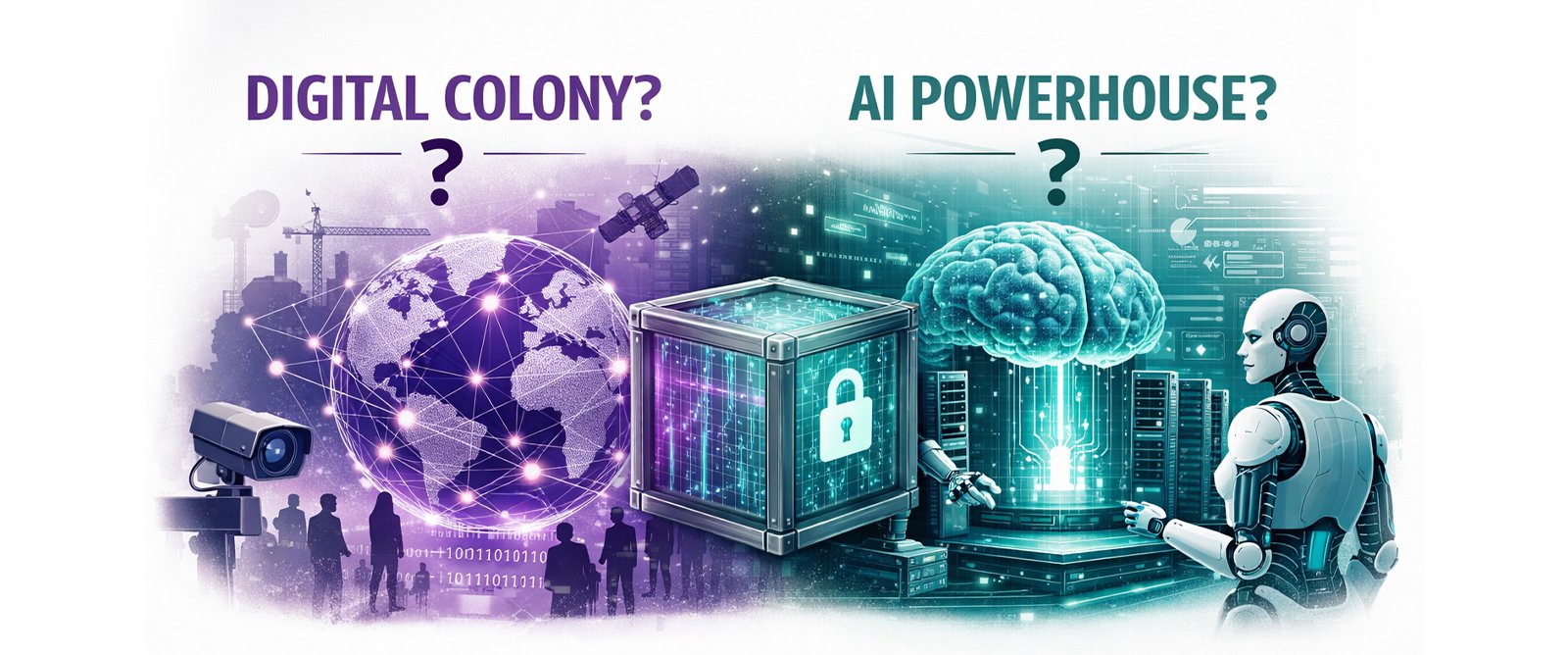
In 2026, the choice facing Indian enterprises is becoming clearer. The digital colony path is tempting. Low upfront costs, quick deployment, and minimal friction make it easy to justify. But over time, it leads to perpetual rent payments, rising dependency, and shrinking strategic autonomy.
The AI powerhouse path is tougher. It demands investment, patience, and a firm stance on data ownership. It means training your own models, securing your own infrastructure, and building intelligence that grows alongside your business rather than outside it.
The real question for leaders is simple. Five years from now, do you want to be paying a subscription to access your own company’s intelligence? Or do you want to be the one controlling it, shaping it, and using it as a competitive weapon?
The era of the rented brain is quietly fading. The era of the sovereign enterprise is just beginning.
iStreet Network is a Sovereign AI Enterprise Platform built on the Sanjeevani of AI™ framework, integrating four core pillars—Observability, Infrastructure, Governance, and Sovereignty & Security—to enable enterprises to operate on infrastructure hosted in India.