CIOs who treat Agentic AI as simply a more powerful form of Generative AI risk making incomplete architecture, governance, and platform decisions. The two approaches are closely connected, but they solve different enterprise problems and require different operating models.
Since 2023, Generative AI has dominated enterprise technology discussions. Organizations have explored AI for content creation, coding, knowledge access, analysis, and employee productivity. As adoption expands, attention is increasingly shifting from what AI can generate to what AI can execute within enterprise workflows.
Much of the recent enterprise AI focus has centered on Generative AI, systems that create content, synthesize information, and support individual productivity. Agentic AI introduces a broader operational model in which AI can work towards defined goals, interact with connected systems, and execute multi-step workflows within established permissions and governance controls.
For CIOs, understanding this distinction is not merely a technical matter. It has direct implications for architecture, governance, vendor selection, and enterprise AI investment. This article explains how Generative AI and Agentic AI differ, where each creates value, and how enterprises can build an architecture that supports both.
Generative AI: What It Is and What It Does Well
Generative AI refers to AI systems that create new content, including text, images, code, audio, and video, based on patterns learned from training data and the context provided by prompts. Large language models are widely used examples of Generative AI.
Generative AI excels at:
- Content creation at scale: Drafting documents, writing code, creating marketing copy, generating reports.
- Information synthesis: Summarising long documents, extracting key insights from complex data, translating between languages.
- Conversational assistance: Answering questions, explaining concepts, providing guidance based on training knowledge.
- Augmenting individual productivity: Making individual knowledge workers significantly more productive in their existing roles.
The defining characteristic of Generative AI is its ability to generate or transform information in response to user or application inputs. A standalone generative model typically does not manage multi-step enterprise workflows or interact with external systems without additional orchestration, tools, and application logic.
Agentic AI: The Fundamental Distinction
Many Agentic AI systems use Generative AI models together with capabilities such as goal-directed planning, tool interaction, workflow orchestration, contextual memory, and state management. These capabilities enable AI agents to pursue defined objectives and execute authorized actions across connected systems.
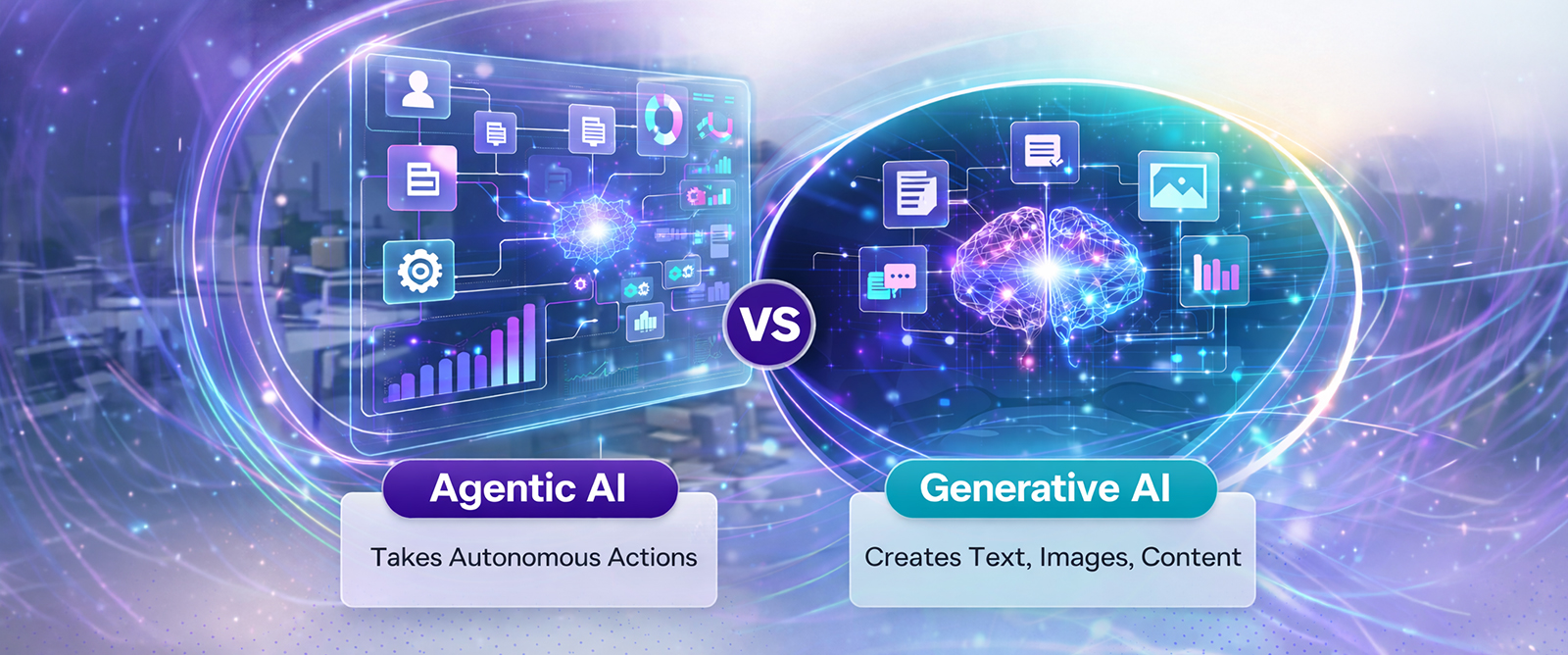
The fundamental distinction is agency. Generative AI primarily helps users create, analyze, or understand information. Agentic AI extends AI into workflow execution by allowing agents to determine and perform appropriate next steps within a defined scope.
| Generative AI | Agentic AI |
| Responds to prompts | Pursues assigned goals |
| Single interaction | Multi-step execution |
| Produces content | Takes actions |
| Human-directed | Autonomous within defined scope |
| No tool use | Uses tools, APIs, systems |
| No persistent state | Maintains memory and context |
| Augments individuals | Transforms operational workflows |
| Deployment: assistant | Deployment: workforce |
For CIOs, this distinction has direct implications for how value is created, where governance is required, and what infrastructure is needed.
Where Each Paradigm Creates Enterprise Value
Generative AI Value Zones
Generative AI creates value by accelerating knowledge-intensive work, reducing time spent on repetitive content and analysis tasks, and improving access to enterprise information. Its value typically comes from improving individual productivity, increasing throughput, and helping employees work with information more efficiently.
Agentic AI Value Zones
Agentic AI creates value at the workflow level by automating or accelerating multi-step processes that require information gathering, decision support, system interaction, and coordinated actions. Its value comes from reducing repetitive hand-offs, increasing process capacity, and enabling more consistent execution across enterprise workflows.
The CIO Strategy Implications
Understanding this distinction drives several critical strategic decisions:
Architecture Decisions
Generative AI deployment is primarily an application integration challenge, embedding LLM APIs into existing tools and workflows. Agentic AI deployment is an infrastructure challenge, requiring orchestration platforms, tool integration frameworks, state management systems, monitoring infrastructure, and governance controls. CIOs who treat agentic AI as a simple API integration will build fragile, unscalable systems.
Governance Priorities
Generative AI governance focuses primarily on output quality and appropriate use, ensuring models produce accurate, appropriate content. Agentic AI governance must extend to action governance, controlling what agents can do, monitoring what they are doing, and maintaining human oversight of consequential actions.
Vendor Selection Criteria
When evaluating generative AI solutions, CIOs primarily assess model quality, integration options, and pricing. When evaluating agentic AI platforms, additional criteria become critical: orchestration capability, tool integration depth, governance and audit infrastructure, memory management, and for Indian enterprises, sovereign deployment capability.
The Combined Platform Opportunity
The most sophisticated enterprise AI strategies are not choosing between generative and agentic AI, they are designing integrated platforms where both paradigms operate:
- Agentic workflows use generative AI for natural-language understanding, reasoning, information synthesis, and content generation within multi-step processes.
- Human interfaces leverage generative AI to allow business users to interact with agents through natural language, review outputs, provide instructions, and manage workflows more easily.
- Operational intelligence combines these capabilities by enabling agents to leverage available enterprise context and Generative AI to summarise information, support decision-making, and coordinate actions across workflows.
iStreet’s Sovereign AI-Native Platform: Built for Both
iStreet’s platform is designed specifically to support enterprise-scale deployment of both generative and agentic AI capabilities within a sovereign, compliant architecture:
- Foundation model flexibility: Supports enterprise AI architectures that can work with appropriate open-source and proprietary models based on workload, deployment, security, and sovereignty requirements.
- Agentic orchestration framework: Enables AI agents to interact with enterprise tools and workflows while maintaining the context, state, permissions, and governance required for multi-step execution.
- Unified governance layer: A single governance and audit framework spanning both generative and agentic AI deployments, essential for DPDP, and sector-specific compliance.
- Indian enterprise integration: Pre-built connectors for common Indian banking, insurance, and government platforms.
The CIOs who will lead their organisations through the next phase of enterprise AI will be those who understand not just what generative AI can produce, but what agentic AI can accomplish. The distinction is not technical jargon; it is the difference between productivity enhancement and operational transformation.
Building the right architectural foundation today, sovereign, scalable, governed, positions your enterprise to leverage both paradigms as they continue to evolve, rather than rebuilding from scratch each time the technology landscape shifts.
Get the Full Picture: CIO AI Strategy Briefing
iStreet offers a dedicated CIO AI Strategy Briefing providing a tailored analysis of the generative and agentic AI opportunity for your specific industry, regulatory environment, and operational context.
- Schedule a CIO briefing with iStreet’s enterprise AI strategy team.
- Request an AI platform architecture review for your enterprise environment.