India runs the world’s largest real-time payments system. UPI now accounts for nearly half of all real-time digital payments globally and about 85% of India’s digital payments, a decade after its launch. Indian banking is following the same trajectory. It now leads the world in AI adoption, and its lenders are scaling quickly, with GenAI use cases in implementation rising from 10% in 2024 to 86% in 2026. In payments, and increasingly in intelligence, India is not catching up with the future of digital banking; it is setting the pace.
But intelligence introduces a new question: ownership. When a bank routes a lending decision or customer interaction through an AI model hosted outside the country, it can lose control over where data resides, how and when the model changes, and whether continued access to that intelligence remains within its authority. For an institution that maintains control over the rest of its critical technology stack, that dependency carries strategic weight. Sovereign AI platform provides a path to retain that control, and India is now building the compute, models, infrastructure, and enterprise platforms required to make it possible.
What is a Sovereign AI Platform for the banking sector?
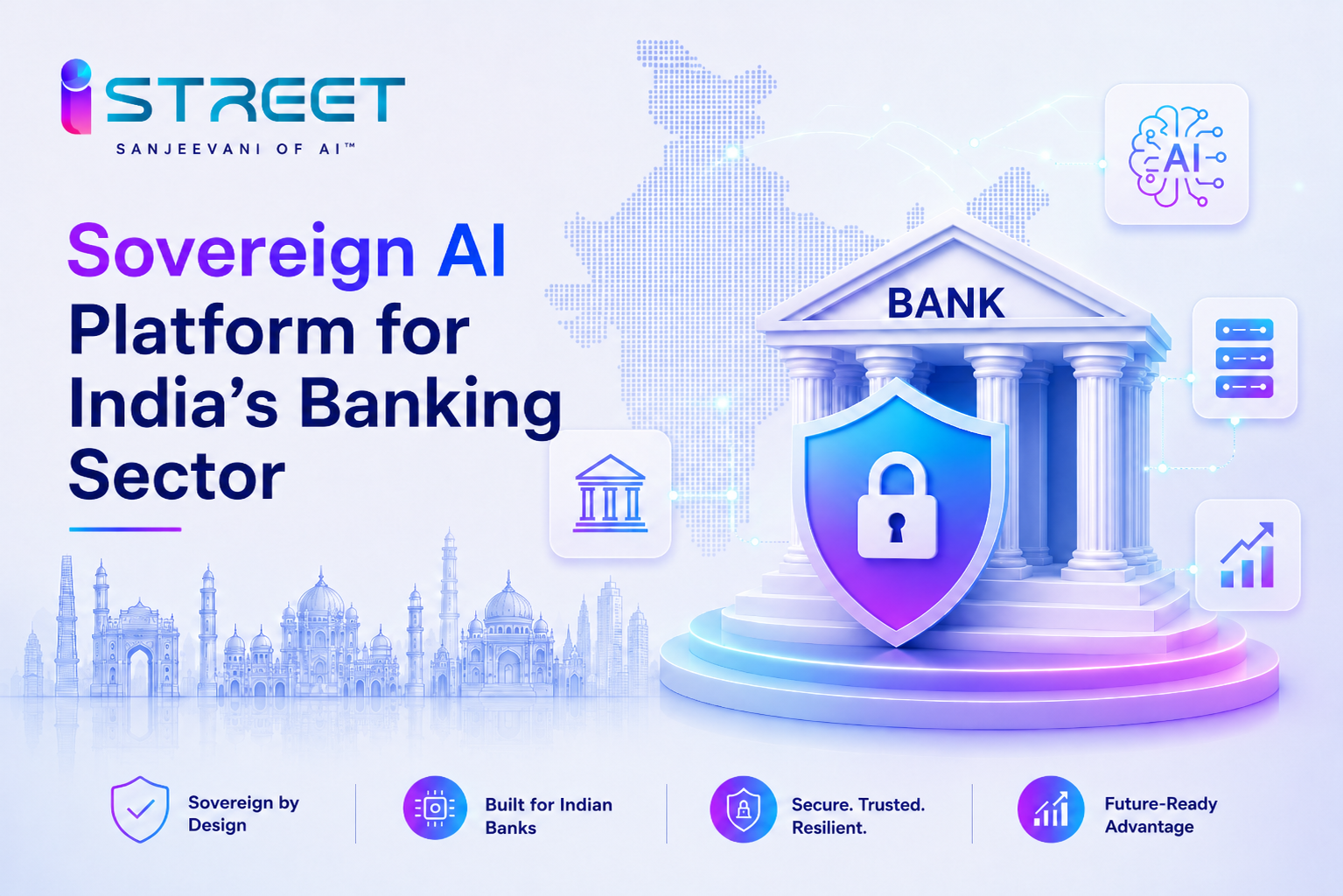
For a bank, a sovereign AI platform is one where critical AI infrastructure, data, models, decisions, and governance remain within defined Indian jurisdiction and under the institution’s operational control. This includes control over where data is processed and stored, how models are deployed and updated, how AI decisions are governed, and how evidence is retained for audit and accountability.
It is not simply an AI model hosted in India. Sovereignty also means having the authority to govern model behaviour, trace material decisions, control access and changes, intervene when required, and suspend or replace AI systems without being dependent on an external jurisdiction or provider.
That distinction becomes particularly important when AI is embedded in lending, fraud detection, customer interactions, risk management, and other critical banking processes, where reliance on externally controlled models can introduce additional governance, operational, and jurisdictional dependencies.
The compliance burden of relying on outside AI
Before onboarding any vendor, Indian banks run board-approved due diligence, enforce contracts, and monitor continuously, with outsourcing directions guaranteeing audit and inspection rights for the bank. Meeting those same obligations for a foreign-hosted model is far heavier and more challenging, which shows:
- Control: infrastructure built and governed outside Indian jurisdiction can be updated, restricted, or switched off by a party the bank does not control, regardless of where the bank’s own data physically sits.
- Accountability: the burden of explaining a model’s decisions to a customer, an auditor, or a regulator stays entirely with the bank, and that is far harder when the model’s training, tuning, and updates happen offshore, outside the bank’s sight.
- Concentration: when many banks rely on the same handful of external AI vendors, one flawed model or one outage can spread the same failure across several institutions at once.
A bank can still govern outside AI. It just takes far more effort to control a system it does not own. That difficulty is precisely the opportunity, and the government is actively encouraging banks and organizations to develop AI within the country rather than rent it from abroad.
India is encouraging Sovereign AI Platforms.
That encouragement is already building real capacity at the national and enterprise levels.
- On compute, the IndiaAI Mission is bringing subsidized, India-based compute within reach of banks, startups, and researchers. Hence, the processing power behind AI no longer has to be rented from a foreign cloud.
- On infrastructure, domestic sovereign cloud providers are scaling quickly, building in-country capacity purpose-built to keep data and workloads under Indian jurisdiction.
- On models, an Indian foundation-model builder is training beyond a trillion parameters, explicitly to reduce dependence on foreign-hosted inference.
On these foundations, a sovereign AI platform for banks brings together:
- Compute the bank can access without depending entirely on a foreign-controlled cloud.
- Data that stays resident and governed inside Indian jurisdiction.
- Operational control, so the bank can see, explain, and override its own AI rather than trusting a vendor’s word for it.
- Legal accountability that survives an audit.
India’s data-localization and data-protection rules require sensitive financial data to stay within the country. Compliance with these requirements is only the starting point. The real test of sovereignty is who controls each layer of the AI stack, not simply where the technology resides. Where a bank applies that test first is a practical choice, and a few areas are leading.
Implementing sovereign AI in banks
Five areas are already applying this sovereignty test across Indian banks in 2026:
- Fraud and transaction monitoring, where AI detects patterns across live, in-country data
- Credit and lending, where decisions require clear and explainable reasoning
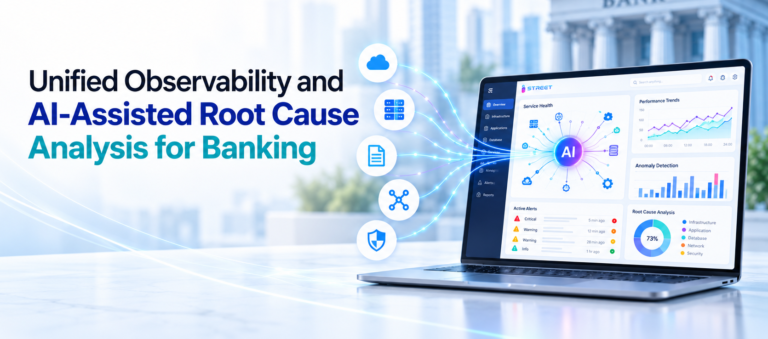
- IT operations and observability, where AI correlates infrastructure signals faster than manual teams
- Security operations, where banks need AI-native visibility across an expanding AI attack surface
- Compliance and governance reporting, where a consistent evidence trail supports multiple oversight requirements
Each use case involves sensitive customer data, financial decision-making, or regulatory accountability. Sovereignty therefore becomes an operational requirement rather than an optional design choice, and the business value differs depending on where a bank applies it first. Banks that already know where their models run, who controls them, and how decisions are made are better positioned to respond as regulatory expectations evolve.
The strategic payoff is adoption with control: a sovereign, governed, and auditable AI architecture lets a bank introduce new models and agentic capabilities without rebuilding governance, data controls, and evidence mechanisms for every new use case.
iStreet’s sovereign AI enterprise platform for banks
iStreet Network’s sovereign AI platform, built on the Sanjeevani of AI™ framework, is the ecosystem in one place. Rather than a bank sourcing infrastructure, security, and compliance from separate, disconnected providers, the Sanjeevani of AI™ framework brings all four together as one continuous lifecycle:
- Modernizing the AI core by correlating infrastructure signals, application performance, and the customer-facing experience of digital banking into a single operational view;
- Securing it by design, with AI-native threat detection and risk-based vulnerability management built in from the start rather than retrofitted onto a traditional security stack after deployment;
- Operating it at scale across every channel a bank uses, from branch to mobile app to contact center, so performance holds the first time real transaction volume arrives; and
- Governing it with assurance, maintaining a live inventory of every AI system the bank runs, whether built in-house or embedded within vendor software
Running these capabilities through a single framework changes the operating model. Institutions using the platform have reduced mean time to resolution and the analyst effort required for compliance reporting by automatically correlating operational, security, and governance data instead of relying on teams to reconcile manually.
iStreet Network’s Sanjeevani of AI™ framework brings these capabilities together as a unified sovereign AI platform, integrating infrastructure, data, models, security, observability, governance, and enterprise operations within a controlled architecture. It is designed to help enterprises retain operational authority over how AI is deployed, governed, monitored, and sustained, while supporting resilient, accountable, and sovereign AI adoption at scale.