The AI capability race is accelerating, but enterprise advantage will depend on more than access to powerful models. It will also depend on how much control organisations retain over their data, infrastructure, models, and AI operations.
Indian enterprises are adopting AI at an unprecedented pace. Fraud detection, document intelligence, customer service automation, and operations monitoring are only the beginning. As these use cases expand, an equally important question is emerging: where does that AI operate, who controls it, and what happens when the commercial or technical conditions behind the platform change?
What Is a Sovereign AI Platform in India, and Why Does It Matter for Your Enterprises?
When an enterprise deploys AI through a public-cloud hyperscaler—whether through a managed LLM API, a cloud-native AI service, or a hosted data platform—it is placing part of its intelligence layer on infrastructure it does not fully control. The model may run on external infrastructure, inference may occur in third-party data centres, and data may move across environments governed by external service conditions.
This is not simply a hypothetical risk. It is an architectural consideration.
For regulated industries in India—including banking, capital markets, and enterprises handling personal data—this creates an important governance challenge. Compliance is not only about having policies in place; it is also about demonstrating where data is processed, how it is handled, and who is authorised to access it.
A hyperscaler SLA does not, by itself, provide that level of operational transparency. Under a shared-responsibility model, enterprises still need sufficient visibility and control to establish what happened, where it happened, and how the environment responded.
Is a Sovereign AI Platform Just About Storing Data in India?
No. Sovereignty, in the context of a sovereign AI platform, does not mean building every component from scratch or avoiding advanced AI capabilities. It means maintaining control over the conditions under which those capabilities operate.
A sovereign AI platform in India gives an enterprise:
1 Data residency
Your data remains within defined deployment and governance boundaries, whether on-premises, in a private cloud, or across approved domestic infrastructure.
2 Model custody
You retain control over which models are deployed, when they are updated, and what data and systems they are authorised to access.
3 Audit transparency
Inference activity, data movement, and agent actions can be logged, traced, and made available to security, governance, and compliance teams.
4 Compute independence
AI workloads can run on infrastructure aligned with the enterprise’s own control, capacity, and deployment requirements rather than depending entirely on shared external capacity.
None of this prevents enterprises from using advanced AI models. It changes where and how those models are deployed, how access is governed, and where accountability remains.
Why Do Indian Enterprises Need a Sovereign AI Platform More Than Anyone Else?
The argument for a sovereign AI platform India is more acute than in many other markets, for several converging reasons.
Regulatory density is rising. Regulatory expectations are increasing. Across regulated sectors, data governance, technology risk, cybersecurity, and accountability are becoming board-level considerations. Enterprises that adopted AI rapidly on external infrastructure may now need to reassess whether those architectures provide the visibility, control, and evidence required by their governance models.
Critical infrastructure has specific mandates. Critical infrastructure operates under higher expectations. BFSI, power, telecommunications, and government-linked environments often operate under sector-specific technology, security, and resilience requirements.
Geopolitical resilience is a real factor. Atmanirbhar Bharat and India’s broader technology self-reliance agenda have increased attention on long-term control over critical digital capabilities. Enterprises are therefore beginning to consider how policy changes, licensing conditions, export controls, or vendor-access restrictions could affect strategic AI workloads.
Talent and institutional knowledge stay local. Knowledge can remain within the enterprise. When AI systems are deployed and governed within controlled infrastructure, more of the operational knowledge required to manage, secure, and evolve those systems can remain within the organisation and its trusted technology ecosystem.
What Does a Sovereign AI Platform Actually Include?
A sovereign AI platform
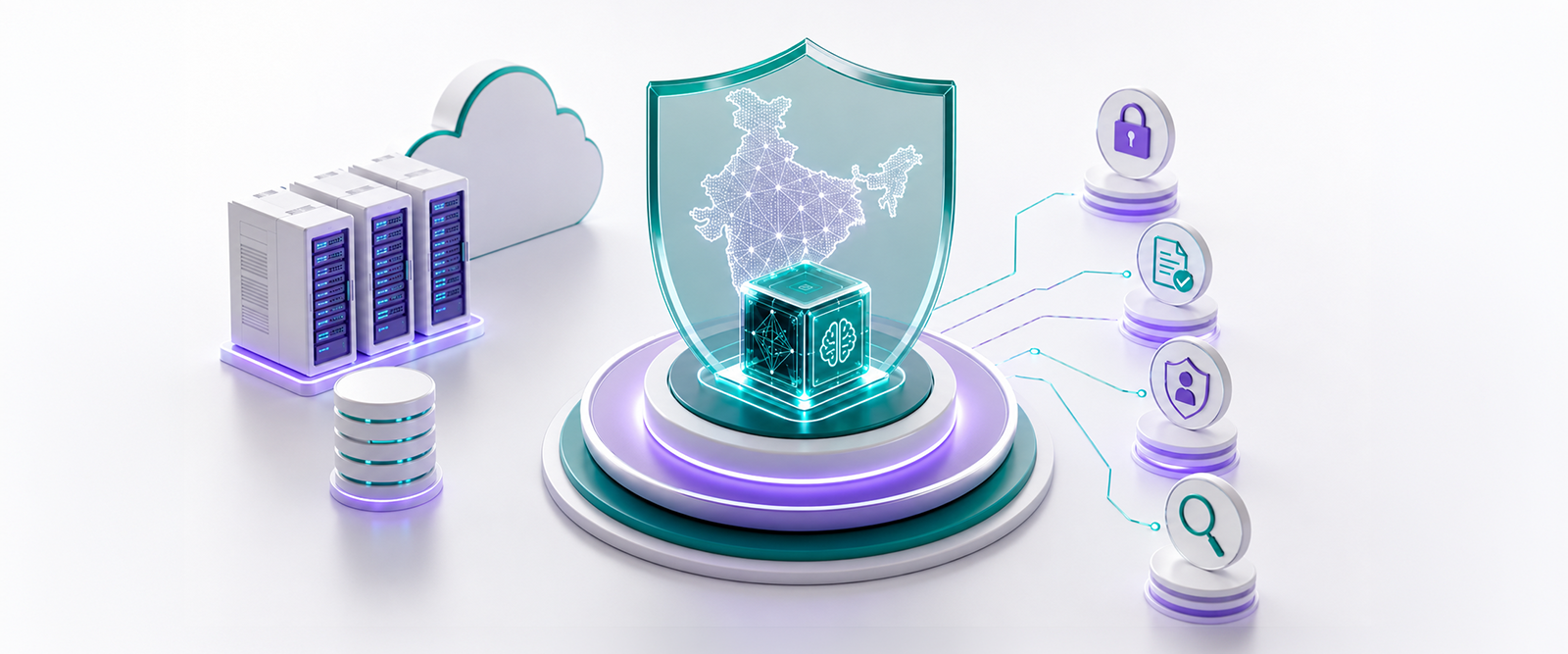
A sovereign AI platform is not a single product. It is an integrated technology stack extending from infrastructure and data through AI models, orchestration, governance, observability, and enterprise applications.
At the infrastructure layer
AI-ready compute, hardened networking, and storage designed for AI workloads can be deployed within infrastructure environments aligned with enterprise control.
At the platform layer
Model orchestration, agent frameworks, data pipelines, governance controls, and observability capabilities are configured around the enterprise’s security, policy, and operational requirements.
At the application layer
Purpose-built capabilities such as agentic security operations, autonomous CRM workflows, full-stack observability, and ROC workflows can inherit the governance, control, and sovereignty principles established across the underlying platform.
The distinction matters because choosing a private-cloud deployment alone does not automatically establish AI sovereignty. Enterprises must also consider model custody, data-processing boundaries, auditability, access controls, external dependencies, and operational governance.
iStreet Network builds sovereignty into its Sovereign AI Enterprise Platform as an architectural principle—connecting infrastructure, AI operations, governance, observability, security, and enterprise resilience within a controlled environment.
How Do You Know If Your Organisation Already Has a Sovereign AI Gap?
If your organisation is deploying AI at meaningful scale, three questions are worth examining now:
- Where does your inference actually happen? Not only where the API request is sent, but where the data is processed
- How auditable are your AI workflows? If the answer requires a call to a vendor support team, there is a visibility and control gap.
- What is your continuity plan if your primary AI vendor changes its pricing, access terms, or availability? A sovereign architecture reduces dependence on any single external provider by giving the enterprise greater control over its AI operating environment.
These questions are not intended to slow AI adoption. They are intended to make AI adoption more durable, governable, and resilient.
Explore What Sovereign AI Looks Like for Your Organisation
iStreet Network’s Sovereign AI Enterprise Platform brings together infrastructure, observability, governance, sovereignty and security, and AI-driven enterprise capabilities within a controlled architecture designed for Indian enterprises.
For organisations evaluating their AI architecture, strengthening governance, or preparing for the next phase of enterprise AI adoption, a sovereign AI platform can provide the foundation for scaling intelligence with greater control, resilience, and accountability.