The Mythos moment is real. But the conversation it has triggered, centred on threat detection, SOC upgrades, and defensive AI, is only half the picture. For a CTO, CISO or CIO running technology at an Indian bank, insurer, or capital markets firm, the deeper question is this: when a Mythos-class threat gets through, and some will, does your organisation have the operational infrastructure to detect the degradation early, contain the impact, recover fast, and demonstrate compliance to regulatory bodies within the mandated window?
That infrastructure has a name: a Resilience Operations Centre (ROC). And in the current threat environment, building one on a sovereign, Atmanirbhar AI-native platform is not a strategic option. It is an operational necessity.
Why BFSI Resilience Is a Bigger Problem Than Cyber Alone
The Mythos discussion has surfaced a useful signal, but it risks flattening a more complex operational reality. Indian BFSI institutions are not primarily constrained by a lack of threat intelligence. The larger challenge is that many resilience architectures—the infrastructure responsible for detecting degradation, orchestrating response, and ensuring continuity—were not built for the complexity or speed of the current environment.
Across Indian banking IT environments, core banking stacks may run alongside UPI transaction flows spanning multiple vendor integrations, cloud-native customer applications layered over legacy treasury and settlement systems, third-party payment gateways with API access into production environments, and mobile apps, merchant portals, and digital onboarding journeys operating in parallel.
When an incident, whether AI-driven, ransomware, or a simple configuration failure – affects any layer of this infrastructure, the downstream impact can cascade at the speed of digital transactions. The question is not only whether the security team detected the threat, but whether the operating model identified the business impact, isolated the failure, invoked the right recovery sequence, and supported the required incident-reporting workflow within the applicable timeframe.
Most Indian BFSI institutions currently rely on three separate operational functions to manage this complexity: a Network Operations Centre (NOC) for infrastructure health, a Security Operations Centre (SOC) for threat response, and a Business Continuity team for declared disaster events. Each operates with its own monitoring tools, escalation paths, and view of the infrastructure. When a complex failure spans multiple domains, the resulting coordination overhead can materially extend time to resolution.
The Resiliency Operations Centre is the architecture that closes that gap.
What a ROC Is, and Why It Is Not Just a Rebranded SOC
The term Resilience Operations Centre is becoming common in Indian BFSI conversations, but it is frequently misunderstood as either a renamed SOC or a broader NOC. It is neither.
1 A SOC asks
Is the organisation protected against threats? Its lens is adversarial. It succeeds when attacks are detected and neutralised.
2 A NOC asks
Is the infrastructure healthy? Its lens is technical. It succeeds when uptime metrics stay green and MTTR for infrastructure incidents stays low.
3 A ROC asks a different question entirely
What is the complete operational picture across infrastructure, security, business transactions, and regulatory obligations—and how do we resolve the issue before disruption materially affects customers, operations, or compliance obligations?
The ROC achieves this through three capabilities that neither the SOC nor the NOC provides alone.
Unified Observability Across the Full Stack
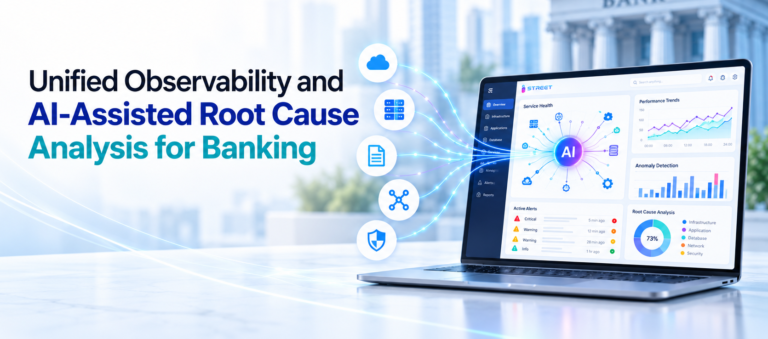
The ROC consolidates telemetry across the technology and operational environment—infrastructure metrics, application performance data, network flows, security events, business transaction health, and external dependency status—into a single operational intelligence platform. For an Indian bank, this means real-time visibility into UPI transaction flows, IMPS settlement operations, and core banking health can sit alongside infrastructure uptime and security event feeds, creating a unified data layer that AI can analyse holistically.
AI-Driven Anomaly Detection and Predictive Failure Analysis
For an Indian bank, this might mean detecting unusual latency patterns in the core banking system early enough to act before customer transactions are affected. It could also identify a spike in failed authentication attempts at a vendor portal that, when correlated with network anomalies, signals the early stages of a supply chain compromise. The detection window between a failure precursor and customer impact creates an opportunity for intervention before disruptions are visible.
Automated Resilience Playbooks
When anomalies are detected, the ROC can execute pre-approved remediation playbooks within defined governance and approval thresholds—restarting services, redirecting traffic, scaling resources, or triggering failover where authorised. This automation can materially reduce mean time to recover (MTTR) across common failure scenarios.
Critically for Indian BFSI, the ROC also supports the regulatory response. The same operational intelligence can generate incident documentation, notification workflows, and audit evidence throughout the incident lifecycle, reducing the manual workload on compliance and operations teams after an incident.
The Sovereignty Problem That Global Platforms Cannot Solve
Mythos is available to 12 global partner organisations under Anthropic’s Project Glasswing. Access to frontier AI capabilities of this kind can create an early operational advantage for participating enterprises, particularly by enabling them to proactively identify and address vulnerabilities across their own and their vendors’ codebases. For Indian BFSI institutions, the larger strategic question is how to adopt comparable capabilities without compromising control, sovereignty, or operational independence.
The operational intelligence layer of India’s BFSI sector, the platform that will detect failures, orchestrate recovery, and generate the compliance evidence requires careful architectural control over where data is processed, how AI inference is executed, and which external dependencies are introduced. Heavy reliance on infrastructure, data pipelines, or model APIs governed outside the organization’s preferred jurisdiction and control model can create strategic and operational dependencies.
A ROC built on foreign hyperscaler infrastructure, with AI inference running through external APIs and operational data flowing through offshore cloud regions, can introduce data-residency, dependency, and control considerations. It can also increase reliance on vendor uptime, pricing, policy, and service availability for a function that is operationally critical to the bank.
This is the Atmanirbhar AI imperative applied to operational resilience—a practical, strategic, and competitive consideration.
iStreet Network’s ROC: Purpose-Built for Indian BFSI
iStreet Network’s Resiliency Operations Centre is designed around the operational resilience requirements of Indian BFSI, with governance and regulatory considerations embedded into the architecture from the ground up.
Sovereign, On-Premise Deployment
iStreet’s ROC platform supports sovereign deployment models, including on-premise and domestic infrastructure environments aligned with applicable organisational and regulatory requirements. AI inference can run within the bank’s controlled perimeter, helping keep operational data within defined boundaries and reducing exposure to external telemetry endpoints.
For public sector banks, cooperative banks, and BFSI institutions operating under heightened data-governance obligations, a sovereign deployment model can become an important architectural consideration rather than an optional add-on.
Compliance-Native Operations
Monitoring, alerting, and remediation workflows in iStreet’s ROC can generate audit trails and incident documentation as part of the operational process. Incident-reporting and compliance workflows can be integrated into the ROC’s operational intelligence layer and triggered based on incident classification and defined governance rules.
This compliance automation has direct operational value beyond regulatory risk reduction. When a bank’s technology team is managing an active incident, the last thing they need is a parallel track of manual compliance documentation. iStreet’s ROC helps reduce that operational burden by integrating evidence capture and reporting workflows into the incident lifecycle.
AI That Understands Indian Banking Infrastructure
iStreet’s predictive failure analytics are designed to operate across the infrastructure patterns common to Indian BFSI, including legacy core banking stacks, UPI and IMPS payment flows, NPCI gateway integrations, multi-vendor ecosystems, and digital banking transaction environments. This India-specific operational context can help the platform identify failure precursors that generic models may not fully account for.
Multi-Vendor Environment Support
A realistic mid-sized Indian bank operates a technology environment spanning legacy on-premise core banking, cloud-native customer applications, third-party payment infrastructure, digital lending platforms, and multiple regulatory reporting systems, each from a different vendor, on different technology generations, with different monitoring tooling. iStreet’s ROC integrates natively with this heterogeneous landscape.
How to Evaluate a Bank Resilience Platform for India
For CTOs, CISOs and CIOs building the business case for ROC investment, the evaluation criteria that matter most in the current environment are not the same ones that would have applied two years ago. The emergence of Mythos-class capabilities is changing the risk calculus. Here is the framework we recommend.
Does it provide unified observability across infrastructure, security, and business transactions? A ROC that integrates only infrastructure telemetry is a sophisticated NOC. The value of a true ROC is in the correlation between infrastructure health, security signals, and business impact, in real time.
Does it deploy sovereignly within your perimeter? If operational data must traverse external cloud infrastructure to enable AI inference, the architecture may introduce additional data-residency, control, and dependency considerations. Sovereignty should therefore be evaluated as an architectural decision, not simply as a feature flag.
Does it support governed incident reporting and compliance workflows? Manual compliance documentation during an active incident can add operational overhead and increase the risk of error. The platform should help generate audit-ready evidence as part of its operational intelligence rather than as an entirely separate process.
Does it reduce MTTR demonstrably? iStreet Network’s ROC has delivered MTTR reductions of 60 to 75 percent in production BFSI deployments. Ask any vendor you evaluate for specific MTTR benchmarks from comparable Indian BFSI environments, not generic industry statistics.
Does it accommodate your current technology, not an idealised future state? Most Indian BFSI institutions cannot replace their legacy infrastructure on a timeline that matches their resilience requirements. The right ROC works with heterogeneous, multi-generation environments. It improves resilience from where you are, not from where you wish you were.
The Business Case Is Not Complicated
For a large Indian bank, a major technology outage can create significant direct and indirect costs across lost transactions, remediation, regulatory exposure, reputational impact, and customer attrition. Reduction in MTTR can therefore translate into lower downtime, strengthening the economic case for ROC investment.
When regulatory exposure, operational resilience requirements, and the financial impact of prolonged outages are considered together, the ROC business case extends beyond technology investment and becomes a broader risk-management priority.
Building that resilience on sovereign Indian infrastructure, aligned with Indian regulatory frameworks, and managed through an AI platform designed for Indian banking operations represents Atmanirbhar AI in practice.
iStreet Network’s ROC in Action
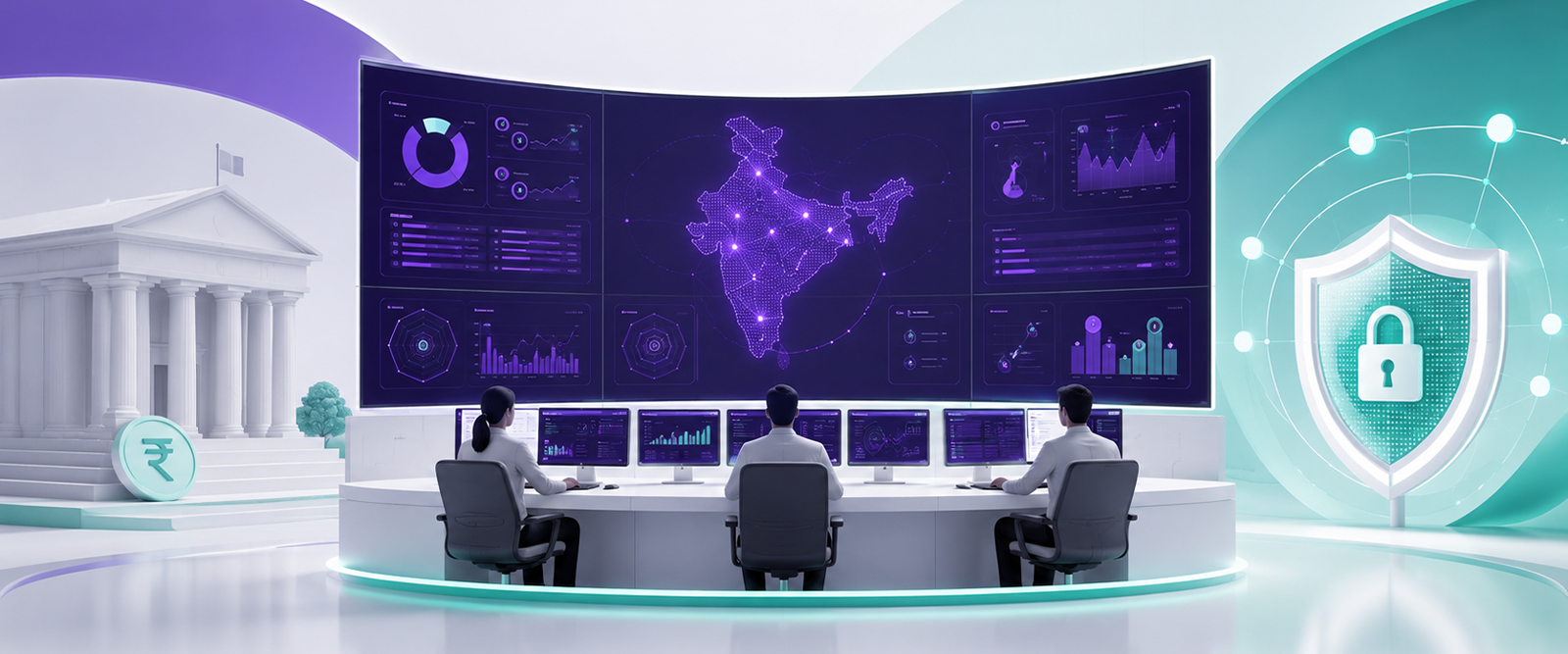
iStreet Network’s ROC, built on its Sovereign AI Enterprise Platform, orchestrates resilience workflows that help BFSI enterprises detect degradation early, respond faster, recover effectively, and operate within a sovereign, governed environment.