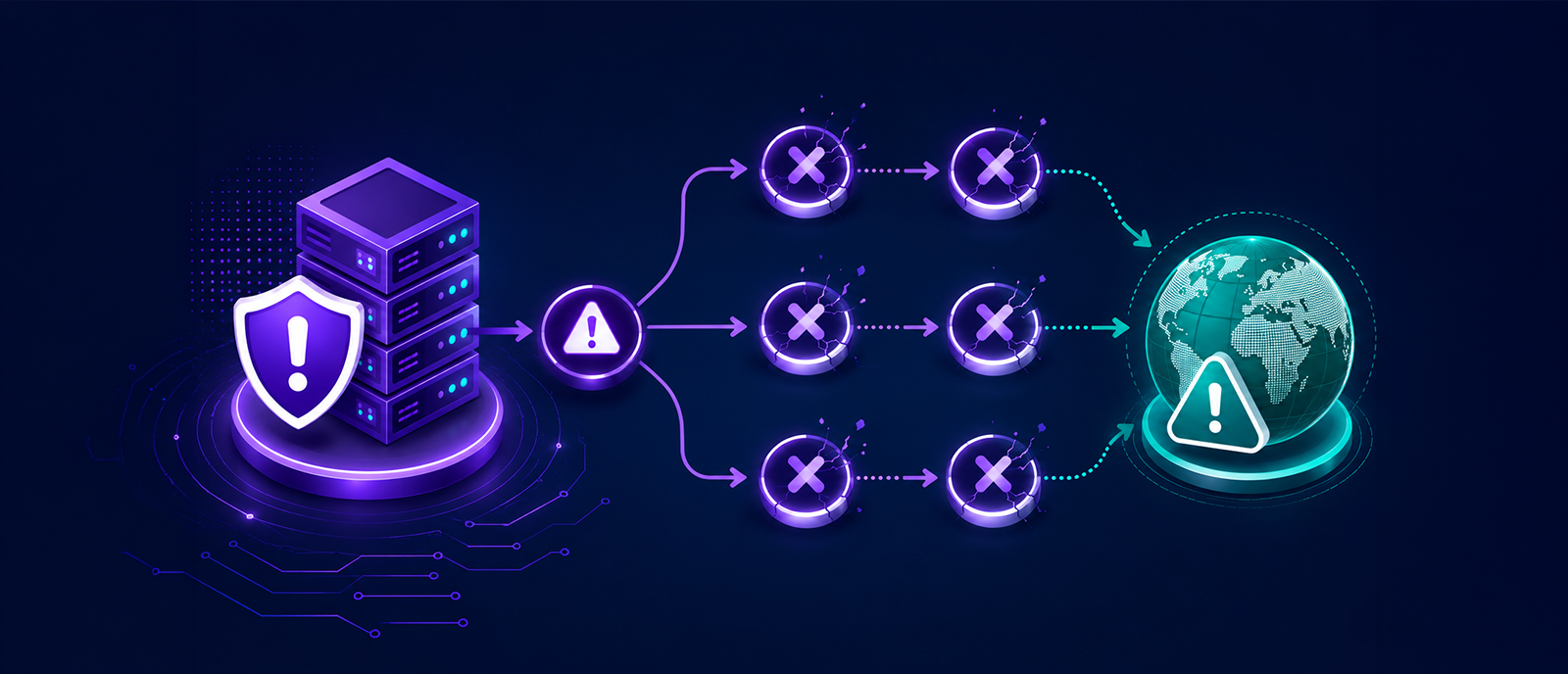
A fault rarely brings a system down on its own. A cascading failure does: one fault propagates across connected systems faster than teams can trace its impact in real time. The incidents below show why this pattern cannot be treated as an edge case.
Three incidents, the same architecture story
CrowdStrike, July 19, 2024: A faulty security software update triggered a global IT disruption affecting Windows systems across airlines, banks, and enterprise services, underscoring how deeply a single dependency in the software stack can cascade across modern digital infrastructure.
AWS US-East-1, October 19–20, a DNS-related fault within a single region cascaded across dependent services, affecting organisations that relied on that infrastructure.
Cloudflare, November 18, a routine database configuration change exceeded a hardcoded limit and caused widespread disruption across services dependent on Cloudflare’s infrastructure.
Three different operators, three different technology environments, but the same architectural pattern: a centralised core that delivers efficiency until a critical component fails and the resulting dependencies amplify the impact. The question is not only why the initial fault occurred, but why response often struggles to catch up with the cascade—and what changes when teams can understand the impact sooner.
The Real Gap Behind Every Cascading Failure
The architectural risk itself is well understood. Centralising a core banking system, network, identity layer, or payment switch can improve efficiency and simplify operations, but it also concentrates dependency. When a critical component fails and sufficient redundancy or failover is unavailable, the impact can propagate rapidly across connected services. Most infrastructure teams understand this trade-off during architecture and resilience reviews.
What is discussed far less is why response can remain slower than the cascade itself. The traditional assumption has been that faster detection—more sensors, more alert rules, and more dashboards—would allow teams to see trouble sooner and respond faster. But major cascading incidents show that detection alone is not enough. Teams may identify abnormal behaviour quickly while still taking significantly longer to understand the root cause, dependencies, and likely downstream impact.
In each case, the critical gap is not simply recognising that something is wrong. It is understanding what the fault is likely to affect next, quickly enough to act before the cascade spreads further. Detection can happen in seconds; operational understanding often takes much longer. For banks, payment networks, and other institutions managing critical services, that difference can determine whether an incident remains contained or escalates into a wider operational and governance issue.
Three capabilities consistently strengthen an organisation’s ability to contain cascading failures. None of them depends on adding more alerts. Together, they reduce the distance between a fault occurring and the operations team understanding its business and technology impact:
1 Real-time topology mapping
A continuously updated view of system and service dependencies, so the potential blast radius becomes visible as soon as a critical component begins to fail.
2 Correlation that outpaces the cascade
Correlating related symptoms to a common root cause as alerts emerge, rather than after teams have manually worked through the noise.
3 Predictive blast radius
Identifying which downstream services may be affected by a degrading component before it fails completely, enabling earlier containment and recovery decisions.
Each is worth taking in turn.
Real-Time Topology Mapping: Seeing the Blast Radius Before It Spreads
Many enterprise environments still rely on architecture diagrams and configuration management databases (CMDBs) that accurately represented the environment at a particular point in time—a design review, an audit, or a migration sign-off. In modern hybrid and multi-cloud environments, however, services, third-party integrations, and infrastructure dependencies can change continuously. When a critical component fails, teams may still need to answer “what depends on this?” using documentation that no longer reflects the live environment.
Real-time topology mapping replaces static dependency views with a continuously discovered, living model of the environment: which services communicate with each other, which systems share databases, and which third-party APIs sit upstream of customer-facing transactions. When a core component fails, the blast radius does not have to be reconstructed manually in a war room. It can already be visible because the topology evolves with the environment itself. Whether this capability is built internally or provided through a purpose-built platform, the objective is the same: current dependency visibility rather than documentation updated only on a project or audit cycle.
This capability also aligns with the growing regulatory emphasis on operational resilience and dependency mapping across regulated financial institutions. For banks, maintaining an accurate view of critical systems, services, and third-party dependencies strengthens both resilience planning and evidence of operational control. Treating dependency mapping as a continuous capability is therefore more effective than revisiting it only during periodic audits or resilience reviews.
Correlation That Outpaces the Cascade
A fault in one critical component rarely generates a single alert. It can trigger tens or hundreds of downstream symptoms as dependent services begin reporting their own failures. Within minutes, the operations team may be looking at a wall of alerts rather than a clear root cause. Rule-based correlation can struggle in dynamic environments when its logic no longer reflects current service dependencies.
Correlation that outpaces the cascade means grouping related symptoms around a likely root cause as alerts arrive, rather than after teams have manually analysed them. An AI-native correlation layer informed by live topology can connect anomalies across downstream services, queues, infrastructure, and applications back to a common upstream issue while the incident is still developing. This is where modern AIOps and GenAIOps capabilities can materially improve operational context.
What teams need in that moment is not more alerts but a trusted operational narrative: what failed, why it matters, and what is already being affected. The ability to move from alert volume to contextual understanding is a critical distinction between merely observing a cascade and having the intelligence required to contain it.
Predictive Blast Radius: Acting Before the Fault Completes
Most critical components show signs of strain before they fail completely: rising latency, growing queues, increasing error rates, or resource saturation that has not yet crossed a static alert threshold. Viewed independently, these signals may appear minor. Viewed against live topology and correlated operational context, they can become an early warning for a specific set of downstream systems.
Predictive blast-radius analysis asks a different question from traditional monitoring. Instead of only asking, “Is this component healthy right now?”, it asks, “If this component continues to degrade or fails, what services will be affected, and who will experience the impact?” Answered early enough, that question enables teams to move from reactive response toward pre-emptive containment, failover, or remediation before the incident develops into a broader service disruption.
Live topology, intelligent correlation, and predictive blast-radius analysis working as one continuous capability—rather than as separate tools that teams must stitch together during an active incident—form the operational model behind iStreet Network’s Resilience Operations Centre (ROC). The ROC brings together observability and resilience intelligence to help teams understand what is happening, identify the likely downstream impact, and act before disruption expands across critical services.
Closing the Gap Before the Next Cascading Failure
The pattern behind cascading failures will continue to matter because highly connected digital environments naturally create dependencies. Centralisation can improve efficiency and scale, but it also increases the importance of resilience architecture, redundancy, dependency visibility, and rapid operational understanding. The differentiator is therefore not whether dependencies exist, but how effectively organisations can identify and contain their impact when a critical component begins to fail.
That difference is no longer about who has the most monitoring. It is about who can close the distance between a fault occurring and the operations team understanding what it means—quickly enough to act within the window before the cascade expands. Detection identifies that something is wrong. Operational intelligence determines what to do next.
For leadership teams planning the next cycle of resilience investment, the question is therefore not only, “How quickly will we know something is wrong?” It is, “How quickly will we understand the impact and act?”
iStreet Network’s Sovereign AI Enterprise Platform extends into operational resilience through its ROC, combining real-time topology mapping, intelligent correlation, and predictive blast-radius analysis across BFSI and critical infrastructure environments.