Agentic AI represents a significant evolution in security operations, moving AI from assisting analysts towards reasoning, orchestration, and governed action across security workflows.
Breach costs, dwell times, and analyst-to-alert ratios already highlight the pressure on modern security operations. But what is happening inside security operations today is better understood through a simple observation: skilled analysts are spending significant time handling alerts and tickets rather than higher-value threat investigation. This is a persistent operational challenge within the enterprise SOC. Security tools have become more sophisticated, and dashboards more comprehensive. Yet the cognitive load on security professionals has continued to increase as the volume of security signals has grown faster than many teams’ ability to analyze and prioritize them.
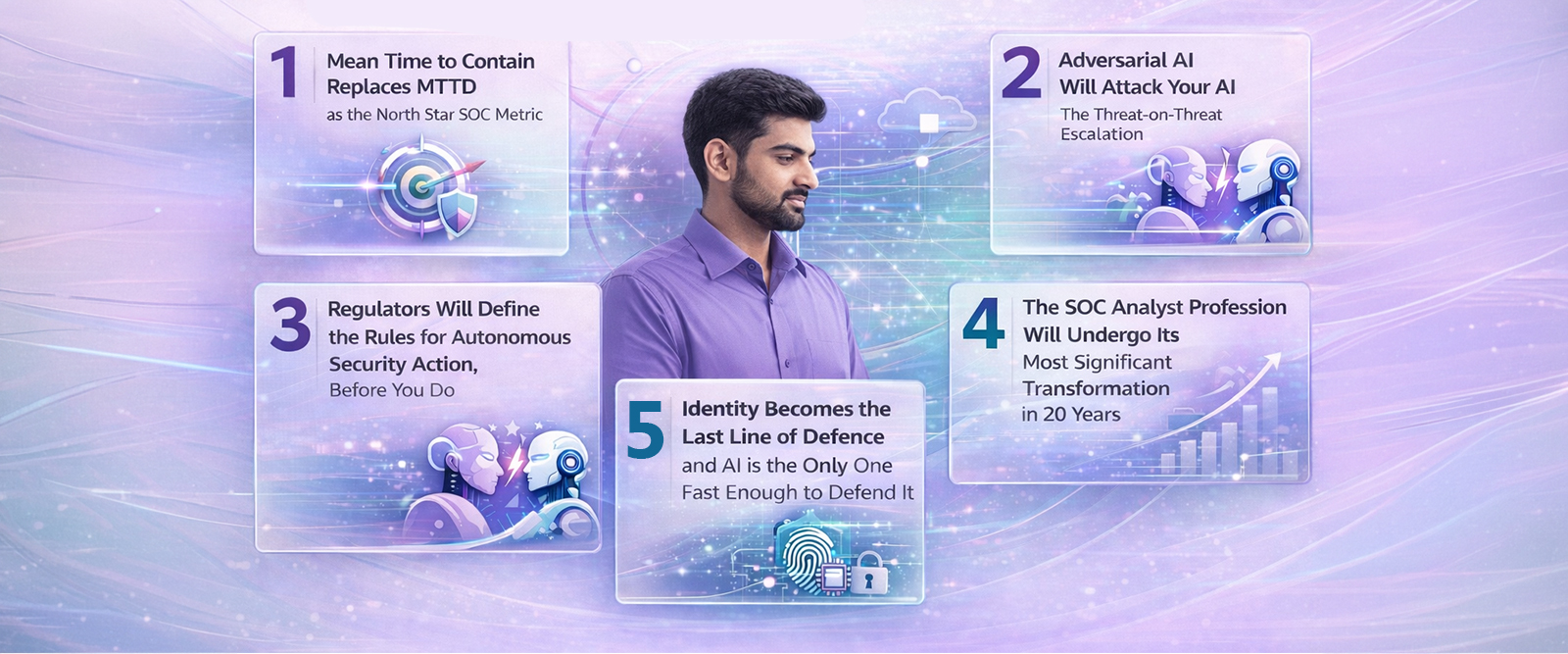
Enterprise security in 2026 is being shaped by a shift from isolated detection tools toward more connected, context-aware and increasingly agentic security operations. The change is not simply the use of more AI in the SOC; it is the way detection, investigation, prioritisation, containment and governance are beginning to operate as one coordinated security workflow. Five trends are defining how enterprises need to prepare.
The Premise: The Next Evolution of the AI-Assisted SOC
In recent years, the dominant model for AI in security operations has been AI-assisted: AI scores alerts; humans decide. AI ranks incidents by severity; humans investigate. AI suggests remediation; humans approve. This model has been valuable. It has helped analysts prioritize incidents, reduce noise, and improve decision support. But it has preserved an important operational bottleneck: many decisions and response actions still require human intervention. Many alerts, including low-fidelity signals, still require analyst review.
As cloud-native architectures, hybrid work, and supply-chain integrations expanded the attack surface, the number of signals requiring human review grew faster than many teams could scale analyst capacity. The transition to Agentic AI changes this operating model. An agentic system can interpret a threat signal, reason across available context, plan a response, execute approved actions across integrated systems, and report outcomes within defined policies and approval thresholds.
That is the premise for the five predictions below.
PREDICTION 01
Mean Time to Contain Gains Importance Alongside MTTD as a Core SOC Metric – From detection speed to containment speed, the KPI that actually reflects business risk
For years, Mean Time to Detect (MTTD) has been a key metric for evaluating SOC performance. But as detection tooling improved, EDR, UEBA, network traffic analysis, detection itself became table stakes. However, what happens after detection can significantly influence the severity and impact of an incident. In 2026, Mean Time to Contain (MTTC) is likely to become an increasingly important measure of SOC effectiveness, the time between confirming a threat and containing its impact. Agentic AI can help reduce MTTC by accelerating investigation, coordinating response actions, and supporting containment across integrated security systems.
MTTC Is the Real Measure of SOC Effectiveness
In a traditional SOC workflow, the path from detection to containment begins when an alert is triggered. A Tier-1 analyst triages it, cross-referencing threat intelligence, reviewing endpoint telemetry, and checking IAM logs. If further investigation is required, they escalate to Tier-2. A senior analyst investigates further, confirms the threat, and initiates a containment action: isolating a host, revoking credentials, and blocking a network path. Investigation, escalation, and manual hand-offs can extend the time between detection and containment. In that window, ransomware may continue moving laterally across additional systems. An insider threat may continue exfiltrating sensitive data. A compromised third-party component may establish persistent access across connected environments. The impact of an incident can increase significantly in the window between detection and effective containment.
An Agentic AI system can help reduce this window by coordinating investigation and approved containment actions in parallel. When a threat meets defined confidence and policy thresholds, the agent can simultaneously isolate the affected endpoint, revoke the associated session token and API keys, snapshot the system state for forensic evidence, notify the incident response team, and open a priority ticket, all while continuing to monitor for lateral movement indicators. These capabilities are increasingly available on platforms that integrate security telemetry, identity context, and response orchestration.What Security Leaders Should Do
- Redefine your SOC SLAs: Track MTTC alongside MTTD to measure both detection and containment performance. Set containment targets based on threat severity, asset criticality, and the level of human validation required.
- Instrument containment coverage: Map priority threat scenarios in your detection library to appropriate containment workflows. Gaps in containment coverage can create significant operational risk.
- Build confidence thresholds into agent design: Not every detection should trigger autonomous containment. Define the evidence thresholds, including threat intelligence matches, behavioral scores, and asset criticality.
PREDICTION 02
Adversarial AI Will Target AI-Enabled Security Systems: The Threat-on-Threat Escalation – The next generation of attackers won’t target your endpoints, they’ll target your security models
There is a a scenario that enterprise security roadmaps increasingly need to address: an attacker attempting not only to evade traditional security controls, but also to manipulate the AI systems supporting security operations. In 2026, this risk is becoming increasingly relevant to operational security. As agentic AI becomes embedded in SOC workflows, supporting triage, containment, and escalation decisions, these systems become an attack surface in their own right. Threat actors may attempt to exploit these systems: not by breaking the underlying infrastructure, but by corrupting the inputs, outputs, and reasoning chains of the AI itself.
Three Adversarial AI Attack Vectors to Prepare For
- Prompt Injection Against Security Orchestration Agents: Agentic AI systems ingest log data, threat intelligence, and ticketing content to make decisions. An attacker who can craft malicious content that passes through these ingestion pipelines, poisoned log entries, weaponised threat intelligence feeds, or manipulated email content in phishing triage workflows, can attempt to inject instructions directly into the agent’s reasoning context. The agent may then suppress an alert, misclassify a threat, or take a containment action that actually assists the attacker.
- Model Poisoning Through Training Data Manipulation: Organisations building custom fine-tuned models on their own security telemetry must protect the integrity of that training data. An attacker with persistent low-level access can subtly manipulate log data over weeks, gradually teaching the model that certain malicious behaviours are benign baselines. If manipulated data enters the training pipeline, it can affect subsequent model behaviour after retraining.
- Evasion Through Adversarial Inputs: AI-based anomaly detectors can be vulnerable to adversarially crafted inputs designed to evade the patterns the model has learned to detect while still being classified as benign or lower risk. This extends traditional evasion techniques into machine-learning-based detection, where attackers may attempt to manipulate inputs to influence the statistical patterns used by the detection model.
Building AI-Resistant Security Architectures
The response to adversarial AI is not to abandon AI-driven security; it is to build defensive controls into AI-enabled systems from the outset. This includes maintaining human approval checkpoints for high-impact autonomous actions, implementing input validation and anomaly detection across data-ingestion pipelines, monitoring AI outputs and decision patterns for anomalous behavior or drift that may indicate manipulation, and maintaining independent detection and human-review mechanisms to identify cases where the AI system may have been manipulated or compromised.
PREDICTION 03
Governance Will Define How Autonomous Security Actions Are Controlled – Governance frameworks for AI-driven SOCs are evolving. Enterprises that establish clear governance early will be better prepared.
In most enterprises today, the level of autonomy granted to an AI security system may still be defined through internal policies, platform configurations, or vendor defaults. As autonomous actions become more consequential, informal governance becomes increasingly difficult to sustain. Regulatory and governance frameworks are increasingly addressing AI-driven decision-making in high-impact operational environments. AI-driven security actions, such as isolating endpoints, revoking access credentials, and blocking network flows, are consequential automated decisions that require clear governance, oversight, and accountability.
Governance Capabilities Enterprises Should Prepare For
- Documented decision thresholds: Enterprises should formally document the criteria under which autonomous security actions are taken, the evidence thresholds, confidence levels, asset criticality, and other conditions that determine when an action can proceed autonomously or requires human approval.
- Immutable audit trails: Autonomous security actions should generate a traceable and tamper-evident record of what the system observed, the decision made, the action taken, and the resulting outcome. This supports accountability, governance, and auditability.
- Human review gates for high-impact actions: Define categories of high-impact security actions that require documented human approval based on their potential operational or business impact. Permanent account deletion, production system shutdown, and cross-tenant network isolation are examples where human approval may be appropriate.
- Explainability requirements: AI systems making consequential security decisions should provide human-readable explanations of the factors and context supporting their decisions, with sufficient information for security, risk, audit, and governance teams to review the decision.
The practical implication is that Agentic SOC deployments should adopt a governance-by-design approach. Audit trails, approval workflows, and explainability controls should be built into the operating model from the outset. Retrofitting governance into an already operational Agentic AI system can be significantly more complex and may introduce governance and compliance gaps during the transition.
PREDICTION 04
Identity Becomes a Critical Control Plane for Enterprise Security – As enterprise access becomes increasingly distributed, real-time identity intelligence becomes a critical SOC capability
The concept of a network perimeter has been eroding for a decade. Zero-trust architectures, SASE frameworks, and cloud-native deployments have all emerged as responses to the same underlying reality: the traditional network perimeter is no longer sufficient as the primary basis for trust. In 2026, this evolution is placing even greater emphasis on identity and access context. Identity is becoming an increasingly important control plane for enterprise security. Every access request to a SaaS application, a cloud database, a microservice API, or a corporate file share involves identity, resource, device, and contextual signals. Whether that identity represents a human user, a machine workload, a third-party integration, or an AI agent, enterprise security increasingly depends on continuously evaluating whether access is legitimate and appropriate in context. Static IAM policies and periodic access reviews alone cannot provide that level of continuous assurance at the speed modern environments require.
The Identity Attack Surface in 2026
The scale of the identity attack surface in a modern enterprise is difficult to overstate. In a mid-sized organisation running a hybrid cloud environment, it is common to find:
- Human user identities across corporate directories, SaaS platforms, and partner systems
- Machine and workload identities, including service accounts, workload identities, and credentials used by APIs and infrastructure automation
- A growing number of AI agent identities, as agentic systems are granted permissions to act on behalf of human users or operate autonomously within production environments
- Federated identities spanning multiple cloud providers, each with their own access control models and audit logging standards
Managing this surface through human-reviewed access governance processes is increasingly difficult to scale. The volume and velocity of access events at enterprise scale can exceed teams’ capacity to review them manually. Agentic AI can help address this challenge by continuously analyzing identity and access activity across distributed enterprise environments.
What Agentic Identity Defence Looks Like in Practice
- Continuous behavioural baseline monitoring: Beyond point-in-time authentication, agentic systems can maintain behavioral baselines for identity and access activity, including the systems typically accessed, access times, locations, and devices. Significant deviations from baseline can trigger further investigation.
- Dynamic zero-trust policy enforcement: Agentic AI can support dynamic access decisions based on real-time context. If a user’s device suddenly changes location while an active session is in progress, or if a credential begins accessing resources outside its normal operational scope, the system can recommend or initiate actions such as reducing permissions, requiring step-up authentication, or suspending access, in accordance with defined policies and approval thresholds.
- Machine identity lifecycle management: One of the more challenging areas in enterprise security is the lifecycle of machine identities and credentials, including service accounts and credentials that may be created for deployment and later remain unused, unrotated, or insufficiently governed.
PREDICTION 05
The SOC Analyst Role Will Shift Towards Higher-Value Security Work – Agentic AI doesn’t eliminate the need for human security expertise—it changes where that expertise creates the most value.
Every conversation about AI in the SOC eventually comes down to the same question: Will it replace security analysts? The answer is more nuanced than either extreme suggests. Agentic AI is likely to automate a growing share of Tier-1 SOC work. Alert triage, initial enrichment, low-complexity incident response, and routine compliance checks are workflows increasingly suited to AI-assisted automation and orchestration, reducing the manual effort required from Tier-1 analysts. The implications for SOC roles and skills are significant, and enterprises should plan for this shift proactively. But automating more Tier-1 work does not reduce the need for security expertise; it shifts where that expertise creates the most value.
The Four Capabilities That Will Define the the Next-Generation SOC Analyst in 2026Elite SOC Analyst in 2026
- AI System Supervision and Validation: As agentic systems take on more automated and semi-autonomous actions, security teams need to validate that these systems are operating as intended by reviewing decision logs, identifying patterns of misclassification, tuning confidence thresholds, and identifying edge cases where an AI-generated decision appears reasonable but produces an incorrect outcome.
- Adversarial Threat Hypothesis Generation: Agentic AI can analyze known threat patterns at scale. It may be less effective when confronting novel attack chains that fall outside established patterns or available context. Experienced analysts will remain central to threat hypothesis development, using their understanding of attacker motivation, emerging techniques, and organizational context to identify emerging threats that may not yet be reflected in existing models or detection logic.
- Cross-Functional Risk Translation: A critical capability for senior security professionals in 2026 is translating AI-driven security findings into business risk language for non-technical stakeholders, including boards, finance leaders, legal teams, and other business stakeholders. Agentic systems can generate and synthesize significant volumes of security intelligence. Converting that intelligence into decisions the business can act on requires human judgment, communication skills, and organizational context.
- Ethical Governance and AI Accountability: As autonomous security systems make consequential decisions—such as determining access, initiating isolation, or supporting regulatory reporting, organizations need clear accountability for the governance and impact of those decisions.
The Verdict: Prepare Now or React Later
The five predictions in this blog are not distant-future scenarios. They reflect developments already shaping security operations, grounded in today’s technologies, evolving governance and regulatory expectations, and operational pressures affecting enterprise security leaders. The question is not simply whether these shifts will occur, but how effectively organizations prepare for and govern them. Agentic AI will not automatically solve the SOC’s challenges. Its impact will depend significantly on the decisions enterprises make about architecture, governance, talent, and strategy.
Supporting this evolution is iStreet Network, a Sovereign AI Enterprise Platform that enables enterprises to advance AI-driven security operations through governance, resilience, and sovereign control.