Enterprise access is no longer limited to employees signing in to a defined set of applications from managed devices. Users move across cloud platforms, business applications, privileged systems, APIs, endpoints, and AI-enabled workflows throughout the day. As these interactions expand, security teams need to understand not only whether an activity is permitted, but whether the way a user is behaving remains consistent with expected patterns.
This is where continuous user-behavior monitoring becomes important.
A valid identity can still perform an unusual action. A privileged account can access a system it rarely uses. A user can download significantly more information than normal, access sensitive systems outside established working patterns, or execute a sequence of actions that individually appear legitimate but collectively indicate elevated risk.
Detecting these deviations requires security operations to move beyond isolated authentication events and static access rules toward continuous behavioral intelligence.
User Behavior Provides an Important Security Signal
Traditional security monitoring often evaluates individual events such as logins, access attempts, policy violations, endpoint alerts, or application activity. Each event provides useful information, but insider threats and compromised identities rarely appear as one obvious security signal.
They are more likely to emerge as changes in behavior.
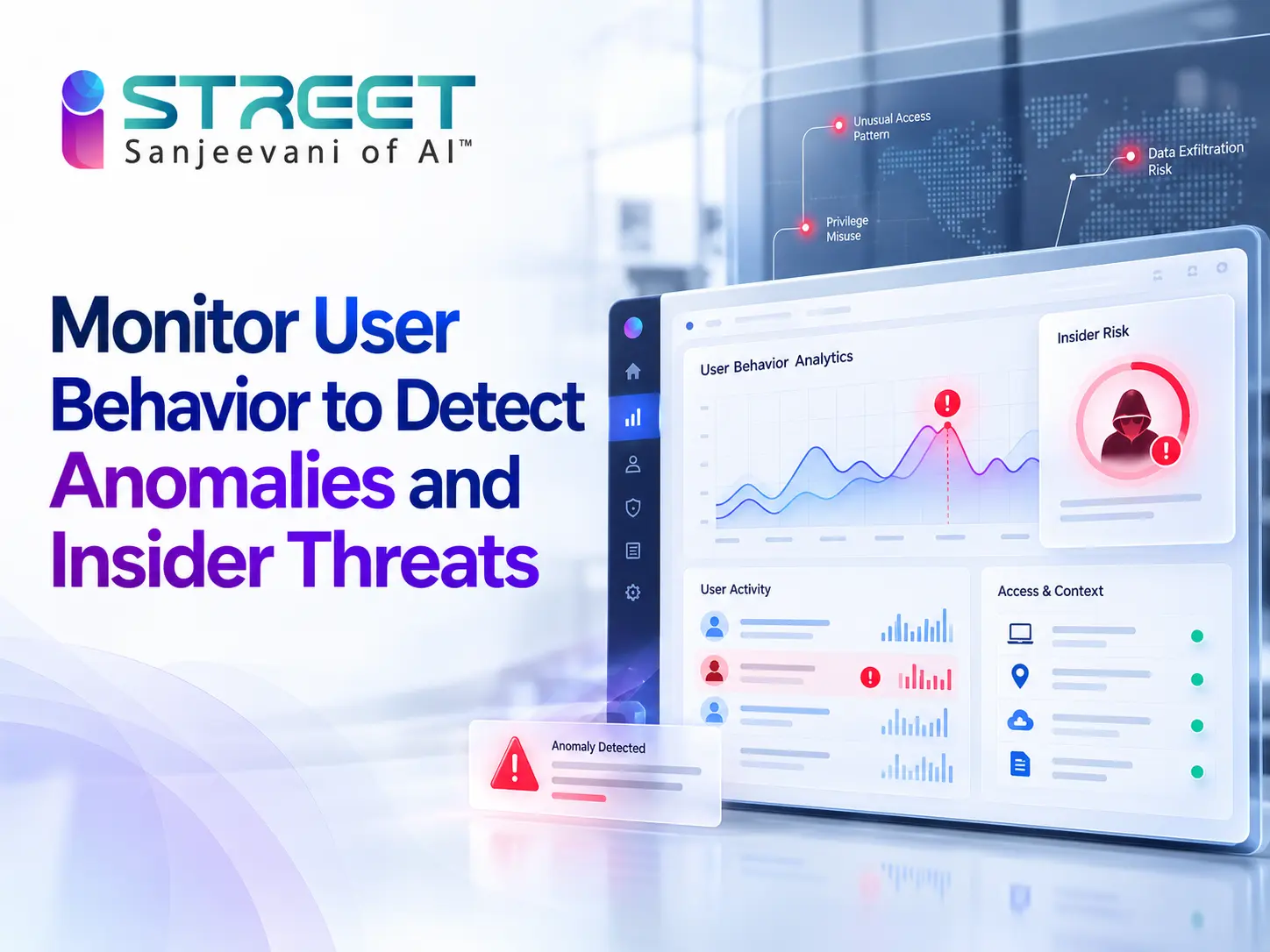
A user who normally accesses a small set of applications may suddenly begin connecting to administrative systems. A privileged identity may start accessing resources from an unfamiliar device. An employee may perform repeated searches across sensitive repositories before transferring unusually large volumes of information.
Individually, these actions may not automatically justify escalation. When compared with established behavioral patterns and combined with identity, endpoint, application, and infrastructure context, however, they can indicate that something has changed.
Behavioral monitoring therefore helps security teams identify anomalies before they become larger security incidents.
Detecting Anomalies Requires Understanding What Is Normal
Effective anomaly detection begins by establishing behavioral baselines.
AI-native security analytics can continuously examine how identities interact with enterprise systems and identify patterns across parameters such as login frequency, access location, device usage, application access, privilege use, resource interaction, data movement, and time of activity.
The objective is not to treat every deviation as a threat. Enterprise behavior naturally changes as employees move between projects, systems, locations, and responsibilities.
Instead, anomaly detection should determine whether a behavioral change is meaningful within the broader security context.
For example, accessing a financial application outside normal working hours may not represent significant risk by itself. If the same activity occurs from an unfamiliar device, is followed by unusual privilege usage, and results in access to sensitive records, the combined behavior requires greater attention.
This shift from individual-event monitoring to behavioral context helps reduce unnecessary escalation while bringing higher-risk activity into focus.
Insider Threat Detection Depends on Connected Context
Insider threats present a particular challenge because the activity often begins with legitimate credentials and authorised access.
The user may already have permission to access the application, database, or infrastructure involved. As a result, perimeter controls alone may not identify the activity as suspicious.
Security teams therefore need visibility into how authorised access is being used.
This includes identifying unusual privilege escalation, abnormal resource access, unexpected data movement, deviations in application usage, repeated access failures, or activity that differs significantly from the user’s established behavioural profile.
The same capability also supports the detection of compromised accounts. When credentials are stolen, the attacker may successfully authenticate but behave differently from the legitimate user.
Behavioral intelligence helps expose that difference.
SIEM++ Connects User Activity Across the Security Environment
User behaviour becomes more valuable when it can be correlated with the wider security environment. iStreet SIEM++ brings together telemetry from identities, endpoints, applications, infrastructure, cloud environments, and security controls to create a more connected view of user activity. Instead of investigating individual alerts independently, security teams can correlate behavioural anomalies with authentication events, endpoint signals, application activity, privilege changes, network events, and threat indicators.
If a user logs in successfully from an unfamiliar endpoint, on its own, the event may not justify escalation. If SIEM++ also identifies unusual administrative access, access to sensitive applications, abnormal data transfer, and endpoint risk within the same activity sequence, the investigation receives substantially more context.
The focus therefore shifts from asking whether a single event is suspicious to understanding whether the complete behaviour pattern represents meaningful risk.
AI-Native SecOps Strengthens Behavioural Analysis
As enterprise environments generate more security telemetry, manually identifying behavioural patterns becomes increasingly difficult. AI-native SecOps strengthens the process by continuously analysing activity across users, systems, and security domains.
Machine-learning-driven behavioural analytics can identify deviations from established patterns, correlate related activity, and surface anomalies that deserve investigation. This enables security teams to focus on questions such as:
- Is the user behaving differently from their normal pattern?
- Is the behaviour unusual for others with similar roles and privileges?
- Are multiple low-level signals forming a higher-risk sequence?
- Has the user’s risk posture changed because of the device, application, privilege level, or data being accessed?
This broader understanding gives analysts a stronger starting point for investigation than isolated alerts alone.
Risk-Based Prioritisation Helps Focus Investigation
Not every behavioural anomaly requires the same response. A useful behavioural security model therefore needs to evaluate anomalies together with asset sensitivity, privilege level, identity context, endpoint posture, threat intelligence, and the potential impact of the activity.
An unusual login involving a standard application may require monitoring. The same anomaly involving privileged access to a critical system may require immediate investigation. By applying risk-based prioritisation, AI-native SecOps can help security teams distinguish between harmless behavioural variations and anomalies that represent a more significant security concern.
This is particularly important in large enterprises where security teams may already be managing thousands of events and alerts every day.
From User Activity to Actionable Security Intelligence
User-behavior monitoring delivers greater value when behavioural insights become part of the broader security operations workflow. Within iStreet’s AI-native SecOps architecture, SIEM++ provides the correlation and intelligence layer required to connect user behaviour with wider enterprise security signals.
Security teams gain the ability to move from:
- User activity to behavioural baselines.
- Behavioural baselines to anomaly detection.
- Anomalies to correlated incident context.
- Incident context to risk-based prioritisation.
- Prioritisation to investigation and governed response.
This connected approach helps security teams understand not simply what a user did, but whether the behaviour represents a meaningful change in risk.
Building Behaviour-Aware Security Operations with iStreet Network
As identities interact with more applications, cloud environments, data platforms, privileged systems, and AI-enabled workflows, understanding user behaviour becomes an increasingly important part of enterprise security operations.
iStreet Network correlates behavioural intelligence into its broader AI-native SecOps architecture through SIEM++, enabling organisations to correlate identity and user activity with endpoint, application, infrastructure, and security telemetry. Within the Sanjeevani of AI™ framework, these capabilities contribute to a more contextual security operating model where anomalies can be identified, investigated, prioritised, and acted upon within the wider enterprise risk environment.
About iStreet Network
iStreet Network Limited is an enterprise-grade, AI-native Sovereign AI ecosystem. At its core is Sanjeevani of AI™, iStreet’s AI Centre of Excellence and integrated framework that brings together observability, security, governance, risk, and compliance to operationalize enterprise AI with greater control, resilience, and assurance.