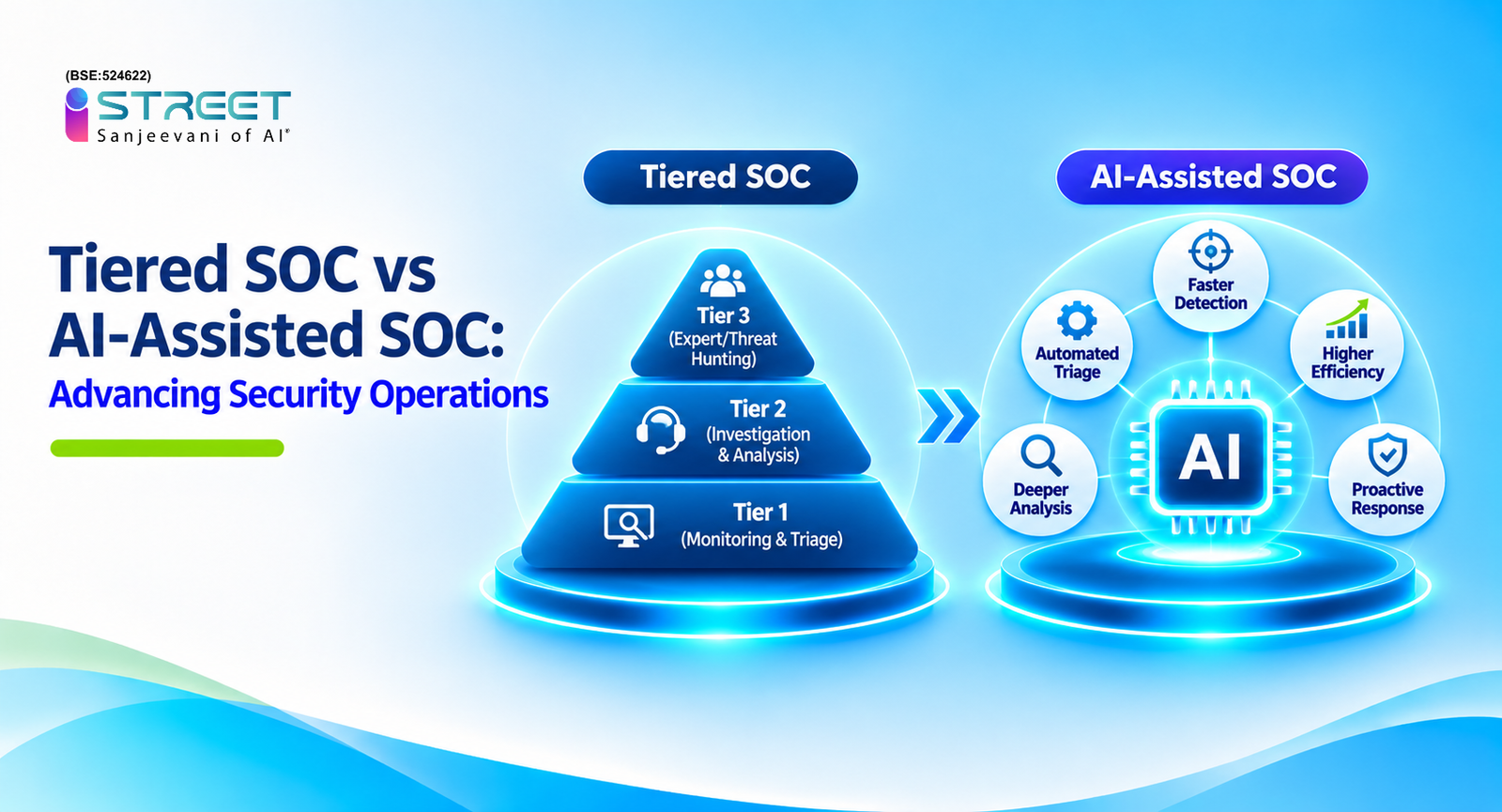
Enterprise security operations have evolved significantly, with Security Operations Centres (SOCs) becoming essential to protecting critical infrastructure, digital services and sensitive information. As organisations expand their technology environments, security teams must manage increasing alert volumes, complex threats and demanding response requirements. Traditional tiered SOCs have established structured approaches to threat detection, investigation and incident response. AI-assisted SOCs extend these capabilities by integrating intelligent analysis and workflow automation into existing security operations. The distinction is not simply technological. It lies in how security responsibilities are distributed, investigation capacity is utilised and operational decisions are executed across the enterprise.
Tiered SOC : Structured Security Operations Through Analyst Expertise
The conventional SOC operating model distributes responsibilities across three levels.
- Tier 1 – Monitoring and Triage: Analysts review security alerts, validate initial findings, document incidents and escalate events requiring further investigation.
- Tier 2 – Investigation and Response: Experienced analysts conduct detailed investigations, correlate evidence, determine incident severity and coordinate containment activities.
- Tier 3 – Advanced Threat Analysis: Senior specialists address complex threats, conduct threat hunting, support digital forensics and improve detection capabilities.
This structure establishes defined responsibilities, specialist expertise and consistent escalation procedures. However, operational efficiency can be influenced by the volume of alerts requiring manual review, the availability of experienced analysts and the number of handoffs between investigation stages. For enterprise security leaders, the opportunity lies in increasing investigation capacity while preserving the expertise and accountability embedded within established SOC operations.
AI-Assisted SOC: Intelligence Integrated into Security Workflows
An AI-assisted SOC extends traditional security operations by incorporating intelligent analysis into alert triage, investigation and response processes. AI can correlate related security events, retrieve supporting evidence, assess asset criticality and recommend investigation priorities. Rather than requiring analysts to reconstruct incident context across multiple technologies, AI-assisted workflows can assemble relevant information before the investigation begins.
This changes how security teams allocate their time. Routine enrichment and preliminary classification can be supported through automation, while experienced analysts concentrate on complex investigations, threat validation and decisions involving significant business impact. The commercial advantage lies in improving the productivity of existing security teams, increasing investigation capacity and enabling more consistent incident handling.
Comparing Enterprise SOC Operating Models
| Operational Dimension | Tiered SOC | AI-Assisted SOC |
| Alert triage | Analyst-led initial assessment | AI-supported classification and prioritisation |
| Investigation | Escalation across analyst tiers | Contextual evidence prepared for analyst review |
| Resource allocation | Work distributed by expertise and escalation level | Human expertise concentrated on higher-value decisions |
| Response coordination | Manual and playbook-driven workflows | AI-assisted recommendations and governed automation |
| Scalability | Additional workload may require greater analyst capacity | Repetitive workloads can be handled with less manual effort |
| Accountability | Defined analyst ownership | Analyst ownership supported by traceable AI recommendations |
AI assistance does not eliminate the need for specialised SOC functions. The two approaches can operate together, with AI supporting established analyst responsibilities.
Where AI-Assisted SOCs Add Value
Privileged Access and Core Banking Security
Core Banking Systems (CBS) support sensitive financial operations and administrative processes. Investigating unusual privileged activity may require security teams to examine identity records, access permissions, application logs and approved changes.
In a tiered SOC, this information may be reviewed across successive investigation stages.
An AI-assisted SOC can correlate privileged access events, behavioural anomalies and related system changes into a consolidated incident view.
Digital Payment and API Security
UPI, mobile banking and FinTech integrations depend on interconnected APIs, payment gateways and authentication services. Security incidents involving compromised credentials or unusual API activity may generate alerts across several systems.
AI-assisted correlation can connect authentication events, API activity, affected applications and related security indicators to establish a clearer understanding of potential threats. This supports faster investigation of suspicious activity without treating every technical anomaly as a security incident.
Coordinated Threats Across Hybrid Banking Infrastructure
Banks operate across on-premises infrastructure, private cloud environments, digital applications and external technology services. A security incident may involve multiple stages, including credential misuse, privilege escalation and unauthorised activity across interconnected systems.
AI-assisted SOCs can correlate related events across identities, endpoints, applications and networks, helping analysts reconstruct potential attack sequences.
Vulnerability Exposure in Critical Banking Services
Financial institutions continuously assess vulnerabilities across applications, infrastructure and connected technology environments. Security teams must determine which findings require immediate attention based on exploitability, asset exposure and operational significance. Connecting vulnerability intelligence with active security events and business-service criticality enables more informed remediation priorities.
Sovereign AI Ecosystem for Security Operations
iStreet Network Limited‘s Sovereign AI ecosystem advances a connected approach to enterprise security operations, enabling financial institutions to strengthen existing SOC investments while improving investigation efficiency, operational coordination and risk-based decision-making. For banks, this approach creates value across critical security priorities, from protecting core banking operations and digital payment services to managing interconnected threats and addressing vulnerabilities affecting business-critical infrastructure.
By reducing repetitive investigation effort, financial institutions can improve analyst productivity and allocate specialist resources to incidents with greater business significance. More coordinated security operations can support timely intervention, reduce avoidable disruption and strengthen the continuity of essential banking services. The ecosystem also supports more informed security investment decisions by helping institutions extend the value of existing technology environments rather than approaching every emerging requirement through isolated investments.


