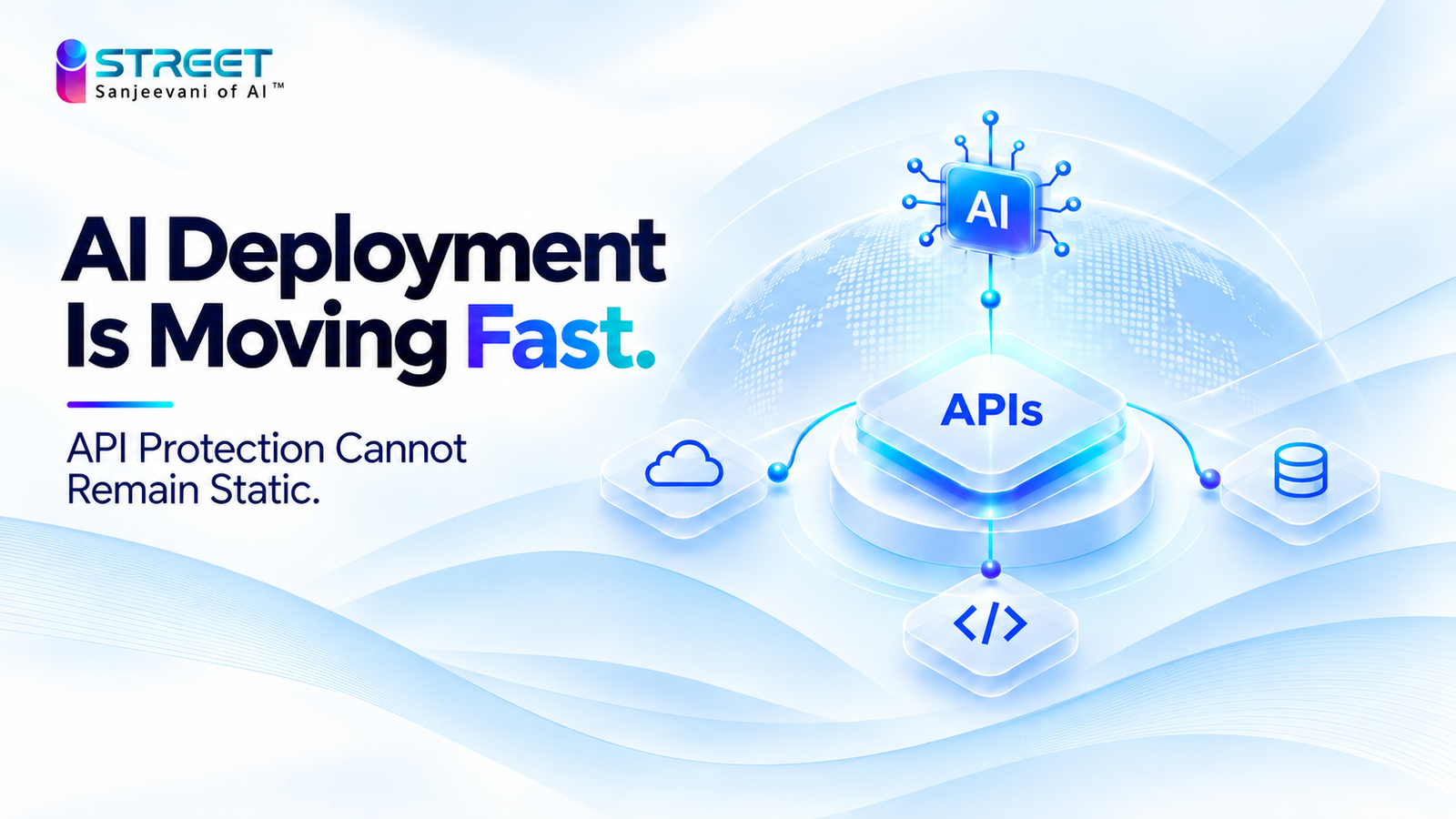
Enterprise AI now reaches production faster than security programmes can discover, inventory, and monitor what has changed. Every model endpoint, retrieval connector, and agent tool is connected through an API, and many are connected without passing through the reviews that once gated a release. AI-native SecOps brings continuous discovery, monitoring, correlation, and response to an environment where AI is both part of the attack surface and a capability used by security teams to analyse and respond to threats.
That imbalance is sharpening, because adversaries work with AI as well. An API that the business has not yet catalogued may be discovered and probed by an attacker before the security team inventories it. The first security challenge is therefore incomplete visibility into the API attack surface.
AI Deployment Now Outpaces Protection
A single retrieval-augmented assistant typically combines an inference endpoint, connectors into document repositories, and a guardrail service, and it may call an external model as well. Each of these components may expose or consume an API with its own authentication, data exposure, and failure modes. Repeating that pattern across every team building with generative AI, the number of interfaces grows with each use case rather than with each major release.
Agentic AI accelerates that growth, as an agent selects its tools at runtime. The agent determines which APIs or tools to invoke dynamically during execution. Tool registries and Model Context Protocol servers make it straightforward to expose an internal system to an agent. That is precisely what makes agents useful, and precisely why the number of reachable APIs can change without being reflected in a change ticket.
Architecture reviews, periodic vulnerability assessment and penetration testing (VAPT), and annual audits were designed for release cycles measured in months. What has changed is the rate at which AI creates new interfaces between one assessment and the next.
Visibility Is Lacking Where AI APIs Actually Run
Those new interfaces tend to appear where declared inventories do not look. A configuration management database, an API gateway catalogue, and a repository of API specifications share one limitation: each knows only what has been explicitly declared or registered. AI traffic often travels outside those declarations between model services inside a Kubernetes cluster, as direct outbound calls from application code to an external model provider, as internal tools exposed to agents, or as superseded API versions left running for backward compatibility.
Drift Turns a Known API into an Unknown One
Teams add parameters and response fields, relax authentication during testing and forget to restore it, and ship new versions alongside old ones. AI systems add a subtler form of drift. The risk profile of a retrieval endpoint depends on what sits behind it, so indexing a new document collection can change the classes of data the endpoint returns without a single line of code changing.
Why APIs Need Continuous Discovery in AI-Native SecOps
APIs need continuous discovery because maintaining an accurate view of the live API attack surface cannot wait for the next inventory. In an AI environment, the interval between two inventories is where new exposure appears. Continuous discovery replaces the question “what did we declare?” with “what is running, who owns it, and what does it expose at this moment?” It answers that question by reconciling three sources, each of which sees only part of the picture.
Runtime traffic, observed at gateways, ingress controllers, service meshes, and network sensors, shows what runs in production but says little about who owns it. Code and specifications, drawn from repositories, API definitions, and infrastructure-as-code templates, show what teams defined but not whether it is live.
Finding those APIs is only half the work, because a longer list of endpoints does not, by itself, reduce risk. Discovery becomes useful when every endpoint carries context:
- an accountable owner
- its exposure, whether internal, partner-facing, or public
- its authentication posture
- its role in the AI system, whether inference, retrieval, tool access, or an outbound call to an external model
With that context attached, the inventory stops being a document that ages and becomes a continuously updated risk register.
How AI-Native SecOps Turns Discovery into Detection
AI-native SecOps turns a self-updating register into detection by giving every discovered API a behavioural baseline and using AI agents to analyse deviations. AI-native SecOps treats AI systems as first-class assets to protect and use AI agents to correlate API activity with identity, vulnerability, and change telemetry. Both depend on discovery: an agent cannot protect an API it does not know exist, or reason for behaviour that has never been baselined.
The baseline records which identities and services call each API, how often, and with what request and response patterns. When API behaviour deviates from this baseline, an AI triage agent correlates with identity, vulnerability, and change data.
Sovereign AI Extends to the Telemetry That Maps It
Accountability also depends on the question that many API security discussions skip: where does the analysis itself run? Sovereign AI means that the infrastructure, models, data, and operations behind an enterprise’s AI remain under its own jurisdictional and operational control. Data residency is designed into the architecture. Enterprises usually apply that principle to training data and inference; it also applies to the security telemetry that describes those AI systems.
That telemetry is more sensitive than it first appears. A complete API discovery record is, in effect, a blueprint of the attack surface: every endpoint, its authentication weaknesses, the data classes it carries, and the agents that can reach it. It can also include runtime samples containing personal or sensitive data. If discovery depends on mirroring traffic or metadata to an analysis cloud outside the enterprise’s control, the security programme itself creates a residency and exposure question.
A sovereign discovery architecture addresses that requirement by keeping the collection, classification models, and triage agents inside the enterprise boundary, on premises or in a sovereign cloud. It exports only what policy permits. This extends sovereign control to security operations and carries the idea of Atmanirbhar AI from the models an enterprise runs to the telemetry that keeps those models accountable.
Continuous API Discovery Sits in the Sanjeevani of AI™ Framework
Continuous API discovery is in every stage of iStreet’s Sanjeevani of AI™ framework. The framework brings four pillars – Infrastructure, Observability, Sovereignty & Security, and Governance into one continuous lifecycle rather than four separate vendor relationships. Discovery provides asset visibility and runtime evidence at each stage of that lifecycle.
In the Modernize the AI core stage, new AI services launch on sovereign, data-resident infrastructure, and runtime discovery identifies them from their first request. No model endpoint or agent tool should remain outside the operational inventory. In the Secure by design stage, unified asset visibility turns each discovered API into an asset with an owner, a risk score, and a detection baseline. It places that asset alongside SIEM++ correlation and risk-based vulnerability management, so that security defends the model, the data, and the infrastructure as one system.
In the Operate at scale stage, the Resilience Operating Centre (ROC) extends that unified defence into day-to-day operations, acting as an AI-powered convergence layer above the NOC and the SOC. Rising latency on an inference endpoint may signal a capacity shortfall or a consumption attack, and a combined operational and security view helps distinguish between them.
That combined view then serves the Govern with assurance stage, in which the continuously updated inventory becomes evidence of what is running, who owns it, and how it is controlled. Each of these stages presumes that an enterprise knows what it runs. Continuous discovery keeps that presumption true on any given day, not on audit day alone.
Keeping AI-Native SecOps in Step with AI Deployment
AI deployment will keep accelerating; the task of AI-native SecOps is to ensure that protection moves at the same speed. That begins with continuous API discovery, becomes actionable when AI agents correlate discovery with behavioural and security signals, and provides auditable evidence when controls are reviewed.
For enterprises in BFSI, government, and critical infrastructure, this supports AI-native enterprise resilience in production: AI systems that remain visible, monitored, governed, and resilient as they scale.
About iStreet Network
iStreet Network Limited is an enterprise-grade, AI-native Sovereign AI ecosystem. At its core is Sanjeevani of AI™, iStreet’s AI Centre of Excellence and integrated framework that brings together observability, security, governance, risk, and compliance to operationalize enterprise AI with greater control, resilience, and assurance.