Enterprises in BFSI, government, and critical infrastructure rarely lack security tools. What they lack is a path between those tools. An alert raised in one console seldom informs a decision in another, so analysts carry context from screen to screen and, in effect, become the integration layer of the SOC.
That manual path is becoming harder to defend. CERT-In’s six-hour incident reporting mandate, Cybersecurity and Cyber Resilience Framework, and regulatory bodies in cyber security directions all shorten the interval between detection and a response the enterprise can justify. So when security leaders evaluate AI security platforms, they ask a practical question first: how will the platform integrate with the security stack we already run?
The clearest answer comes from following that path in order. This article explains how AI security platforms integrate with existing security stacks by tracing one set of signals through every stage: collection, interpretation, correlation, response, and deployment. Each layer of integration then appears at the point where it does its work.
Does an AI Security Platform Replace Existing SIEM and Security Tools?
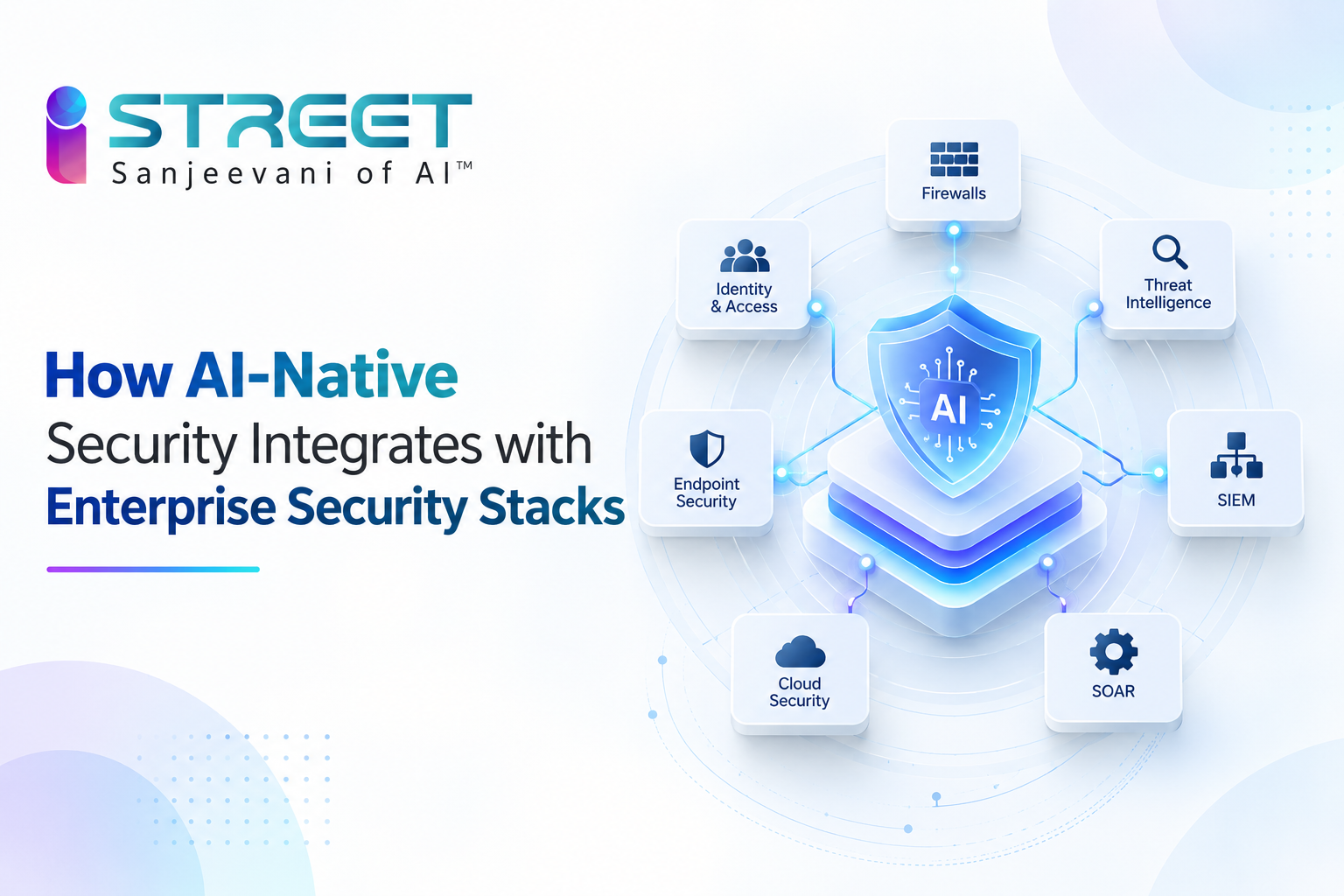
In most enterprise deployments, it does not work. An AI security platform works alongside the SIEM, EDR, IAM, and other tools already in place, adding a decision layer above them rather than taking over their functions.
The alternative is a replacement model, which asks the enterprise to migrate log storage, detection rules, and workflows into a new system. This model puts years of tuned detection content at risk and leaves coverage gaps while the migration runs. For an enterprise with log-retention obligations, those gaps are compliance exposures as well as operational ones.
The overlay model avoids these risks by leaving each tool in its established role. The SIEM remains the system of record for retention and compliance reporting, EDR continues to protect endpoints, and IAM continues to govern access. The platform sits above them: it consumes what they generate, reasons across them, and returns decisions and actions to them. What changes is not the stack itself but the path between its tools, and that path is what the rest of this article traces.
How Do AI Security Platforms Ingest Data from Existing Security Tools?
AI security platforms ingest data from existing security tools through API-based connectors, log-forwarding and streaming pipelines, and on-premises collectors. Enterprise platforms combine all three because security tools differ in how they expose data, how much data they produce, and where they sit in the network.
- API-based connectors are the primary route for modern security tools such as EDR consoles, email gateways, identity providers, cloud security platforms, and vulnerability scanners.
- Log-forwarding and streaming pipelines carry the high-volume telemetry that APIs are not designed for, such as firewall logs, DNS queries, proxy traffic, and authentication events.
- On-premises collectors cover the systems that neither route can reach. In BFSI data centres, OT environments, and government networks, critical systems often sit in segmented or air-gapped zones.
Together, these three mechanisms bring every tool’s data into one platform. Ingestion alone does not make that output usable.
How Do AI Security Platforms Correlate Alerts Across Multiple Tools?
AI security platforms correlate alerts across multiple tools by analysing the relationships between events, rather than matching them against fixed rules. Traditional SIEM correlation relies on predefined conditions within a fixed time window, so it detects only the patterns its rule authors anticipated.
The platform first builds an entity graph, a connected model of users, devices, applications, and network flows, from the normalized and resolved data. It then maps each alert to the MITRE ATT&CK framework, which lets it recognize when separate alerts represent successive stages of one attack, such as initial access, execution, and lateral movement. The finding lies in the sequence, not in any single alert. User and entity behaviour analytics (UEBA) add a further layer by comparing activity against established behavioural baselines, so the platform can flag deviations that no rule describes. The platform consolidates related alerts into a single incident and prioritizes it by asset criticality and exploitability, rather than by alert volume or the severity of each tool assigned on its own. Agentic platforms extend correlation into investigation, using the same integrations in the opposite direction.
Right Sequence for Integrating an AI Security Platform into an Existing SOC
The right sequence for integrating an AI security platform into an existing SOC is to extend the platform’s authority in four stages.
- Observe: The platform ingests data, correlates alerts, and produces incident narratives
- Assist: The platform delivers triage recommendations, investigation summaries, and prioritized queues to analysts who retain every decision.
- Act with approval: The platform proposes response actions through the integrated tools, such as endpoint isolation or account suspension, and an analyst approves each action before it runs.
The iStreet Approach: Integration Inside the Sovereign Boundary
iStreet’s Sovereign AI-Native security architecture keeps every stage of the security operations lifecycle traceable within the enterprise’s controlled environment, whether deployed on-premises or in an India-hosted private cloud. This extends across data ingestion, normalization, correlation, investigation, and response. iStreet’s security offerings, including SIEM++, RBVM, and the Agentic SOC, integrate with the existing SIEM, EDR, IAM, network, vulnerability management, and other security tools enterprises already operate, rather than requiring them to replace their existing stack. Security telemetry remains within Indian jurisdiction, AI models operate under enterprise control, and automated actions remain traceable through auditable records. This is Atmanirbhar AI applied to security operations, combining sovereign control with AI-native security intelligence.