The Paradigm Shift: From Detection to Prevention
As IT environments grow increasingly complex, with on-premise data centers, multi-cloud deployments, microservices architectures, and hybrid applications creating dependencies that are difficult to interpret manually at enterprise scale, the gap between threshold-based monitoring and proactive operational intelligence becomes increasingly significant. Traditional threshold-based monitoring typically alerts teams when predefined conditions are met. By that stage, service degradation or operational impact may already have begun. Customers may already be experiencing performance issues, while operational, financial, or compliance impact may be developing. The incident response that follows remains essential, but it is primarily focused on containing and resolving an issue that has already emerged.
Early Warning systems help shift IT operations from reactive detection towards proactive intervention. Instead of relying solely on breached thresholds, an Early Warning capability applies AI-driven analytics to identify behavioral deviations and related signals that may indicate an emerging issue, giving teams an opportunity to intervene before the issue escalates into broader service impact. This represents a meaningful evolution in operational capability, enabling teams to act on emerging risk rather than relying only on post-impact response.
At iStreet Network, AIOps capabilities by HEAL embed predictive anomaly detection and Early Warning into the operational intelligence layer, helping enterprises identify emerging risks earlier and strengthen resilience across complex, mission-critical environments.
Why Early Warning Is Essential in Modern IT Infrastructure
The case for Early Warning is rooted in a simple observation: many IT failures do not occur instantaneously. They develop over time. A memory leak can accumulate gradually over hours or days before causing an out-of-memory failure. Database connection pools can show progressive signs of exhaustion before reaching saturation. Disk I/O patterns can change progressively before reaching levels that degrade application performance. Network latency can increase gradually under specific traffic conditions before contributing to timeouts across dependent services.
Each of these failure modes has a signature, a pattern of metric changes, log entries, and behavioural shifts that precedes the actual failure by a detectable margin. The challenge is that these precursor signals are subtle, distributed across multiple data sources, and often individually unremarkable. A 3 percent increase in API response time. A marginal reduction in connection pool availability. No single signal crosses a threshold. No single alert fires. But the compound pattern, visible when signals across multiple layers of the technology stack are analyzed together, may indicate that a service-impacting issue is developing.
This is exactly what Early Warning systems are designed to detect. By analysing historical and live data through machine learning models that learn the precursor patterns of your specific environment’s failure modes, the platform identifies emerging issues with enough lead time to enable planned intervention rather than emergency response.
How Early Warning Actually Works
The effectiveness of iStreet’s Early Warning capability, delivered through HEAL Software’s AIOps solution, rests on three core principles.
Predictive analytics powered by historical learning. The AI analyses historical telemetry and operational patterns to identify behaviors associated with emerging operational issues. For example, changes in database connection availability combined with increasing query latency may indicate growing connection-pool pressure, while sustained changes in memory consumption may signal an increasing risk of resource exhaustion. These patterns can support real-time predictive analysis by continuously comparing current telemetry with historical behavior and emerging anomalies. When correlated signals indicate elevated risk, the system can surface an Early Warning, giving operations teams additional context and time to investigate before the issue develops into broader service impact. This is where AIOps predictive analytics moves operations beyond static thresholds by identifying patterns that indicate an issue is developing.
Business impact scoring. Not all emerging issues carry equal business risk. A memory trend that will exhaust capacity on a development server in 72 hours is fundamentally different from the same trend on a production payment processing server during festival season. Early Warning prioritises alerts based on business impact, assessing which systems are affected, which customer-facing services are downstream, what revenue is at risk, and which compliance obligations could be compromised. This ensures that the most critical emerging issues receive attention first, regardless of the technical severity of the underlying metric. This also supports business-impact prioritisation, so emerging issues are ranked according to service criticality and operational consequence.
Contextual intelligence that combines automation with human judgement. AI-driven Early Warning achieves its highest value when automated predictions are combined with human oversight and validation. Organisations that blend automated alerts with manual validation resolve incidents three times faster than those relying solely on legacy tools. The platform provides the prediction and the context. The engineering team provides the domain expertise and the judgement to determine the appropriate response. This collaboration between machine intelligence and human expertise produces consistently better outcomes than either operating alone. Human validation remains important when early-warning predictions lead to operational intervention.
Measurable Impact: Before and After Early Warning
The metrics tell the story clearly. Enterprises deploying Early Warning report dramatic improvements across every operational dimension.
Early Warning results show critical incidents reducing from 12 per month to 5 per month, a 58% reduction. Mean Time to Detect improved from 47 minutes to 12 minutes, a 74% improvement that enables earlier identification of emerging issues. Mean Time to Repair improved from 2.1 hours to 1.3 hours, a 38% reduction that helps reduce the duration and potential impact of incidents. SLA compliance increased from 68% to 94%, strengthening overall service reliability and SLA performance.
These are not theoretical projections. They are operational outcomes measured in production enterprise environments where the difference between 68 percent and 94 percent SLA compliance can mean the difference between regulatory approval and regulatory action.
How Indian Enterprises Can Apply Early Warning
The practical applications of Early Warning span the full breadth of enterprise IT operations.
Anomaly detection powered by AI-driven monitoring. The platform tracks over 100 metrics simultaneously, CPU load, memory utilisation, disk I/O, network latency, API response times, transaction throughput, error rates, and more. Machine learning models establish dynamic baselines for each metric and flag deviations that indicate emerging problems. One Indian fintech institution reduced false positives by 70 percent after implementing custom-tuned anomaly detection thresholds that account for their specific traffic patterns and seasonal variations.
Smart escalation paths that route intelligence, not noise. Instead of overwhelming IT teams with irrelevant alerts, the AI routes early warnings to the right teams based on predicted root causes and business impact. If the Early Warning system identifies an emerging database performance issue, the alert is routed directly to the database operations team with full context, not broadcast to every on-call engineer across the organisation. This targeted escalation ensures that the right expertise is engaged immediately, without the coordination overhead that delays response in conventional escalation models.
Preemptive incident management. Early Warning does more than identify emerging issues; it gives operations teams the context and lead time needed to plan proactive interventions before conditions escalate. During high-traffic periods, predictive capacity intelligence can help teams identify emerging resource constraints and take corrective action before they affect critical services or customer transactions. For Indian enterprises managing seasonal or event-driven demand, this shifts capacity management from reactive incident response towards proactive operational planning.
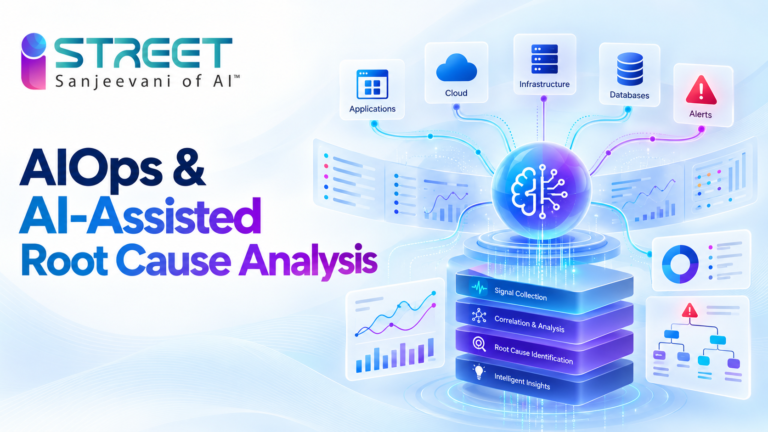
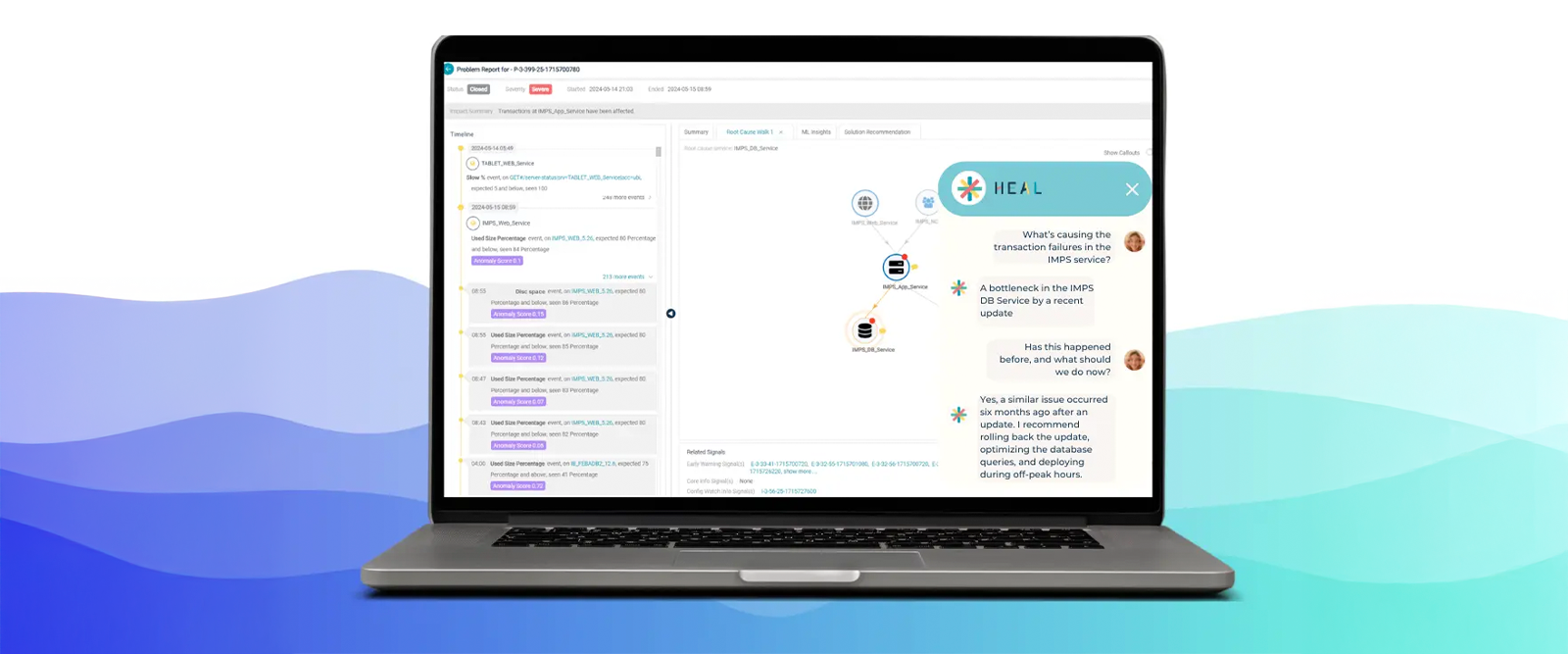
Automated Root-Cause Analysis with AIOps. When Early Warning identifies an emerging issue, the platform simultaneously initiates root cause analysis, correlating logs, traces, metrics, and historical patterns to identify the underlying cause before the issue manifests as a visible failure. For enterprise IT teams, automated root-cause analysis can reduce investigation time by correlating metrics, logs, traces and historical incident patterns before degradation becomes a visible outage.
Maximising the Value of Early Warning
Deploying Early Warning is the starting point. Maximising its value requires operational practices that amplify the platform’s intelligence. Early warning becomes more valuable when it is integrated into a broader operational-resilience model rather than treated as a standalone alerting capability.
Enrich alerts with business context. Enrich Early Warnings with relevant business context, including affected users, critical services, potential financial impact, and applicable SLAs or compliance considerations. This contextualization helps engineering and leadership teams assess urgency, prioritize responses, and allocate resources based on business impact.
Improve AI models with feedback loops. Improve Early Warning accuracy through disciplined feedback loops by validating predictions and correcting false positives. Training AI with real-world incident data improves alert accuracy by 48% within three months. Validated outcomes and analyst feedback can be incorporated into model tuning, helping the system refine future anomaly detection and recommendations over time. This continuous feedback process strengthens the relevance and accuracy of predictive operations.
Enable cross-team collaboration. Shared dashboards and unified incident channels ensure real-time coordination between DevOps, security, application, and infrastructure teams. Early Warning is most effective when it feeds into a collaborative resolution process rather than siloed team workflows.
Regularly refine alerting rules. Quarterly reviews align Early Warning thresholds with infrastructure changes, new deployments, and evolving application architectures. As your environment changes, the prediction models must evolve with it.
Early Warning in Practice: Strengthening Payment Gateway Resilience
A leading financial services institution, processing high volumes of financial transactions daily, experienced recurring payment gateway latency issues that contributed to significant SLA penalties over a six-month period. Its existing monitoring tools generated more than 500 false alerts per day, creating substantial triage overhead for the IT team and making it more difficult to prioritise meaningful warning signals.
iStreet Network’s Early Warning capability, powered by HEAL AIOps, analyzed transaction telemetry and API latency patterns in real time. The platform applied dynamic baselines based on workload behavior, historical patterns, and operating context. It identified an emerging latency pattern 40 minutes before the projected gateway failure, giving the operations team sufficient lead time to implement a targeted intervention and avoid the anticipated service disruption.
The result: an anticipated service disruption avoided, reduced SLA exposure, and a shift in the institution’s operational approach from reactive incident response towards proactive intervention. This is the shift from reactive monitoring toward resilient IT operations built around earlier detection, contextual investigation and planned intervention.
Building Future-Proof IT Operations
Early Warning systems represent the operational frontier of AIOps, the point where IT operations evolve from detecting and responding to failures into preventing them entirely. With predictive analytics and human expertise working together, Indian enterprises can reduce downtime, lower IT costs, improve SLA compliance, and strengthen the customer trust that underpins competitive advantage.
iStreet Network’s Resilient Operations embeds Early Warning as a core capability, helping enterprises move beyond reactive incident response by identifying emerging risks early and enabling teams to intervene before they escalate into broader service impact.
Talk to our advisors to explore how Early Warning can transform your enterprise operations.
Originally inspired by insights from HEAL Software, an iStreet Network AIOps product.