Modern enterprise IT environments generate more data, more alerts, and more complexity than any human team can manage alone. AIOps is the answer.
Enterprise IT has reached an inflection point. The average large organisation now operates across hybrid cloud environments, manages thousands of microservices, and fields tens of thousands of monitoring alerts every single day. Legacy approaches to IT operations, manual triage, siloed toolsets, and reactive firefighting, simply cannot keep pace with the velocity and volume of modern infrastructure demands.
This is precisely why AIOps has moved from a forward-looking concept to an operational imperative. According to Gartner, in 2026, more than 70% of enterprises will have adopted AIOps platforms to augment or replace traditional monitoring and event management workflows. If your IT organisation has not yet explored AIOps, the competitive gap is widening.
This guide provides a comprehensive, ground-up explanation of what AIOps is, how it works, why it matters for enterprise teams, and how to evaluate whether your organisation is ready to adopt it.
The Problem: IT Operations at Breaking Point
Enterprise IT teams today face a convergence of pressures that legacy operations models were never designed to handle. Infrastructure sprawl across on-premises data centres, public clouds, and edge deployments means that the operational surface area has expanded by orders of magnitude. Meanwhile, business expectations for availability, performance, and rapid feature delivery have only intensified.
The result is a familiar but unsustainable pattern. Operations teams spend the majority of their time triaging alerts rather than improving systems. A 2025 study by PagerDuty found that 62% of IT operations professionals report spending more than half of their working hours on reactive incident management. Critical issues get buried under noise. Mean time to resolution (MTTR) stretches from minutes to hours, and sometimes days. The cost is not just operational, it is reputational and financial.
What Is AIOps? Defining the Concept
AIOps, short for Artificial Intelligence for IT Operations, is the application of machine learning, advanced analytics, and automation to IT operations data and workflows. The term was originally coined by Gartner in 2017, but the discipline has matured significantly since then.
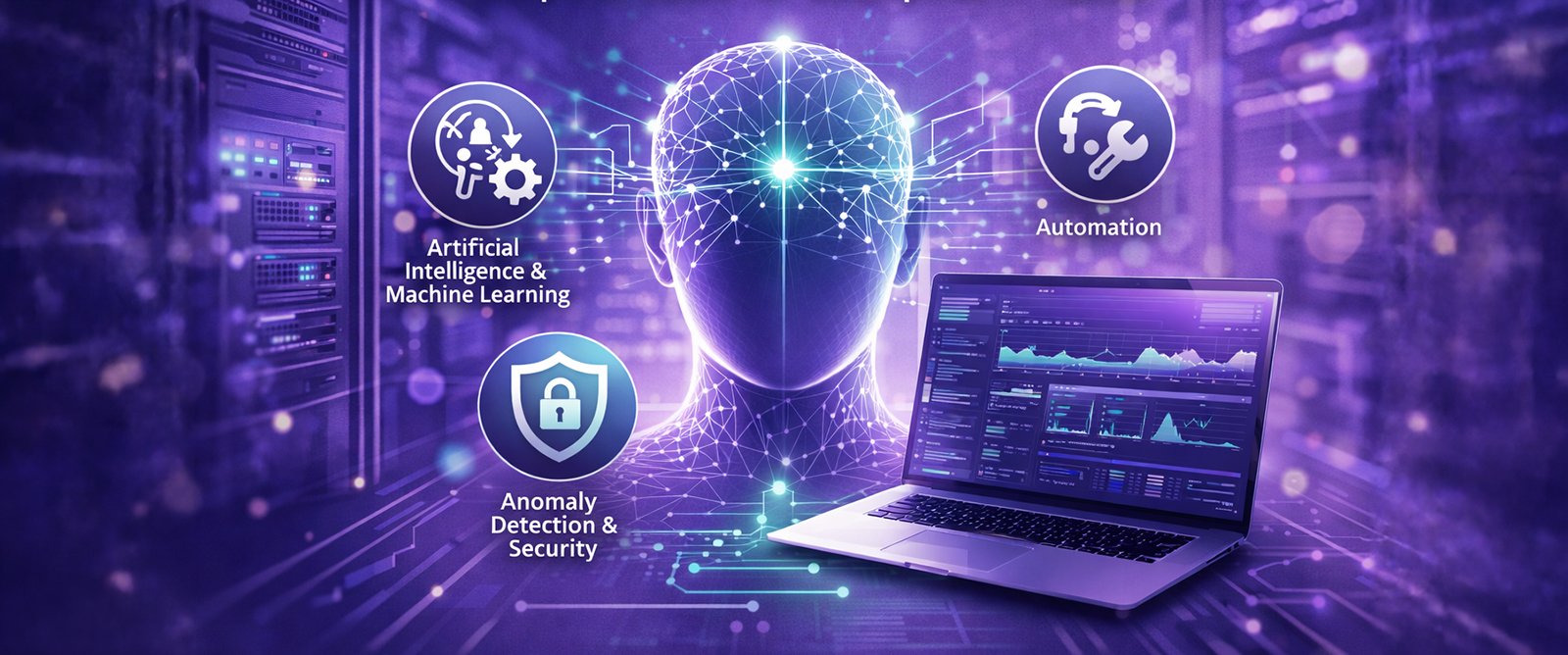
At its core, AIOps platforms ingest vast volumes of operational data, logs, metrics, traces, events, and topology information from across an organisation’s technology stack. Then apply machine learning algorithms to detect anomalies, correlate related events, suppress noise, identify root causes, and in many cases trigger automated remediation actions without human intervention.
The key capabilities of an AIOps platform include:
- Data Aggregation and Normalisation: Collecting and standardising data from disparate monitoring tools, cloud platforms, applications, and infrastructure components into a unified data lake.
- Noise Reduction and Alert Correlation: Using ML-driven pattern recognition to group related alerts, suppress duplicates, and surface only the events that require human attention.
- Anomaly Detection: Establishing dynamic baselines for system behaviour and automatically flagging deviations that indicate emerging issues before they become outages.
- Root Cause Analysis: Leveraging topology awareness and event correlation to identify the underlying cause of an incident rather than just its symptoms.
- Automated Remediation: Executing predefined or AI-recommended actions to resolve known issue patterns without waiting for manual intervention.
How AIOps Works: The Architecture Overview
Understanding the operational architecture of AIOps is essential for IT leaders evaluating adoption. A typical AIOps platform operates across four layers:
Layer 1: Data Ingestion
The platform connects to existing monitoring tools (such as Prometheus, Datadog, Splunk, Nagios, and cloud-native monitoring services), ITSM platforms, log aggregators, and APM solutions. It ingests structured and unstructured data in real time, creating a comprehensive operational data fabric.
Layer 2: Machine Learning and Analytics
Once data is normalised, ML models are applied. These models are trained on historical operational data to recognise patterns, establish baselines, and detect anomalies. Supervised learning handles known issue classification, while unsupervised learning surfaces previously unknown correlations and failure modes.
Layer 3: Correlation and Insight
This is where the platform connects the dots. Rather than presenting thousands of individual alerts, AIOps correlates related events into unified incidents. It maps dependencies across services and infrastructure components to trace the propagation path of a failure from root cause to business impact.
Layer 4: Action and Automation
At the top of the stack, AIOps platforms present actionable insights to operations teams through enriched incident dashboards. For mature implementations, the platform can also trigger automated runbooks, restarting services, scaling resources, rerouting traffic, or opening tickets, based on predefined policies and confidence thresholds.
Why Enterprise IT Teams Need AIOps
The case for AIOps is not theoretical. It is grounded in measurable operational and business outcomes that enterprise teams are already achieving.
- First, there is the noise reduction benefit. Organisations deploying AIOps typically see a 70–95% reduction in alert volume through intelligent deduplication and correlation. This alone frees significant engineering capacity.
- Second, AIOps dramatically improves MTTR. By automating root cause identification and surfacing contextualised insights, teams can resolve incidents in minutes rather than hours. Enterprises report MTTR improvements of 50–80% within the first year of deployment.
- Third, AIOps enables a shift from reactive to proactive operations. Anomaly detection catches degradation patterns before they escalate into outages, reducing the frequency and severity of production incidents. This translates directly into improved SLA compliance, better customer experience, and reduced revenue loss from downtime.
- Finally, AIOps is the foundation for the broader vision of autonomous IT operations. As organisations mature their AIOps practice, they move along a continuum from assisted operations (human-in-the-loop) to augmented operations (AI-recommended actions) to autonomous operations (self-healing systems).
AIOps Use Cases Across the Enterprise
AIOps is not limited to a single domain. Its applications span the full breadth of enterprise IT:
- Infrastructure Monitoring: Correlating alerts across servers, networks, storage, and cloud resources to identify infrastructure-level root causes.
- Application Performance Management: Detecting latency spikes, error rate increases, and throughput degradation across distributed application architectures.
- Security Operations: Enriching security alerts with operational context to distinguish genuine threats from benign anomalies, reducing false positive rates in SOC environments.
- Change Impact Analysis: Assessing the operational impact of deployments and configuration changes in real time, enabling faster rollback decisions.
- Capacity Planning: Using predictive analytics to forecast resource utilisation trends and recommend provisioning actions before performance thresholds are breached.
Evaluating Your Organisation’s AIOps Readiness
Adopting AIOps is not simply a matter of purchasing a platform. Successful implementations require a degree of organisational readiness across three dimensions.
Data maturity is the first consideration. AIOps platforms are only as effective as the data they consume. Organisations need reasonably well-instrumented environments with consistent data collection practices across their technology stack.
Process maturity is equally important. Teams that have already established incident management workflows, runbook documentation, and post-incident review practices will see faster time-to-value from AIOps, because the platform can learn from and augment existing processes.
Cultural readiness is the third dimension. AIOps changes the operational model. Teams need to be willing to trust AI-driven insights, adapt their workflows, and shift their focus from manual triage to exception handling and continuous improvement.
Common Misconceptions About AIOps
Despite its growing adoption, several misconceptions about AIOps persist in the enterprise market. In reality, AIOps augments human capabilities by handling the repetitive, high-volume analytical tasks that consume operator time, allowing them to focus on strategic decisions and complex problem-solving that require human judgement and creativity.
Another common misconception is that AIOps requires a complete overhaul of existing monitoring infrastructure. In practice, AIOps platforms are designed to integrate with and build upon existing tooling investments. They ingest data from the monitoring solutions already in place, Prometheus, Datadog, Splunk, ServiceNow, and dozens of others adding an intelligence layer without requiring organisations to rip and replace their current stack.
Finally, some organisations assume that AIOps delivers value only at massive scale. While the benefits do compound with scale, mid-sized enterprises with even a few hundred servers and a handful of critical applications can see meaningful MTTR improvements and noise reduction from AIOps deployment. The threshold for value realisation is lower than many organisations expect.
Getting Started with AIOps
AIOps is no longer an emerging concept. It is a mature, proven discipline that enterprise IT teams are deploying to regain control over increasingly complex environments. The organisations that invest in AIOps today are building the operational resilience and agility that will define competitive advantage in the years ahead.
If your team is ready to move beyond reactive operations and explore what AIOps can deliver for your enterprise, the next step is a focused assessment of your current operational data landscape and incident management workflows.
→ Request a personalised AIOps readiness assessment
→ Explore the iStreet AIOps platform
→ Contact Us for a live demo with our solutions engineering team